


Is the stock market ready for easier margin loans?

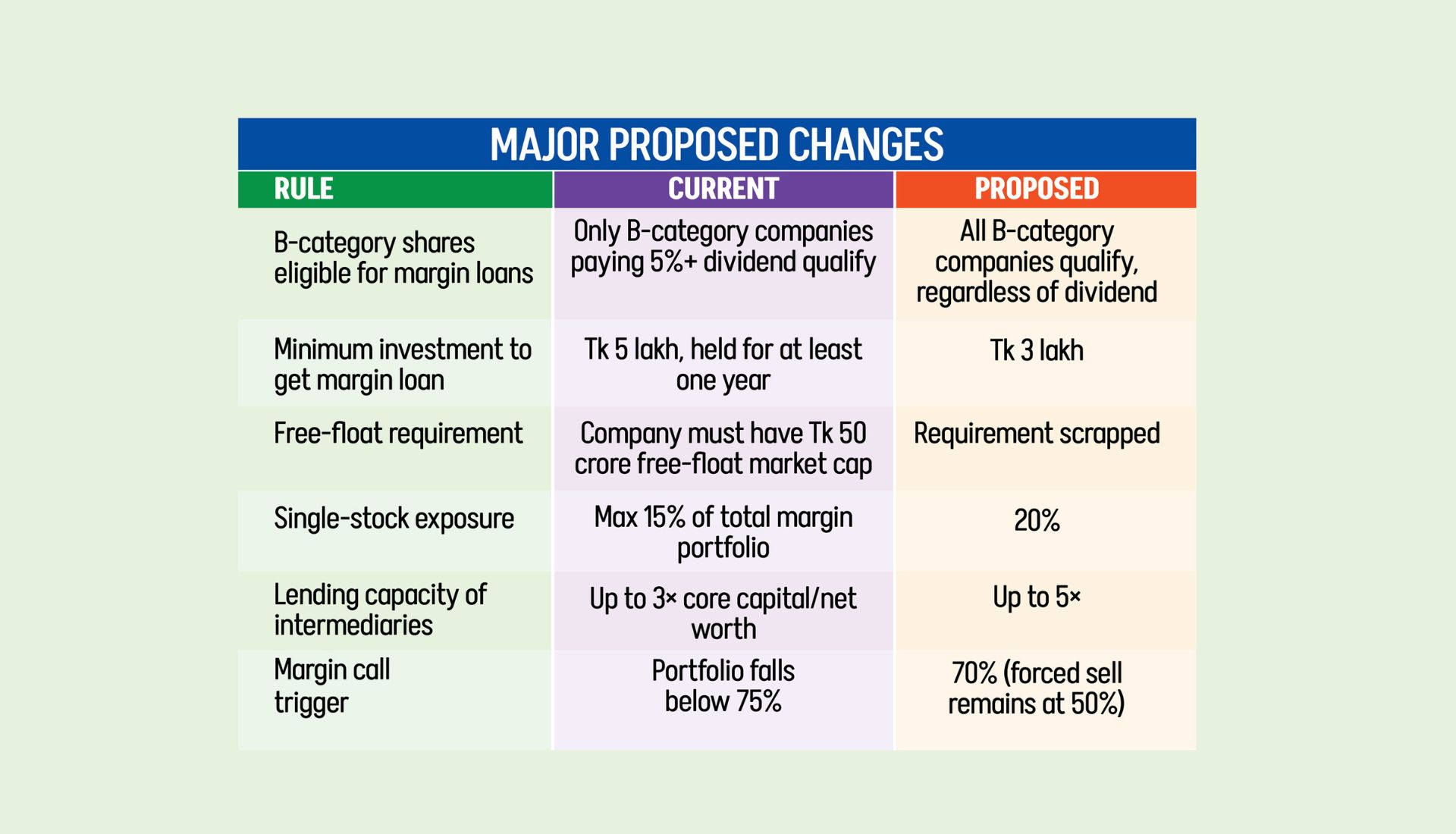
The Bangladesh Securities and Exchange Commission (BSEC) has drafted new rules to make margin lending easier, allowing investors to borrow money from their brokerage to buy shares, using shares they already own as collateral.
The draft has been published for stakeholder comment. BSEC argues that rules brought in by the previous commission made these loans too hard to get.

Under the new proposal, whether a stock qualifies for margin lending would depend on things like the company’s book value and how regularly it has paid dividends.
The real question is whether relaxing these rules will actually help the market. While it may inject some liquidity into the stock market in the short term, could it also create greater risks over the longer term?
It is worth recalling that the previous commission’s primary justification for tightening the flow of margin loans was that many investors had borrowed money to purchase shares but failed to manage their leveraged positions properly, resulting in significant losses.
That’s the basic danger of a margin loan. The money has to be paid back no matter what happens to the share price. If the price falls far enough, the broker is supposed to sell the borrower’s shares automatically to recover the loan -- this is called “forced selling.”
When many investors are in this position at once, forced selling by one can push prices down further, which triggers more forced selling elsewhere, and the whole market slides.
The aftermath of the 2011 stock market crash -- one of the worst in Bangladesh’s stock market history -- offers an important lesson. At that time, brokerage houses were not allowed to execute forced sales of clients’ shares.
Many brokers ended up owing more than their clients’ accounts were worth -- what’s called “negative equity” -- and some still haven’t recovered. The episode also placed the capital market under prolonged stress.
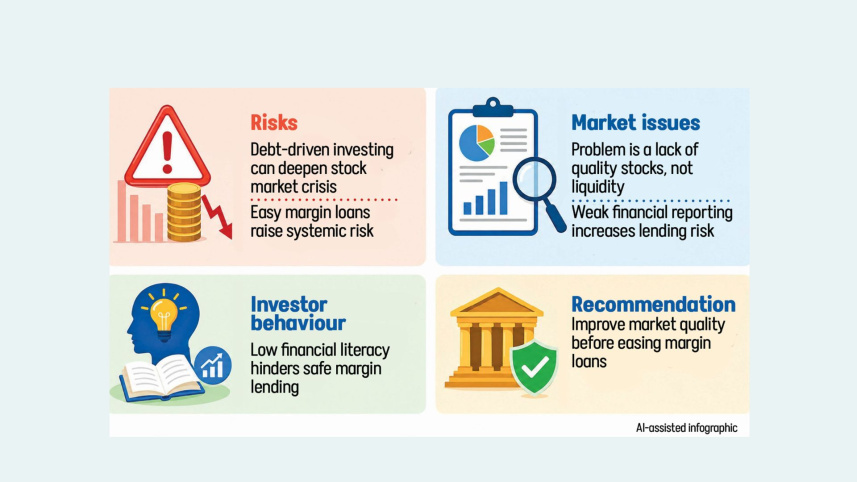
So, what is the solution? Margin loans exist in stock markets all over the world, and normally that’s fine. However, in a market like Bangladesh, where there is a shortage of fundamentally strong listed companies and investors often speculate on manipulated stocks, borrowing money to invest in equities is extremely risky. Borrowing to invest in that kind of market doesn’t only put individual investors at risk but it can also leave brokerages and other institutions exposed if they cannot force-sell in time.
The real problem, hence, becomes the question about whether forced selling can actually be executed if market conditions warrant it. In Bangladesh, the pattern has been that investors take margin loans to buy speculative stocks, and when prices fall and their shares are due to be sold off, they often take to the streets to protest instead.
In a market investors hold such a mindset, margin lending isn’t just a risk-management issue, it can turn into a political headache for the government, since forced selling has a history of triggering street protests. So why is BSEC moving to ease it?
There seem to be two justifications. One is that it should be up to lenders and borrowers to weigh their own risk before extending or taking a loan. But that only works if investors act rationally. Irrational, herd-driven investing is one of the well-known weaknesses of Bangladesh’s stock market.
The second argument could be that easier loans mean more money flowing into the market, which should boost trading activity. However, the local capital market’s problem isn’t a shortage of money, it’s a shortage of good companies to invest that money in. Pumping in more borrowed cash without more solid companies to absorb it is unlikely to produce sustainable benefits. In the long run, it may not serve anyone’s interests.
The proposed framework for which stocks qualify for margin loans -- book value, dividend history -- raise another concern: how reliable are those financial indicators? After all, investors relied on the published financial statements of several Islamic banks when purchasing their shares over the last decade. Some of these banks were classified as Category A companies, consistently paid attractive dividends, and reported strong earnings per share. Later, it turned out the banks’ financial statements had been inflated, and the real value of those shares collapsed.
In such an ecosystem, why should capital market intermediaries also be exposed to additional risks by extending margin loans?
To be fair, plenty of listed companies do report genuine, trustworthy profit and book-value figures, and those numbers are still useful. But they shouldn’t be the only test for whether a stock is safe to buy on margin. Other checks are needed too.
Most importantly, until Bangladesh’s financial reporting and credit rating systems are more reliable, margin loans shouldn’t be made easier for small investors to get.
There’s also the matter of financial literacy. Many retail investors in Bangladesh don’t fully understand what they’re signing up for when they take a margin loan, which is part of why forced selling triggers protests instead of acceptance.
 For all latest news, follow The Daily Star's Google News channel.
 The problem extends beyond investors alone. In a country where the finance minister himself instructed market participants in 2012 not to execute forced sales even when portfolio equity fell below the prescribed threshold, and where the BSEC also discouraged forced selling, it is legitimate to question whether margin lending is an appropriate product for the country’s capital market.
More than half the companies listed on Bangladesh’s stock exchanges fall into the two lower-quality tiers -- Category B and Category Z. Making margin loans easier to get in a market this heavy with weaker companies is unlikely to do much long-term good. It’s more likely to generate business for brokers and other intermediaries while adding risk to the system as a whole.
A better policy focus for the government would be attracting more genuinely strong companies to list on the stock exchange in the first place. Once high-quality companies are listed, investors will naturally return, and liquidity will improve without artificial stimulus. Capital naturally flows to opportunities where sustainable returns are available.
Equity investment should ideally be financed through personal savings rather than borrowed money. If equity investments are increasingly funded by debt, the very nature and purpose of equity financing become distorted.
It’s true that easing margin loans could give the market a short-term lift. But, from the long-term perspective, keeping margin lending as limited as reasonably possible is likely to be a healthier policy for a market like Bangladesh.
Lastly, since stocks are volatile assets, that volatility, if it moves upward, allows for rapid wealth creation through margin loans. However, when the market becomes in a falling trend, investment can evaporate very fast. Are our investors ready for that?
Comments