


Why Bangladesh imports mangoes despite being a top producer


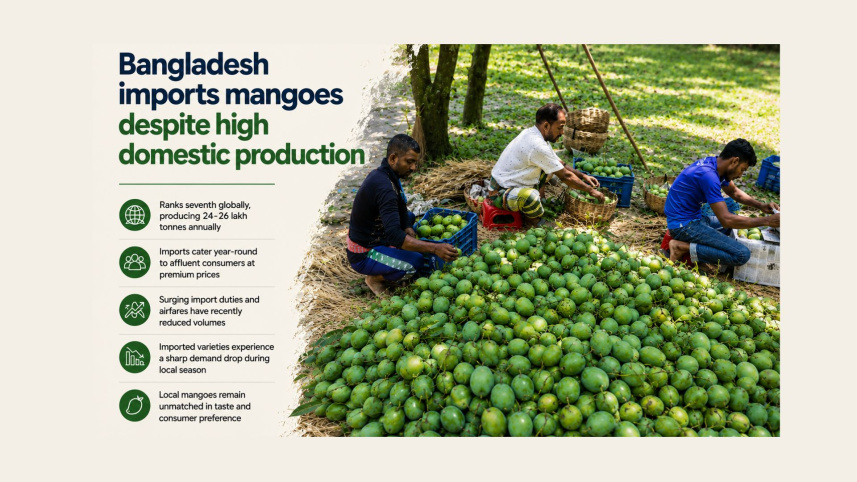
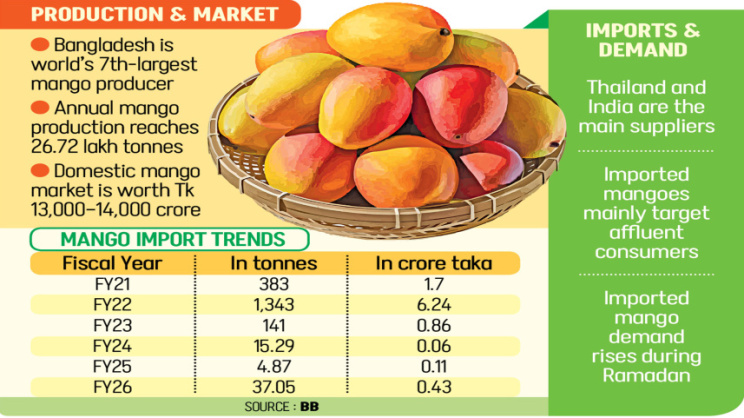
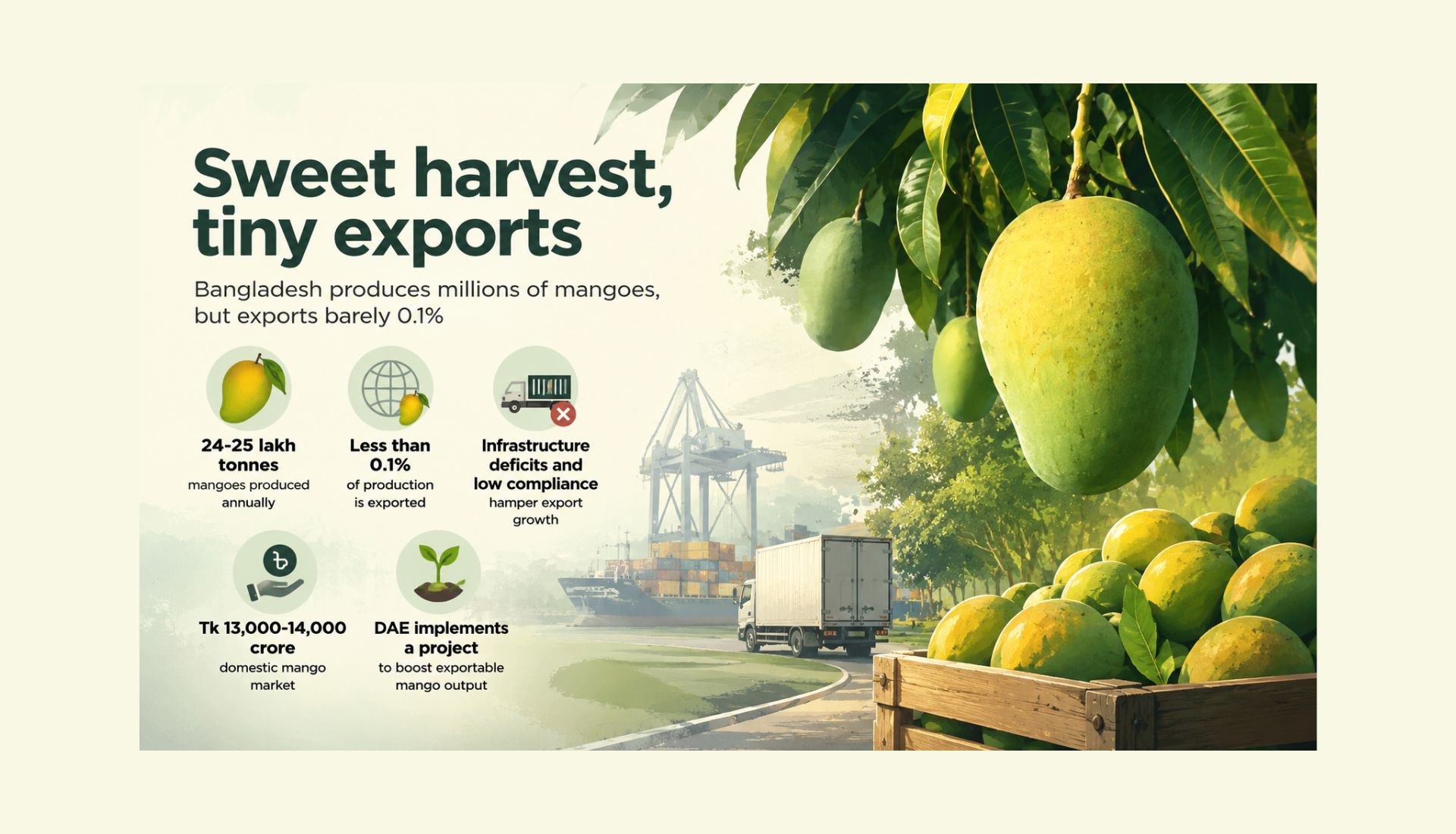
Bangladesh ranks seventh among the world’s mango-producing nations, growing 24-26 lakh tonnes annually for a domestic market worth Tk 13,000 to Tk 14,000 crore.
Yet, the country regularly imports mangoes to meet growing year-round demand from the higher-income consumers.

The imported mangoes remain a fixture at fruit shops across kitchen markets and superstores in Gulshan, Banani, Baitul Mukarram, Dhanmondi, and Uttara -- catering mainly to high-income buyers willing to pay premium prices year-round.
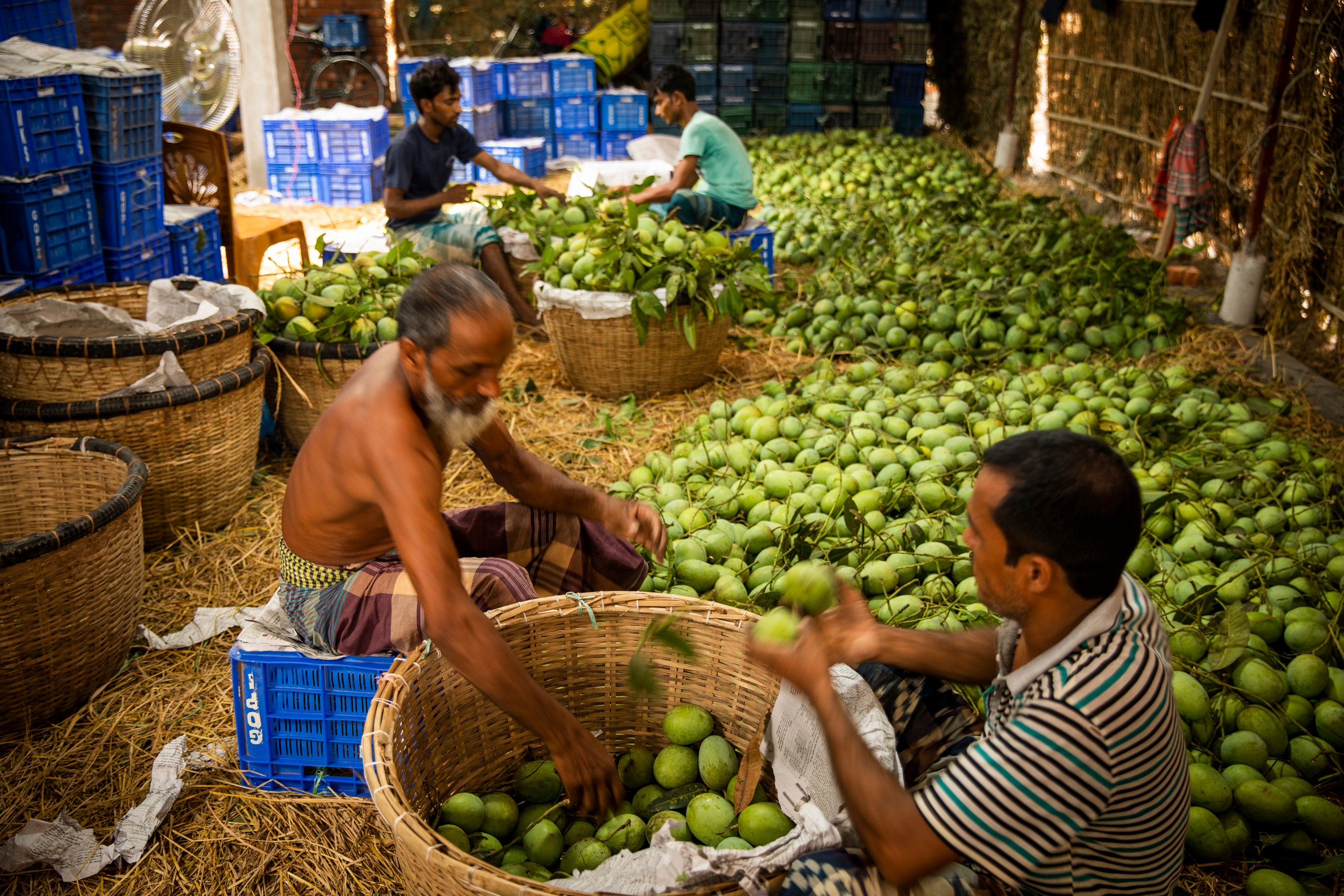
However, traders say demand for imported varieties drops sharply during the local mango season as Bangladeshi mangoes remain unmatched in taste.
According to Bangladesh Bank data, mango imports stood at 38.3 tonnes in fiscal year 2020-21 (FY21), rising sharply to 1,343 tonnes in FY22, before falling to 141 tonnes in FY23, 15.29 tonnes in FY24, and just 4.87 tonnes in FY25. Imports rebounded to 37.05 tonnes during the July-May period of the recently concluded FY26.
Bangladesh has imported mangoes from Thailand, Egypt, India, Kenya, the Netherlands, Myanmar, the UK, and Australia, among other countries. However, in FY26, imports came only from Thailand, India, and a handful of other countries.
Md Abdul Manik, a mango importer, told The Daily Star that import volumes were higher in previous years because costs were lower. Duty then stood at around Tk 45 per kg and airfare at Tk 70 to Tk 80 per kg.
At present, he said duty has increased to around Tk 500 per kg, and airfare has risen to around Tk 300 per kg, which has reduced import volumes because customers cannot afford the higher prices.
By comparison, he said, countries including Thailand, the UAE, and other Middle Eastern nations impose food import taxes of only around 5 percent.
The importer argued that lower taxes in Bangladesh would make fruits like grapes, apples, and maltas more affordable.
As it stands, he said, only a small segment of higher-income consumers can afford imported mangoes, with demand driven mainly by sweetness. Thai Sweet Mango remains the most sought-after variety.
Mohammad Limon, sales representative of Unimart’s Gulshan-2 branch, said demand for foreign mangoes falls once the local season begins and imports are scaled back accordingly, picking up again once the season ends.
Varieties such as Australia’s R2E2, India’s Katimon, Thailand’s Banana Mango, along with a few others, are in higher demand, he said. Besides these, mangoes are also imported from the Netherlands.
R2E2 is sold at Tk 1,500 to Tk 1,600 per kg, while Katimon is sold at Tk 250 per kg. Although these mangoes are in demand throughout the year, demand is higher during the month of Ramadan, according to Limon.
Demand for all varieties peaks during Ramadan, he added.
Kabir Hossain, a fruit seller at Gulshan-2 kitchen market, said Thailand’s Jamboo, Cherry Mango, and Sweet Mango are in high demand. Jamboo is sold at Tk 1,400 per kg, Cherry at Tk 1,400 to Tk 1,500 per kg, and Sweet Mango at Tk 1,200 per kg.
The buyers of imported mangoes are mainly big businessmen and salaried professionals. About 200 to 300 kg of mangoes are sold per week, he told the reporter.
 For all latest news, follow The Daily Star's Google News channel.
 Md Sorof Uddin, chief scientific officer at the Regional Horticulture Research Centre in Chapainawabganj, said, “Imported mangoes help meet consumer demand during the domestic off-season, but they cannot match the taste and quality of Bangladeshi mangoes.”
He said consumers often purchase imported mangoes because local varieties are unavailable, prioritising availability over flavour.
Comments