


China’s GDP growth set to slow
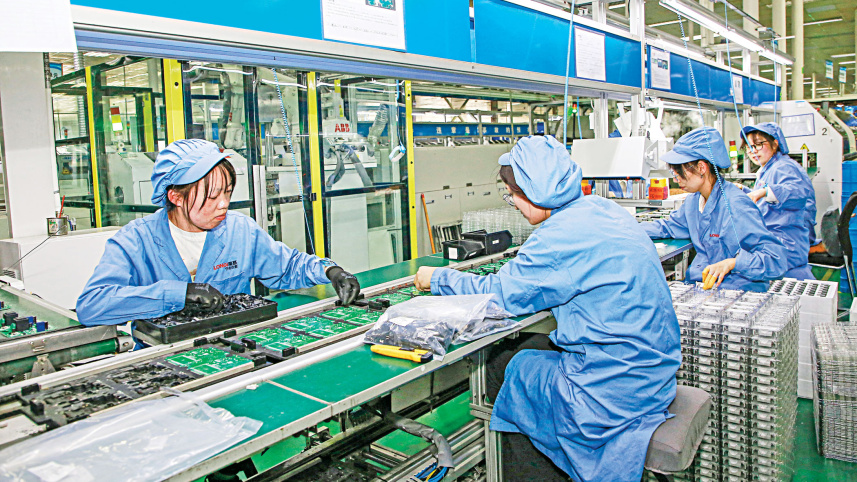
China’s economy likely slowed in the second quarter after a solid start to the year. Weak domestic demand offset the boost from resilient exports during a global oil shock, fueling expectations for fresh policy stimulus.
Beijing is grappling with a deepening supply-demand imbalance. Strong industrial output, buoyed by AI-driven exports, contrasts with weakening consumption and private investment amid a prolonged property downturn and volatile global oil prices.

Gross domestic product is forecast to have grown 4.5 percent year-on-year in April-June, cooling from 5.0 percent in the first quarter, a Reuters poll of 54 economists showed.
The projected pace would mark a fall from the 4.7 percent growth forecast in a Reuters poll in April. It would be at the lower end of the official full-year target of 4.5-5 percent.
Growth has become more uneven. Exports continue to support headline activity, but domestic demand has softened notably, analysts at Goldman Sachs said in a note.
Moreover, the boost from exports has not translated into a stronger labour market or meaningful profit improvement. This limits the pass-through from external demand to domestic growth.
China’s exports, due for release on Tuesday, likely grew at a slightly slower but still-solid pace in June. Firms accelerated shipments to the US ahead of potential new tariffs.
They also rode the AI boom. Additionally, companies competed aggressively on prices to win over cost-conscious consumers.
Investors are closely watching an expected late-July Politburo meeting for clues on fresh stimulus. This could shape policy for the rest of the year.
Analysts expect no aggressive action unless growth slows more sharply. This is given resilient exports and Beijing’s focus on curbing excess factory capacity to fight deflation.
GDP growth is projected to edge up to 4.6 percent in the third quarter. It is then expected to slow to 4.5 percent in the fourth, according to the poll.
For 2026 as a whole, China’s GDP growth is forecast to cool to 4.6 percent from 5.0 percent last year. It is projected to ease further to 4.4 percent in 2027.
On a quarterly basis, the economy is forecast to have expanded 0.9 percent in the second quarter. This marks a slowdown from 1.3 percent in January-March.
The government is due to release second-quarter GDP data on July 15. June retail sales, industrial production and investment data will come out at 0200 GMT.
Analysts expect China to lean on fiscal policy to cushion any further slowdown. The central bank has limited room for high-profile easing even after the retreat in oil prices.
The government is expected to speed up fiscal spending after a second-quarter slowdown. This followed front-loaded support early in the year.
Beijing has set a budget deficit of around 4 percent of GDP for 2026. It has also lined up heavy bond issuance to shore up growth.
China’s growth should pick up over the second half of this year as fiscal support ramps up, Capital Economics said in a note.
But domestic overcapacity will remain entrenched. This leaves China’s economy reliant on exports for growth.
Analysts polled by Reuters expect the central bank to keep its key policy rate unchanged for the rest of 2026. The seven-day reverse repo rate will remain steady.
 For all latest news, follow The Daily Star's Google News channel.
 They also expect the weighted average reserve requirement ratio to remain steady in the third quarter. A possible 20-basis-point cut is expected in the fourth.
The central bank has left policy rates and RRR unchanged since May 2025. It opted instead to use short-term liquidity operations to keep funding conditions supportive.
This comes while overhauling its monetary policy framework and strengthening policy transmission. Analysts estimate a 1.2 percent rise in consumer prices for this year.
This is below the government’s target of around 2 percent. Inflation is expected to steady at 1.2 percent in 2027.
Comments