


Critical analysis of the national budget of Bangladesh for FY27: an economic outlook

The finance minister on June 11 this year presented the national budget for FY27, titled “Journey towards a democratic, humane and inclusive economy.” At Tk 9.38 lakh crore—the largest in the country’s history and 19 percent larger than the previous year’s revised outlay—the budget is structured around 10 strategic priorities and an ambitious vision of a one-trillion-dollar economy by 2034.
The budget projects GDP (gross domestic product) growth of 6.5 percent and inflation of 7.5 percent for 2026-27 fiscal year. Both targets warrant serious scrutiny.

Bangladesh’s GDP growth in FY26 was only 4.41 percent. Achieving 6.5 percent within one year would require a dramatic revival of private investment, the resolution of energy shortages, a stabilised banking sector, and a favourable global environment—none of which can be taken for granted.
The World Bank, International Monetary Fund, and Asian Development Bank all projected growth below 5 percent, making the 6.5 percent target a potential credibility problem rather than an aspirational plan.
On inflation, the picture is equally concerning. As of May 2026, overall inflation had reached a 16-month high of 9.42 percent, with food inflation at 9.06 percent and transport inflation at 9.86 percent. The ongoing Middle East conflict has added an estimated $3 billion to Bangladesh’s energy import costs in just four months.
The World Bank-IMF joint assessment forecasts inflation declining only to about 8.9 percent in FY26 before possibly falling to 6 percent in FY27. In this context, the budget’s 7.5 percent inflation target for June 2027 is an optimistic—not realistic—projection.
The banking sector represents one of the most alarming dimensions of the economic landscape. Non-performing loans (NPLs) stood at Tk 5.57 lakh crore as of December 2025, amounting to 30.60 percent of all outstanding loans. This gives Bangladesh the highest NPL ratio in the world; no other country currently reports a figure above 30 percent. Even war-torn Ukraine had an NPL rate of 26 percent in September 2025.
Further compounding the problem, the capital adequacy ratio has collapsed from 7.3 percent in 2005 to a deeply negative 2.64 percent by the end of 2025. These figures are acknowledged within the budget speech itself—a candour that deserves recognition, though the prescriptions for addressing them remain insufficient.
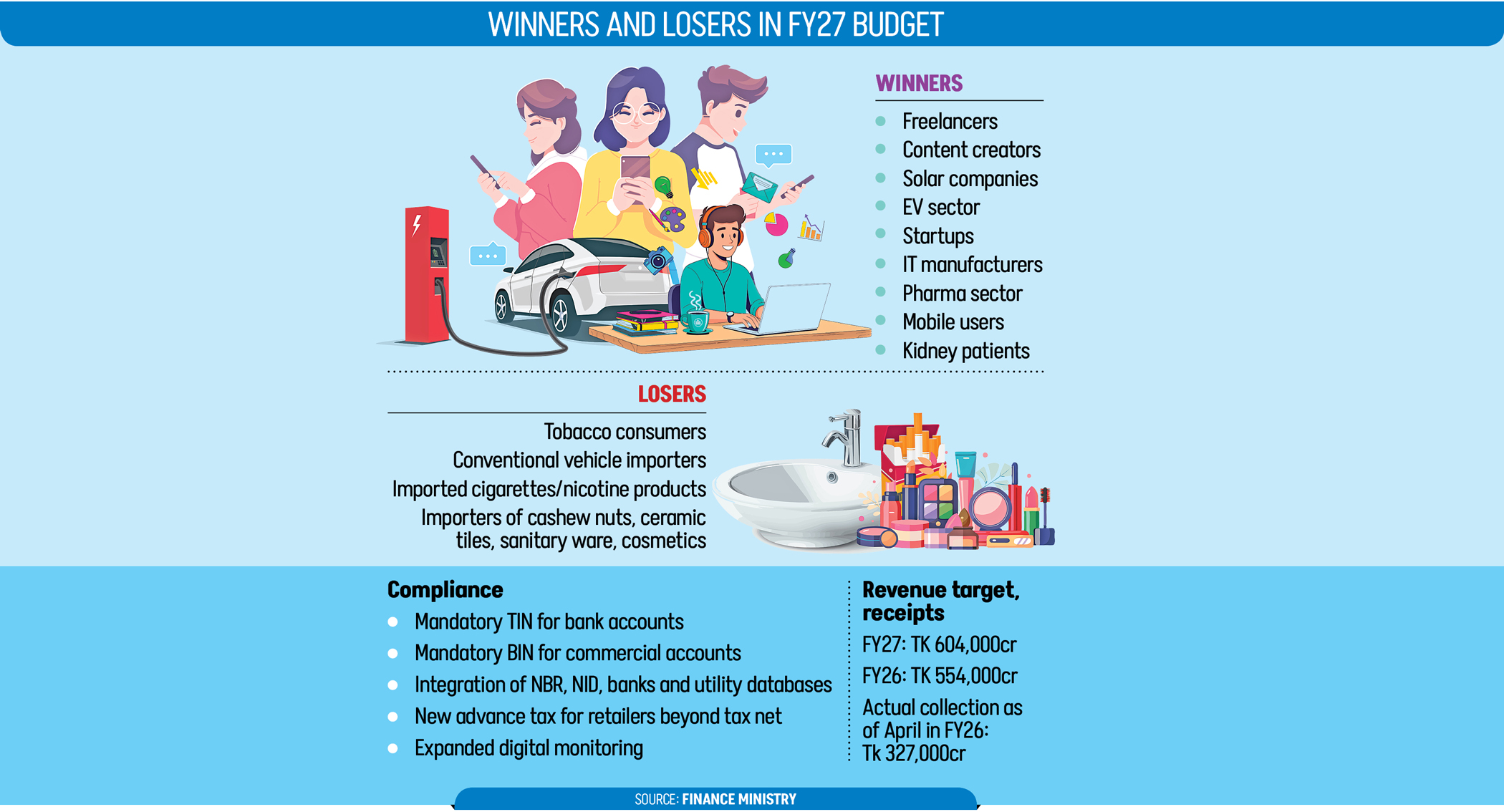
The budget sets a revenue target of Tk 6.95 lakh crore, with Tk 6.04 lakh crore assigned to the National Board of Revenue (NBR). However, during July–April of FY2025–26, total revenue collection reached only Tk 3.82 lakh crore, a growth of just 9.87 percent over the previous year.
Bridging this gap within a single year would require the NBR to nearly double its collection pace—something the speech itself admits is constrained by the economy’s most deep-rooted vulnerabilities and which is structurally impossible without transformative administrative reform.
Bangladesh’s tax-to-GDP ratio dropped to 6.8 percent in FY25—one of the lowest in the world. Meanwhile, its debt-to-GDP ratio is rising from 32.2 percent in 2024 toward an estimated 33 percent in 2026, and external debt repayments are expected to climb from $4.8 billion in FY26 to approximately $5 billion in FY27.
The proposed fiscal deficit of Tk 2.43 lakh crore (3.6 percent of GDP) will be financed partly through Tk 1.12 lakh crore in domestic bank borrowing—borrowing from a sector with negative capital adequacy—and through foreign loans, some of whose negotiations remain incomplete.
The IMF and World Bank have revised Bangladesh’s debt-risk classification from “low” to a higher category. The budget thus risks repeating a cycle: borrowing more from a weakened sector to meet a revenue target that cannot be achieved with the current collection capacity.
The Annual Development Programme (ADP) implementation rate stood at a dismal 40.7 percent as of April 2026. As the finance minister himself acknowledged, “setting ambitious targets is meaningless without ensuring a realistic, functional balance among revenue generation, expenditure planning, and implementation capacity.” Paradoxically, the FY27 budget, by its own internal logic, does precisely what it cautions against.
Despite these critiques, the budget’s 10 strategic priorities reflect a coherent development philosophy: inclusive growth, quality education and healthcare, social protection, investment-led employment, deregulation, financial stability, energy security, digital transformation, environmental management, and accountable institutions.
The social infrastructure allocation of Tk 2.79 lakh crore (29.74 percent of the total budget) and the physical infrastructure allocation of Tk 1.74 lakh crore (18.66 percent) signal a meaningful shift toward human development and away from a megaproject culture.
The emphasis on LDC-graduation preparedness—including trade diversification, bilateral agreements, and port modernisation—is strategically sound. The government’s formal request for a three-year deferral of LDC graduation reflects a pragmatic recognition that Bangladesh needs time to build competitiveness before losing preferential market access.
Bangladesh’s FY27 budget is honest in its diagnosis but overly optimistic in its prescriptions. The finance minister has correctly identified the structural ailments—low tax effort, weak institutions, a broken banking sector, mounting debt, and suppressed private investment—and the ten-priority framework points in the right direction.
However, revenue targets that require nearly doubling NBR collections, growth projections that outpace multilateral forecasts by nearly 2 percentage points, and deficit financing through a sector with negative capital adequacy are not just ambitious—they are internally contradictory.
 For all latest news, follow The Daily Star's Google News channel.
 The vision of a trillion-dollar economy by 2034 is worthy. But the path there demands genuine institutional transformation: tax reform, bank resolution, and effective implementation—not optimistic arithmetic that sounds convincing in a budget speech but collapses in execution.
The writer is an economic analyst and associate professor of economics at the Department of Humanities and Social Sciences of the Bangladesh University of Engineering and Technology.
Comments