


El Niño, Bangladesh's vegetable exports, and the price of deciding too late
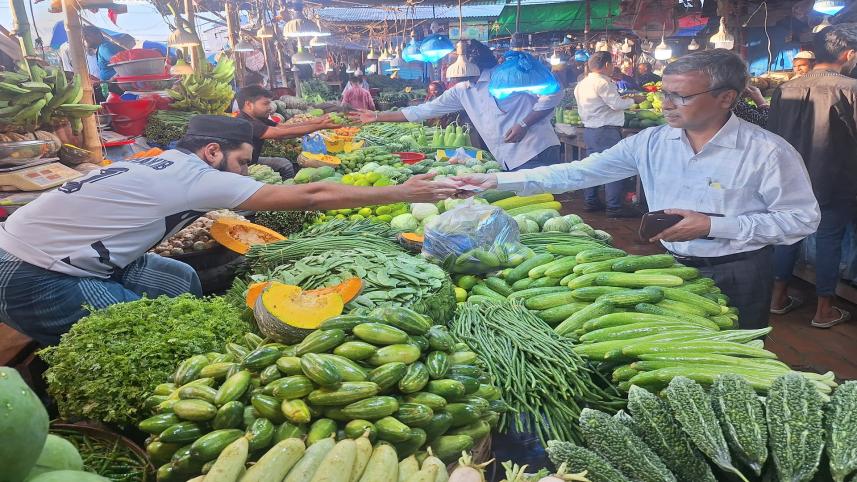
I live near Hatirjheel, and after office I usually buy vegetables from the carts parked outside my house. For the past few years, I’ve felt the same disturbance at every cart: the cost is too high. No flood, no drought, no visible crisis. The figures of the Bangladesh Bureau of Statistics (BBS) stayed broadly flat. That stability is, in a way, the story. When prices rise without a visible shock, markets are reacting to something harder to see: uncertainty. In 2023, that uncertainty had a name: El Niño.
Before that year, the only El Niño I knew was Fernando Torres, the former World Cup-winning Spanish footballer. The real thing is a periodic warming of Pacific surface temperatures, which sends Mother Earth into mood swings every few years. In 2023, we were one of her victims. Between April and July, rainfall fell 42 to 65 percent below normal.

The water that did not fall over Bangladesh in those months would have filled half of Kaptai Lake. Temperatures ran 2.6°C above normal. In Dhaka, we remember the heat waves. In Narsingdi, a farmer I met, Obayed, remembers it as the year his export crops failed to fetch him enough revenue.
What happened to Obayed is not a production story. It is a trust story, and it travels across three crops. It begins with rice. Bangladesh’s blanket export ban in October 2023 was directed at rice, but the message reached wider. Buyers in the UAE, Malaysia and the UK who had been sourcing aromatic rice learned that this supplier could close its doors without notice.
Those are the same markets where Bangladesh’s vegetables go. The buyer who could no longer count on the rice contract reconsidered the vegetable contract too. The vegetable numbers tell what followed: Chattogram seaport shipments collapsed from nearly 70,000 tonnes in FY22 to 14,202 in FY24.
Total value briefly rose to $112 million as scarcity-inflated air-freight prices masked the damage, then crashed 58 percent in the first half of fiscal year 2024–25. The premium air-freight buyers—the diaspora markets in Dubai, Kuala Lumpur and London—had moved to suppliers in India and Thailand.
And here is where potato becomes the diagnostic. Potato is bulk: shipped by the container, sold by the tonne, and switched back to as soon as the price makes sense. Diaspora premium produce—fresh chilli, ridge gourd and pointed gourd—is not. Bulk trust is cheap and recoverable.
Premium trust is expensive and slow. We lost both. The one we lost more permanently was the one actually worth something. The price signal had appeared in April 2023, months before the WMO declared El Niño in July. The ban only arrived in October, by which time FY24 was already a zombie outbreak.
India that same year offers an instructive parallel. It banned rice exports early and decisively, only for the feared shortfall never to materialise. Production exceeded the previous year, and by mid-2024 Delhi was signalling the ban might be lifted.
But India’s buyers had already learned what a blanket export ban means: a supplier that can disappear without notice. Even if India’s monsoon had failed as feared, the blanket form of the policy would still have shaken trust. Blanket instruments destroy trust on their own terms, regardless of whether the climate fear was justified.
I am not arguing against export restrictions. Every major food-producing nation uses them, and the WTO framework doesn’t discourage them. The problem is reactive, blanket policy. The export market is not a marathon; it’s a 100-metre sprint: you miss your chance and you are off the market. The fix is not less restriction; it is adaptive restriction: crop-specific rather than blanket, time-bounded rather than indefinite, and regional rather than national.
Bangladesh already receives seasonal meteorological and market intelligence months ahead of every harvest cycle. What is missing is an institutional mechanism that links climate forecasting, export monitoring and trade policy into one coordinated response. The point of such a mechanism is to give foreign buyers something to trust.
Because, as I write this, the forecasts have only tightened. The WMO confirmed in late April that El Niño will most likely develop between May and July, with high confidence. NOAA puts the probability at 61 percent.
India’s meteorological department revised its monsoon forecast downward this week, raising the chance of a deficient season to 60 percent. The summer vegetables for FY27 are going into the ground in Narsingdi right now. Obayed will plant whatever he plants. The question is whether his crop has a buyer in Kuala Lumpur six months from now.
We have weeks. Maybe.
The writer is a coordinator for trade facilitation at Swisscontact Bangladesh.
 For all latest news, follow The Daily Star's Google News channel.
Comments