


Fuel price hike to push up inflation, weaken consumption: BRAC EPL
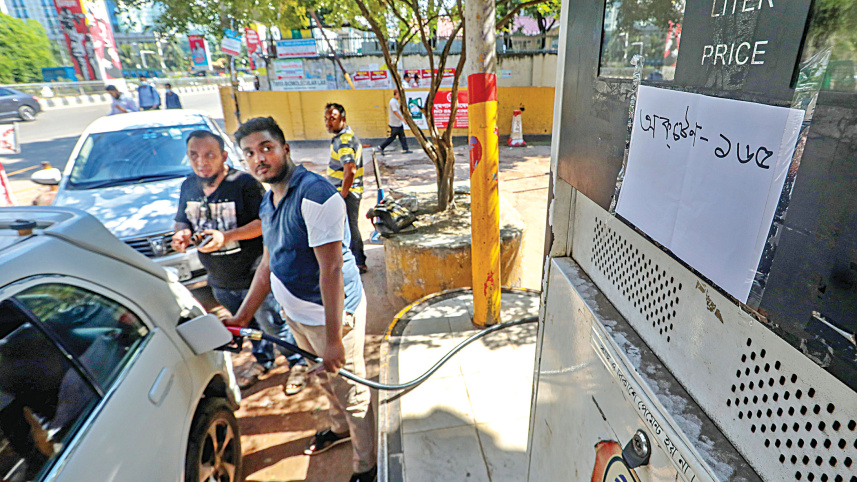
A sharp hike in fuel prices will push up inflation and is likely to weaken real disposable income and weigh on aggregate consumption, particularly among price-sensitive households, according to an analysis by BRAC EPL Stock Brokerage Ltd.
The government raised retail prices of all major petroleum products by Tk 20 per litre, which became effective from September 21.

Diesel, which accounts for around 65 percent of total annual fuel consumption as it is widely used in freight, public transport and irrigation in Bangladesh, saw the highest increase in percentage terms -- at 17.4 percent -- compared to kerosene, petrol and octane.
“The September adjustment therefore has a broader economic footprint than the headline increase alone suggests,” said BRAC EPL in a special brief released yesterday.
The price spike follows five months of unchanged domestic prices despite a sharp rise in international fuel and freight costs. Bangladesh meets 95 percent of its oil and 30 percent of its gas requirements through imports.
“The timing reflects a widening gap between domestic administered prices and international procurement costs,” said the report, citing an Energy Division estimate of Bangladesh Petroleum Corporation’s accumulated losses of Tk 22,875 crore from fuel sales between March and August due to elevated global fuel and freight costs.
BRAC EPL said the price adjustment alters the balance of macroeconomic risks.
“The first-round effect will be higher transport, irrigation and distribution costs. The second-round effect is likely to emerge through food prices, services and wage expectations,” said the brokerage firm.
“We therefore expect inflation to face renewed upward pressure in the near term, particularly in categories where distribution and fuel costs represent a significant share of final prices.”
BRAC EPL said higher freight and farm input costs are likely to lift near-term inflation, compress real household purchasing power and soften discretionary consumption.
“For corporates with limited pricing power, higher logistics and utility costs could also press on margins and capacity utilisation,” it said, adding that softer demand, together with higher operating costs, may reduce production volumes and capacity utilisation.
“The effect on aggregate output is likely to be negative in the near term, although the magnitude will depend on the degree of cost pass-through and the persistence of elevated global oil prices.”
The report said the interest rate channel also becomes less supportive. Should inflation expectations rise further, Treasury yields could reverse their recent downward trajectory to preserve positive real returns and sustain auction demand, it said.
“However, ample system liquidity and subdued private credit demand are likely to act as initial counterweights. Corporate borrowing costs could also follow, creating additional headwinds for private investment and working capital.”
The fiscal impact, however, moves in the opposite direction, said the BRAC EPL report.
By narrowing BPC’s losses, the fuel price adjustment should reduce government subsidy and BPC’s financing needs. This, in turn, would ease pressure on government borrowing and improve fiscal flexibility, potentially creating more room for priority spending if the savings are sustained, it added.
The report said improved fiscal dynamics and lower financing requirements are modestly supportive of Bangladesh’s currency, the taka.
“However, a higher oil import bill increases the demand for foreign currency, partially offsetting these benefits,” it said, adding that the price adjustment is likely to provide only modest support to the taka rather than a strong forex tailwind.
“The near-term macro impact is likely to be negative owing to higher inflation, weaker consumption and weaker economic activities,” said BRAC EPL Brokerage Ltd.
The report, however, raised concerns over supply security.
 For all latest news, follow The Daily Star's Google News channel.
 “With Saudi pipeline capacity disrupted and global diesel markets tightening ahead of winter, Bangladesh could face another period of tight fuel availability if replacement cargoes are delayed,” it said.
Comments