


ICAB warns bank borrowing may crowd out private investment
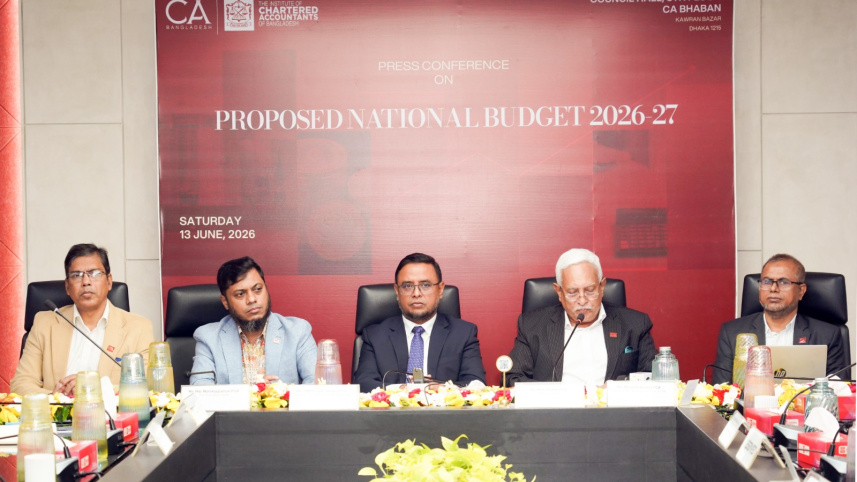
The Institute of Chartered Accountants of Bangladesh (ICAB) has emphasized that achieving the government's revenue collection target of Tk 695,000 crore in the proposed national budget for fiscal year 2026-27 will require comprehensive reforms and coordinated implementation efforts.
According to ICAB, the budget projects a fiscal deficit of Tk 243,000 crore, of which Tk 112,000 crore is expected to be financed through domestic borrowing from the banking sector.

The regulatory body for the accounting profession cautioned that such reliance on bank financing could constrain credit availability for the private sector and potentially discourage private investment.
The observations were made at a press conference titled “Chartered Accountants’ Perspectives on the Proposed National Budget 2026-27,” organised by ICAB at its office in the capital today.
Speaking at the event, ICAB President NKA Mobin said the finance minister has proposed a national budget of Tk 938,000 crore, equivalent to 13.7 percent of the country's gross domestic product (GDP).
He said the proposed budget reflects the government's commitment to maintaining macroeconomic stability, enhancing revenue mobilisation, generating employment, expanding investment, and fostering private-sector growth.
He further highlighted the government's strong focus on increasing revenue collection, modernising the tax system, accelerating digital transformation, improving the business climate, and promoting investment-friendly policies.
ICAB believes that raising the tax-to-GDP ratio while ensuring greater transparency and accountability in tax administration is essential for sustaining long-term economic growth.
The institute also underscored the importance of technology-driven tax administration and tax-base expansion.
In this regard, the Document Verification System (DVS) has emerged as a significant initiative.
ICAB expressed confidence that the DVS, jointly implemented by the National Board of Revenue (NBR) and ICAB, has already contributed to strengthening transparency in tax administration, curbing tax evasion, and enhancing revenue collection, and will continue to play an even more impactful role in the years ahead.
Sarker Nahidul Islam, director of Tax and Advisory Services at Rahman Rahman Huq, said the proposed reforms represent a significant shift towards simplifying the tax system, improving compliance, and making business operations easier in Bangladesh.
He said the restructuring of the tax framework into five categories, with a focus on easing the cost of doing business, expanding the tax net, and strengthening compliance, is particularly important as the country approaches its 2026 graduation milestone.
He highlighted that several measures will directly reduce operational complexity for businesses, including the introduction of a digital business service platform, the simplification of FB account operations, and the fixing of the dividend-processing timeline at 30 days.
Finally, he pointed out that the expansion of VAT input credits to labour, transportation, and solar power, along with simplified access to double-tax treaty benefits, will improve tax efficiency.
He concluded that clearly defined record-keeping requirements—12 years for companies and six years for non-corporate entities—will enhance documentation standards and strengthen compliance enforcement.
Snehasish Barua, a chartered accountant and a partner at Snehasish Mahmud & Co, said the government's primary objective is to control inflation.
To support this goal, it reduced income tax, VAT, and customs duties at the source and import stage before presenting the budget. These measures aim to provide relief to consumers, particularly as electricity and utility costs continue to rise.
The main concern among practitioners is implementation at the field level, particularly the risk of harassment by tax and VAT officials, he said.
The NBR must take practical steps to address this issue. Otherwise, revenue collection pressure will continue to fall on existing taxpayers rather than through an expansion of the tax base and the inclusion of new taxpayers in the system, he said.
 For all latest news, follow The Daily Star's Google News channel.
Comments