


IPO rules to be made easy to attract new listings: BSEC chairman
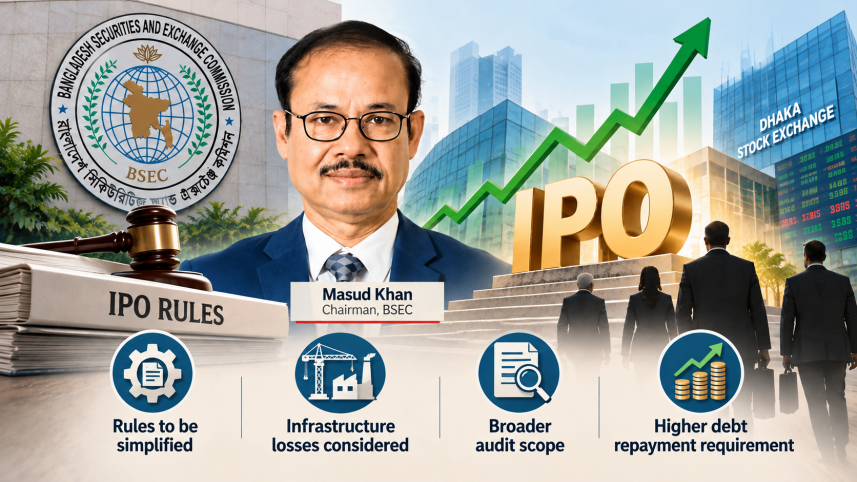
The stock market regulator will bring major changes to its initial public offering (IPO) rules to make it easier for new companies to get listed on the stock market, said Masud Khan, chairman of the Bangladesh Securities and Exchange Commission (BSEC).
The new rules would take into account accumulated losses incurred by companies undertaking long-term infrastructure projects, but loss-making companies will not be allowed to be listed, he said.

The proposed changes also include expanding the scope of audits, revising debt repayment requirements for IPO proceeds and adopting international methods for share price valuation.
The draft rules will soon be published on the commission’s website for public consultation after being finalised.
The BSEC chairman made the remarks while addressing a seminar as the chief guest at a programme organised today to mark World Investor Week 2026.
The Dhaka Stock Exchange (DSE) and the DSE Brokers Association of Bangladesh (DBA) jointly organised the seminar.
Masud Khan said the rules were being formulated in consultation with market stakeholders to expand companies’ opportunities to get listed while protecting investors’ interests.
He said the existing IPO rules impose restrictions on the listing of companies with accumulated losses.
However, large infrastructure projects, such as power plants, hotels, cement factories and steel mills, require substantial investment over a long period. It is not unusual for such projects to incur losses before commencing commercial operations. Against this backdrop, the IPO rules are being revised to take accumulated losses into account, he said.
However, this does not mean that any loss-making company will be allowed to enter the stock market, he added.
Masud Khan said auditors would be given broader responsibilities in verifying documents under the proposed changes.
Currently, the DSE and BSEC examine various documents, but the revised rules would introduce a more extensive verification process resembling forensic auditing.
The BSEC chairman also announced plans to revise the debt repayment requirements under the IPO rules. According to him, the commission is considering raising the existing 30 percent requirement for debt repayment.
BSEC Commissioner Nahid Mahtab said technological advances had made stock market investment more accessible. However, fraudsters were also exploiting the same technology to spread misinformation rapidly and target investors.
Artificial intelligence and advanced data analytics can help identify suspicious trading patterns, he said.
However, technology should be used to flag suspicious activities and generate alerts. Human judgement and review must remain integral to the final assessment and any legal action, he added.
Mominul Islam, chairman of the Dhaka Stock Exchange, said false information, investment scams and manipulative campaigns on social media were undermining investor confidence in the stock market.
One of the biggest challenges facing the market is ensuring that accurate, timely and comprehensive information about investment products and projects reaches all investors, he said. The proliferation of social media has added digital fraud to these challenges.
He noted that some individuals were presenting themselves as stock market experts on social media and publishing various forms of technical analysis. In many cases, such analyses were driven by the interests of particular groups.
Rather than helping investors make informed decisions, these campaigns were intended to influence them and serve the promoters’ own interests, he said.
 For all latest news, follow The Daily Star's Google News channel.
 The DSE has taken initiatives to modernise its surveillance and monitoring systems to combat digital fraud. It is also working with the BSEC to raise investor awareness.
Mominul said no globally recognised investment bank was currently operating in Bangladesh. Most financial intermediary institutions in the country were also relatively small and had limited institutional capacity.
As a result, the lack of strong brokerage houses, merchant banks and asset management firms was making it difficult to overcome the stock market’s crisis of confidence, he said.
He further said that institutions associated with the stock market had relatively small budgets for communication and promotional activities. Taking advantage of this limitation, market manipulators were able to disseminate their messages more effectively to the public.
Therefore, the market needs to strengthen its capacity to highlight positive developments and deliver reliable information to investors, he added.
DBA President Saiful Islam, BSEC Commissioner Nafeez Al Tarik and others also spoke at the event.
Comments