


What SpaceX’s long private life says about financing Bangladesh’s champions

When SpaceX sold shares to the public on Nasdaq on June 12, it became the largest initial public offering in history, raising about $75 billion at a valuation of $1.77 trillion. The size is what draws attention. What should interest Dhaka is the calendar: the company had been private for almost a quarter of a century before that morning.
That long private life was bought, year by year, with private money. A succession of venture and growth investors funded SpaceX through heavy losses, and the company arranged to buy back employee and early-investor shares roughly twice a year, giving holders cash without a public listing.

That recurring liquidity removed the main reason most companies are pushed to go public early. America now has fewer listed companies than it did in the 1990s, a decline driven less by regulation than by the depth of private capital available to keep good companies private until they choose to list. A listing there is the last step of a long chain rather than the first.
Bangladesh reads a record like this and reaches, understandably, for the wrong lesson. The instinct is to ask when the country will produce a company of that scale. It already produces companies that work. The harder questions are who finances them on the way up and who owns them once they have arrived.
Consider bKash, the first Bangladeshi company to reach a billion-dollar valuation. It serves tens of millions of customers and turns a profit. Its growth was financed from abroad by the International Finance Corporation, the Gates Foundation, Ant Group and, finally, SoftBank, whose 2021 investment set that valuation. A Bangladeshi saver cannot own a piece of it except indirectly, through its listed parent bank. The value was built at home and is held, in large part, overseas.
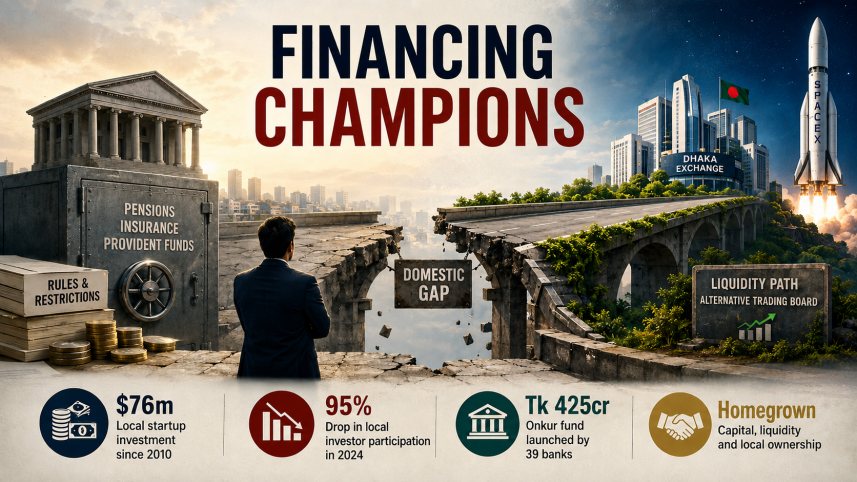
The same story runs through the sector. Since 2010, local investors have put only about $76 million into Bangladeshi startups, and in 2024 their participation fell by 95 percent in a single year. Seed cheques make up most deals but a small share of the money; capital for companies trying to scale is almost entirely foreign.
The IPO drought that has frozen the Dhaka exchange since early 2024 draws the headlines, but the exit is the last link in the chain. Bangladesh’s chain breaks at the first.
The reason is specific, and it can be fixed. The country’s largest pools of patient money are not permitted to fund private companies. The rules written for the new Universal Pension Scheme bar it from investing in private enterprises; insurance life funds and provident funds sit, by regulation and habit, in government securities and bank deposits.
A venture fund in Dhaka has almost no domestic institution from which it can raise money. With no local backers, founders take the capital on offer, and that capital comes from abroad.
I have seen the problem firsthand through investments in more than 10 Bangladeshi startups over the past five years. The same constraint appears each time. A company reaches the point where it needs to scale, the domestic money is not there, and the choice narrows to foreign capital or none at all. Just as telling, an early backer has little way to realise a return without selling the whole company, usually to a buyer from outside the country.
The government has seen the gap. In May, 39 banks launched a Tk 425 crore venture fund called Onkur to back local startups, the most serious domestic effort yet, and the people behind it are credible. The sum is modest relative to the need, and it draws on bank balance sheets rather than the far larger pools held in pensions and insurance. An earlier measure, a 2021 instruction for banks to set aside 1 percent of profits for startups, deployed less than Tk 5 crore out of more than Tk 100 crore allocated.
A more durable fix is to give that capital a way home. The BSEC has a starting point in the Alternative Trading Board, the platform it launched in 2023 for trading shares of unlisted companies, which has drawn almost no business since.
Built out into a functioning venue where private companies and their early investors can trade shares without a full stock-market listing, it could do for Dhaka, in miniature, what the twice-yearly tender market did for SpaceX: let backers take money off the table while a company keeps growing. A visible route to liquidity is also what would, in time, draw domestic institutions in, once they can see how money comes out as well as goes in.
None of this manufactures a trillion-dollar company, and it should not try to. What it does is allow a promising company to be financed at home for long enough to grow, give its backers a way to come and go, and eventually let it list in Dhaka, owned in part by the people who already use it.
The frozen IPO market has had no shortage of attention. The machinery that would carry a company towards it is the part still missing, and building it can begin now.
The writer is currently managing director at RetailBook and was previously at Citi. He can be reached at fahim@arcapholdings.co.uk
 For all latest news, follow The Daily Star's Google News channel.
Comments