


When rising fuel prices meet persistent inflation

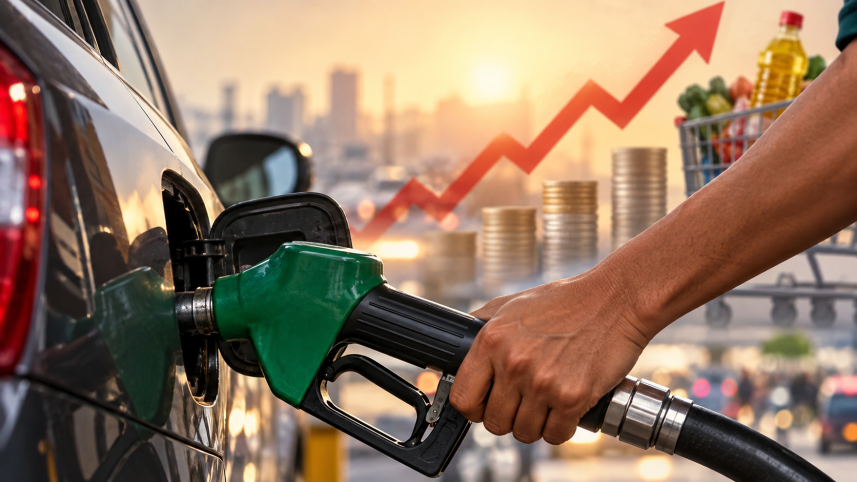
A further Tk 20 per litre increase in fuel prices has landed at a difficult time for most households in Bangladesh. It comes five months after the last major adjustment in April, followed by a smaller rise in June. Fuel prices have risen across much of the world following the conflict that began with US and Israeli strikes on Iran and subsequent tensions around the Strait of Hormuz. For Bangladesh, the impact is compounded by persistent domestic inflation.
For more than four years, Bangladesh has struggled to bring inflation down from rates close to 10%, against a longer-term average of around 5-6%. Before the Hormuz crisis, Bangladesh maintained relatively low domestic fuel prices compared with many other countries. Now the situation is such that while inflation stays elevated, the government is having to make substantial price adjustments given its acute fiscal space constraint, with the tax-GDP ratio falling below 8 percent.

In fact, among the developing countries with which Bangladesh is commonly compared, its fuel price increase since the Hormuz conflict has been one of the largest, at around 38 percent, compared with less than 10 percent in India, 19 percent in China and 27 percent in Viet Nam. Indonesia has experienced a gasoline price rise nearly as large as Bangladesh’s, but inflation in Indonesia is much lower, at around 3.3 percent.
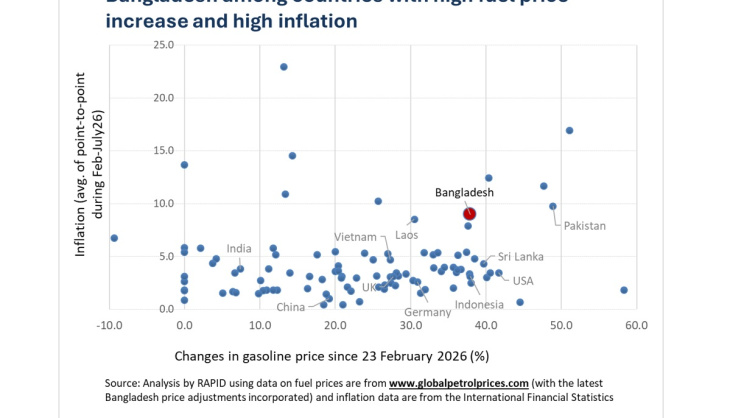
The dual blow of prolonged high inflation and steep fuel price increases falls on consumers, particularly poor and vulnerable households. It comes amid recent assessments suggesting that poverty in Bangladesh is likely to have risen substantially since the last official household survey in 2022.
Higher fuel costs would ripple through almost every economic activity, raising the cost of producing goods, transporting them to market and providing essential services. Poor households, small farmers, and enterprises with limited working capital have the least capacity to absorb the additional pressures, whether through higher prices, narrower margins or reduced consumption.
One may well ask how many more shocks households can bear when their real purchasing power has been declining for years. Yet, for several years now, the response to prolonged inflation has too often been delayed and half-hearted, without sufficient attention to the scale of the problem.
During the interim government’s tenure, efforts to control inflation relied heavily on demand management. Bangladesh Bank raised its policy rate and maintained a tight monetary stance, but liquidity support for troubled banks and rising government borrowing, particularly borrowing directly from the central bank, complicated that effort. Supply-side measures received less sustained attention.
After the February 2026 election, the new government recognised the importance of bringing inflation down. Its first budget, however, set an ambitious growth target and substantially higher spending. This was accompanied by a large stimulus package for struggling industries, significant provision for restructuring weak banks and, subsequently, approval of a new public-sector pay scale for phased implementation. Bangladesh Bank also reduced its policy rate by 50 basis points. Each measure responds to a real problem, but together they raise the question of whether the drive to revive growth is adequately reconciled with lowering inflation.
Spending out of the crisis is risky when inflation remains high and firms cannot readily expand production. Energy shortages and reliance on imported fuel constrain the supply response, while additional demand could put fresh pressure on prices and the foreign exchange reserves Bangladesh Bank is seeking to rebuild. This makes the supply constraints central to the inflation debate.
One principal element of the supply side deserves closer examination. Merchandise imports fell from a peak of $79 billion in FY22 to $68 billion in FY25. According to Bangladesh Bank’s provisional estimates, imports recovered substantially to $75 billion in FY26, though they remained below the FY22 level. Import compression may have contributed to supply shortages. The policy question is whether formal or informal barriers to importing essential goods and production inputs are unnecessarily restricting supply.
This question warrants a systematic comparison of prices for selected essentials in Bangladesh, international markets and, particularly, neighbouring countries, allowing for differences in exchange rates, quality, transport costs and taxes. Where substantial gaps persist, there is a need to examine whether tariffs, import permissions, access to foreign exchange or delays in opening letters of credit are restricting supply.
This is also an opportune moment to consider prudent tariff rationalisation, with particular attention to the widespread use of supplementary and regulatory duties. These duties can impede imports even where domestic producers are unable to increase supply sufficiently. Easing such constraints and facilitating imports could relieve price pressures.
The pressure to rebuild foreign exchange reserves makes import policy sensitive. Reserve accumulation remains essential, but the budget’s projection of $41 billion in gross reserves by the end of FY27 should be weighed against the costs of restricting imports. The objective should be to rebuild reserves without unnecessarily constraining the supply of essential goods and production inputs.
There is a fiscal dimension too. With weak revenue mobilisation, ambitious spending plans can mean greater government borrowing. Support for troubled banks, industrial stimulus and public-sector pay increases may each have a case, but their scale, timing and financing matter when bringing down inflation is already proving difficult. Price stability needs to carry greater weight in these decisions.
Stabilising the taka helps contain import costs and inflationary pressures. During high inflation, taka depreciation would only add fuel to the fire. However, if inflation remains high while the nominal exchange rate barely moves, the taka may appreciate in real terms, undermining export competitiveness.
For instance, as against Bangladesh’s average rate of 9-10 percent during FY23–FY26, India’s inflation fell from 6.7 percent to around 4 per cent; Viet Nam was able to contain it within 3–4 percent while China saw near-zero inflation. These differences must have put pressure on Bangladesh’s export competitiveness and contributed to its recent difficulty in expanding exports. Holding the nominal exchange rate steady cannot substitute for bringing inflation under control.
Finally, goods must move reliably from farms, ports and factories to markets. Extortion along transport routes, delays and other logistical obstacles add to costs and disrupt supply. Tackling them requires sustained enforcement, alongside better freight and market infrastructure. Without a more effective domestic supply chain, even adequate imports or harvests may fail to ease prices where consumers buy their essentials.
The fuel price increase has exposed a wider policy challenge. There is a critical need to protect vulnerable households now while addressing the import, fiscal and distribution constraints that have allowed high inflation to persist. Households cannot keep absorbing external shocks through a steady loss of real purchasing power. Nor can it be overemphasised that failure to rein in inflation is likely to have serious consequences for macroeconomic stability and external competitiveness.
The socioeconomic costs of persistent inflation are too high for price stability to be weakened by conflicting policy choices; tackling it requires sustained commitment and prudent, practical measures across the economy.
 For all latest news, follow The Daily Star's Google News channel.
 The author is an economist who serves as chairman of Research and Policy Integration for Development (RAPID). He can be reached at m.razzaque@rapidbd.org
Comments