


Raja Rammohun Roy: An architect of Asian cosmopolitan modernity
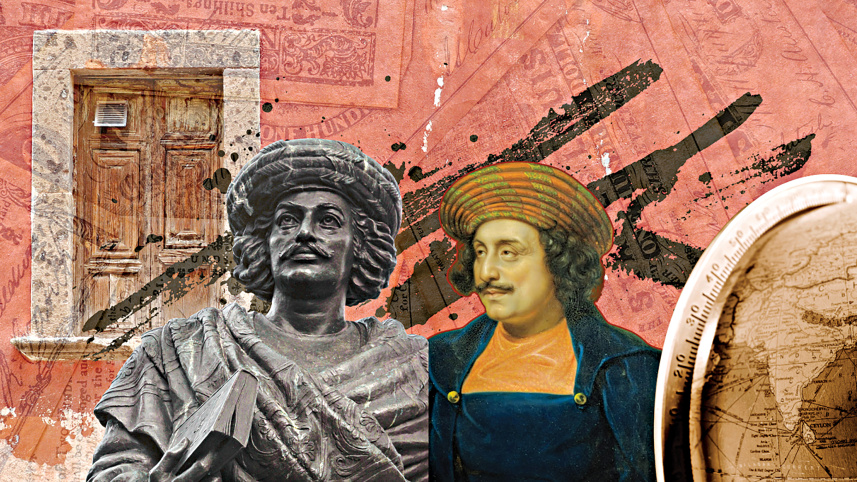
Raja Rammohun Roy was a trailblazer in South Asian and, arguably, Asian culture, literature, journalism, and education. He is often described as the “Father of Modern India,” the “Prophet of Indian Nationalism,” a pioneer of the Bengal Renaissance, and a founder of Asian Anglophone literature. He also spearheaded Indian journalism, publishing newspapers in three languages: Sambad Kaumudi in Bengali, Mir’at’l-Akhbar in Persian, and Bengal Herald in English. His efforts to promote Western education and establish English-medium institutions in Calcutta laid the foundations of modern South Asian education, influencing generations. Moreover, Rammohun was a versatile linguist, proficient in nine languages: Arabic, Bengali, English, Greek, Hebrew, Hindi, Latin, Persian, and Sanskrit.
Rabindranath Tagore once said, “Languages are jealous sovereigns and passports are rarely allowed for travellers to cross their strictly guarded boundaries.” The fact that Rammohun could cross the borders of nine cultures and claim his “citizenship” in those diverse literary-linguistic domains bespeaks his imagination’s cosmopolitan reach and the freedom with which his mind could traverse continents, creeds, and cultures. Owing to the scope and depth of his intellectual engagement and influence, historian Stanley Wolpert has compared him with the leaders of the Florentine Renaissance, describing him as a “beacon of change, auguring the rebirth of pride and faith [in Indian identity].”

An avant-garde reformist, Rammohun sought to modernise India by introducing bold, unorthodox ideas to transform prevailing institutions and practices within Hinduism, the majoritarian religion to which he belonged. He wanted to replace Hindu idolatry and polytheism with Islamo-Christian monotheism and to abolish sati, the caste system, child marriage, polygamy, dowry, and repressive gender practices. His method for achieving this was to incorporate Enlightenment rationalism and Western liberal ideas, such as individualism, individual rights, freedom of thought and expression, and freedom of association across languages and faiths. He also sought to create an interfaith dialogue among Islam, Christianity, and Hinduism to purify the latter of its antiquated customs. For this, he was ostracised by his community, beginning with his parents forcing him to leave the family home in adolescence, and later, his mother, along with other family members, launching a legal challenge against him to disown him and deprive him of his inheritance. Despite such hostilities between the mother and son, Rammohun saw his mother, Tarini Debi, as a model of independent womanhood.
Rammohun was born in 1772 into a Kulin Brahmin family in Radhanagar, Bengal. The family was wealthy and influential, yet ultra-conservative. His great-grandfather, Krishnachandra Bandyopadhyay, served the Mughal treasury under the Nawab of Bengal during the reign of Emperor Aurangzeb. He was awarded the Mughal title “Raya Rayan” (King of Kings), and the family adopted the abbreviation “Roy” or “Rai” as its family name, replacing their caste name “Bandyopadhyay.” Rammohun’s other title, “Raja,” also came from a Mughal ruler. It was conferred on him by Delhi’s Mughal emperor, Akbar Shah II, when he was sent to England in 1829 as the emperor’s emissary to the court of King William IV.
Rammohun was brought up in Bengali, Persian, and Sanskrit. Persian was the lingua franca of Bengal at the time. His father first appointed a munshi to teach him Persian at home. Around the age of nine, he was enrolled in an Islamic madrasa in Patna, Bihar, where he became so proficient in Arabic and Persian that he read the Qur’an and Sufi poetry in their original languages and was deeply influenced by Islam’s monotheistic ideology. In 1803, he published his first book, Tuhfat-ul Muwahhidin (A Defence of Monotheism), in Persian, with an Arabic preface, in which he launched a rationalist critique of Hinduism to modernise it, in light of Islamic ideals, advocating a universal religion based on reason and belief in one universal God. This sparked a torrent of tirades from the orthodox segments of his community, including his family and friends.
According to John Digby, an East India Company official who became his employer, close friend, and confidant in 1803, Rammohun began learning English in 1794, at the age of 22. He was slow at first, but picked up the language rapidly after being assigned to handle all of Digby’s public correspondence and through conversation with European colleagues and friends at the Company. Recalling Rabindranath’s statement about the challenges of acculturating to a foreign tongue, one cannot but admire Rammohun’s genius in how quickly he gained creative command of English, the instrument of empire, and harnessed it not only to contest imperial hegemony but also to crystallise and voice his reformist ideas. His publications in English began with Translation of an Abridgement of the Vedanta (1816) and A Defence of Hindoo Theism (1817), which made him only the second native Asian to produce literary work in English, after another Bengali, Sake Dean Mahomed, who published his inaugural title, Travels, in 1794, as an immigrant in Ireland.
Indian Hindus were relatively hospitable to the English language and literature after its arrival in the seventeenth century. In contrast, Muslims were indifferent and hostile from the outset, having lost their power to the British. Welcoming English literature, Rabindranath, for example, exclaimed in My Reminiscences (1917), “Our hearts naturally craved the life-bringing shock of the passionate emotions expressed in English literature. Ours was not the aesthetic enjoyment of literary art, but the jubilant welcome of a turbulent wave from a situation of stagnation.” When approached by Mulk Raj Anand about whether he should write in English, Gandhi said in approval, “The purpose of writing is to communicate, isn’t it? If so, say your say in any language that comes to hand.” However, Hindus did not readily accept the imposition of English education in Indian institutions through Macaulay’s Minute of 1835. Condemning it, Gandhi said in 1910, “To give millions a knowledge of English is to enslave them. The foundation that Macaulay laid of education has enslaved us.” Rabindranath, a great patron of Rammohun, also rejected English and introduced Bengali as the sole medium of education at Santiniketan and Visva-Bharati.
However, Rammohun was an exception in this regard. He not only welcomed English but also English education. He firmly believed that the best way to modernise the subcontinent was through English and Western education. That’s why he established his English-medium Anglo-Hindu School with a Western curriculum in 1822, thirteen years before the British education policy was introduced in the subcontinent. Although Macaulay’s 1835 “Minute on Education” was meant to instil Anglophilia in Indian blood and produce a group of mimic men— “a class of persons, Indian in blood and colour, but English in taste, in opinions, in morals, and in intellect”—Rammohun saw it in a different light. He believed that only an English education could bring a scientific and rational awakening in India and overhaul society through a synthesis of the East and West, something neither Sanskrit nor Persian could accomplish, since, in his view, they were useless anachronisms in the modern international world of scientific knowledge based on reason and inquiry.
In 1823, when the British administration proposed establishing a Sanskrit College in Calcutta, Rammohun vehemently rejected the idea, arguing that “the Sanskrit system of education would be best calculated to keep this country in darkness.” Yet in 1826, he founded his Vedanta College, blending East and West, where Hindu monotheistic philosophy, as found in the Upanishads and the Bhagavad Gita, would be taught in Sanskrit, while Western rational and scientific knowledge would be imparted in English. This was his vision for modernising both Hinduism and the Indian subcontinent.
To propagate the Vedantic vision of monotheism and overcome superstitious practices in Hinduism, Rammohun founded the Brahmo Samaj movement in 1828, with the active support of the Tagore family. His robust public campaign against sati, which he denounced as a barbaric and un-Hindu custom, also led to its abolition by the then Governor-General William Bentinck in 1829. In 1823, Rammohun orchestrated a public protest against the Acting Governor-General John Adam’s Licensing Regulation Act, which was intended to muzzle the Indian press. He argued that freedom of religion and speech were natural human rights that every conscientious ruler had to uphold. This made him the first Indian, and presumably the first Asian, to stand up for individual freedom and dignity, which is the foundation for building a democratic, creative, and progressive modern society.
Rammohun travelled to England in 1829, defying the Hindu prohibition against kala pani, or crossing the ocean—the first kulin Brahmin to do so. There, he was hailed as a uniquely “enlightened” figure by the leading Unitarian philosophers of the time. His monotheistic vision of a single universal God, rejecting the Christian Trinity, had made him a celebrity among Unitarians in India, the UK, and the USA. He was also warmly received by King Louis-Philippe of France during a brief visit to Paris in late 1832. However, not long after, he contracted meningitis and died on 27 September 1833, in the care of his Unitarian friends in Bristol. He was buried rather than cremated, once again flouting the Hindu norm. His tomb in Arnos Vale Cemetery in Bristol, England, now epitomises the cosmopolitan modernity he had envisioned through an East-West symbiosis.
Professor Mohammad Quayum, an affiliate of Flinders University in South Australia, has published more than 40 books and over 100 journal articles and book chapters on American, Bengali, and Asian Anglophone literature.
 For all latest news, follow The Daily Star's Google News channel.
Comments