


The wardrobe
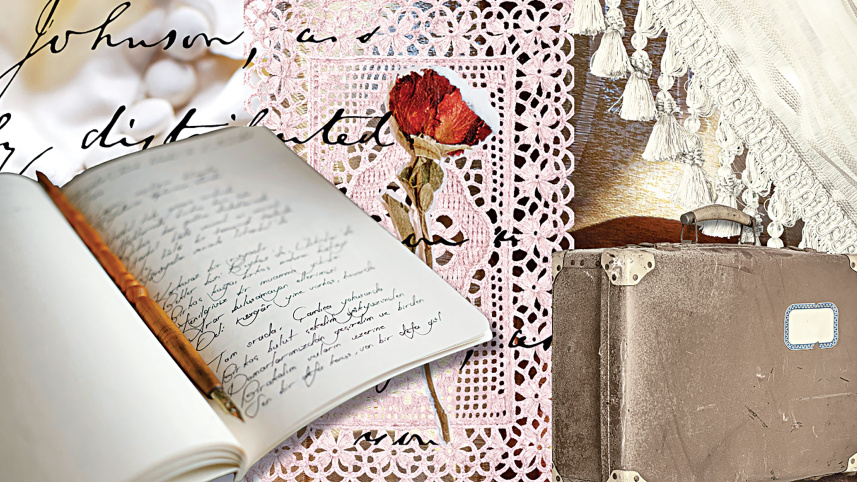
It arrives on a Tuesday afternoon, wrapped in a coarse jute sheet and tied with frayed rope.
The delivery man leaves it in the corridor outside Amreen’s flat with a scribbled receipt and a shrug. By the time she drags it inside, her palms are streaked with dust, and her back aches.

It is an old travelling trunk, made of dark chestnut wood, its corners banded with tarnished brass. The lock resists before opening with a rusty groan. Even closed, it carries a smell she cannot name at first—mothballs, rose oil, damp paper, and the faint sweetness of wood that has spent decades breathing monsoon air. Near the clasp, three initials survive in fading gold.
E.L.B.
No one in the family recognises them.
The trunk is one of the last things to leave her grandmother’s house in Narayanganj after the funeral. The caretaker packs it with a cracked tea set, bundles of letters, and a silent harmonium before sending everything to Dhaka.
“I’ve no room for old junk,” Amreen’s mother says over the phone. “Keep it if you want. You always had a weakness for forgotten things.”
Amreen does.
She teaches history at a private university where classrooms have glass walls and students quote theorists with practised confidence. At twenty-eight, she has built a quiet life in a one-room flat in Mohammadpur, surrounded by books she never quite manages to shelve. Most evenings end with lecture notes, tea gone cold, and the muffled chorus of rickshaw bells drifting up from the street.
The trunk sits unopened at the foot of her bed for nearly a month.
Sometimes she uses it as a table for stacked papers. Sometimes she catches herself looking at the faded initials before turning away.
It is on a Saturday afternoon, during a power cut, that she finally opens it.
Inside, clothes lie folded between brittle newspapers from 1961. The pages crumble at the edges. Headlines announce speeches, floods, shortages—events she has taught so often that they have become dates instead of lives.
She lifts away the paper carefully.
A velvet evening gown, dark as a moonless sky.
A cream lace blouse with tiny pearl buttons.
A muslin petticoat, impossibly fine.
A tweed riding jacket, its cuffs worn smooth.
At the very bottom rests a small leather diary.
The first page reads:
 For all latest news, follow The Daily Star's Google News channel.
 Eleanor L. Bose
Dhaka, March 1942.
Amreen frowns.
She has never heard the name.
The handwriting is precise, impatient, unmistakably English.
The heat grows more intolerable by the day. The cook has forgotten the salt again. Rani sings while sweeping the verandah, always the same melody. I cannot understand the words, yet I find myself waiting for them each morning.
Amreen turns another page.
Wore the jade brooch to the Residency Ball. Whitmore declared it the only touch of England left in this country.
She closes the diary.
The room feels strangely smaller.
For years she has lectured about empire as policy, economics, and conquest. Here it lingers in softer things—a brooch, a melody, the complaint of an Englishwoman longing for another sky.
That evening she slips on the cream blouse almost absent-mindedly.
The lace is rougher than it looks. The sleeves pull her shoulders back. Looking into the mirror, she notices not the blouse but her own posture, straighter somehow, more deliberate.
She smiles at the absurdity of it.
Yet when she catches her reflection again, the smile fades.
For an instant she sees Dida.
Not her face.
Her bearing.
Over the following week, curiosity turns into habit.
She wears the riding jacket to the Bangla Academy library on a rainy afternoon. A colleague admires the tailoring. At the university, the dean laughs.
“Where have you been hiding this, Amreen? You’ve begun dressing like a memsahib.”
The word is meant kindly.
Still, it stays with her.
Later, walking through the bazaar near Shia Mosque, she pauses at a vegetable stall. A little girl, no older than twelve, studies the jacket with open curiosity.
“You look important,” the girl says.
Amreen laughs.
“I’m only a teacher.”
The girl shakes her head.
“No. You look like someone people listen to.”
The remark unsettles her more than she expects.
That night, while preparing a lecture on colonial identity, she rereads a passage by Frantz Fanon before deleting it. Instead she types a single question from Gayatri Spivak.
Can the subaltern speak?
She stares at the screen.
For the first time, the question feels less academic than personal.
Unable to sleep, she reaches for Eleanor’s diary again.
As she turns a page, something slips free.
An old photograph.
A group of women stand on the verandah of a colonial bungalow. Some wear saris. Others wear evening dresses. In the centre stands a young woman with an unmistakable face.
Dida.
She is wearing a midnight-blue velvet gown.
Amreen’s pulse quickens.
She turns the diary pages until she finds the entry written on the same date.
Her eyes stop at the first line.
Rani refused to wear the borrowed sari…
Rani refused to wear the borrowed sari. Said it smelled of ash. I told her she was being foolish. She looked at me in a way that made me strangely ashamed.
Amreen reads the sentence again.
Rani.
She whispers the name aloud, tasting its familiarity.
As a child, she had once asked Dida what she did before Partition. Dida had smiled without looking up from the vegetables she was cutting.
“I worked in a big house.”
Nothing more.
No stories. No complaints. No pride.
Only now does Amreen understand that silence can be another way of remembering.
She studies the photograph again.
Dida stands among the women, the velvet gown falling awkwardly over her narrow shoulders. The others smile at the camera. She does not. Her eyes meet the lens with a calm that borders on defiance, as though she refuses to become part of someone else’s memory.
The diary offers no explanation.
Perhaps Eleanor had asked her to wear the gown for a joke. Perhaps it had been for a photograph to send home to England. Or perhaps, for one stolen moment when the house stood empty, Rani had slipped into the dress herself, curious about the weight of another life.
The truth has disappeared.
Only its shadow remains.
Amreen closes the diary and rests her hand on the velvet. The fabric is softer than she remembers. She wonders how many hands have touched it—Eleanor’s, Rani’s, and now hers—each carrying a different history inside the same seam.
She thinks of her lectures.
Empire.
Resistance.
Nationalism.
Words that marched confidently across classroom screens.
None of them had prepared her for this: the intimacy of history folded into cloth.
That evening she climbs to the rooftop wearing the riding jacket one last time.
Rain has washed the city clean. Water glitters on corrugated rooftops. Somewhere nearby onions sputter in hot oil, their sweetness rising with the damp smell of brick and earth. The call to prayer drifts across Mohammadpur, dissolving into the clang of distant rickshaw bells.
She closes her eyes.
“Dida,” she says quietly, “why did you keep them?”
The wind brushes past her, lifting the loose edge of the jacket before letting it settle again.
No answer comes.
Yet the question itself changes.
Perhaps the trunk was never about Eleanor.
Perhaps it had always been about Rani.
Not because she wanted to preserve the life of the woman she served, but because she refused to let that part of her own life disappear. The clothes were evidence that history had once entered the kitchen, the servants’ quarters, the laundry room—places no official archive ever thought worth recording.
Amreen suddenly understands why Dida never spoke about those years.
Some lives survive only because they leave behind ordinary things.
The next morning she dresses in a plain white taant sari, worn leather sandals, and Dida’s thin silver bangles.
As she walks into class, a student grins.
“No vintage today, Miss?”
She smiles.
“No.”
The room grows quiet.
“Today I’d rather begin somewhere else.”
Instead of opening her slides, she places the velvet gown on the seminar table.
Gasps ripple across the room.
The students lean closer, not touching it, only looking. Someone notices the hand-stitched hem. Another points to an almost invisible repair beneath one sleeve.
“What period is it from?” a student asks.
“The 1940s.”
“And whose was it?”
Amreen lets the silence linger.
“It belonged,” she says at last, “to more than one woman.”
She tells them nothing about Eleanor.
Nothing about Rani.
Instead she asks them what a piece of clothing can remember after the body has forgotten.
The discussion lasts nearly two hours.
For once, no one hurries to pack their bags.
After class, a quiet student named Nodi waits by the door.
“My grandmother never threw old clothes away,” she says. “She believed fabric remembers the shape of the people who lived inside it.”
Amreen smiles.
“Perhaps historians should listen to grandmothers more often.”
Nodi laughs softly and leaves.
That evening the flat feels different.
Not empty.
Lighter.
Amreen opens the trunk once more.
She folds the blouse carefully along its worn creases. The riding jacket follows. Last comes the velvet gown, its deep blue catching the fading light before disappearing beneath the layers of newspaper.
She places Eleanor’s diary on top.
Then, after a moment’s hesitation, she slips inside a small card of her own.
It bears only a few lines.
These belonged to Eleanor L. Bose.
They were kept by Rani.
Both deserve to be remembered.
She closes the lid gently.
The lock clicks into place.
Outside, the evening traffic gathers its familiar rhythm. A child laughs somewhere below. Someone calls for tea. Life moves forward, indifferent to what has been preserved and what has been lost.
The trunk remains at the foot of her bed.
Not as a relic.
Not as an heirloom.
As an archive.
And every now and then, when the room is quiet, Amreen imagines it breathing—patiently holding two lives together until someone else is ready to listen.
Haroonuzzaman is a Bangladeshi translator, novelist, poet, researcher, and academic. With over three decades of international teaching experience—including a 20-year tenure at the Independent University, Bangladesh (IUB)—he has dedicated his life to bridging cultural divides. He can be reached at haroonuzzaman1951@gmail.com.
Comments