


The story of Bangladesh’s books

We have long heard stories about the late military ruler H M Ershad and his deep desire to be recognised as a poet. Few, however, knew that the publication of one of his poems played a decisive role in saving the National Book Centre (Jatiya Grontho Kendra) from dissolution. At a time when the institution was set to be merged with Bangla Academy under the military government’s administrative reform initiative—popularly known as the Enam Committee restructuring—the National Book Centre’s monthly magazine Boi published Ershad’s poem “Konok Prodip Jwalo” (“Light the Golden Lamp”). The gesture apparently worked. Ershad promptly reversed the merger decision, allowing the National Book Centre to survive.
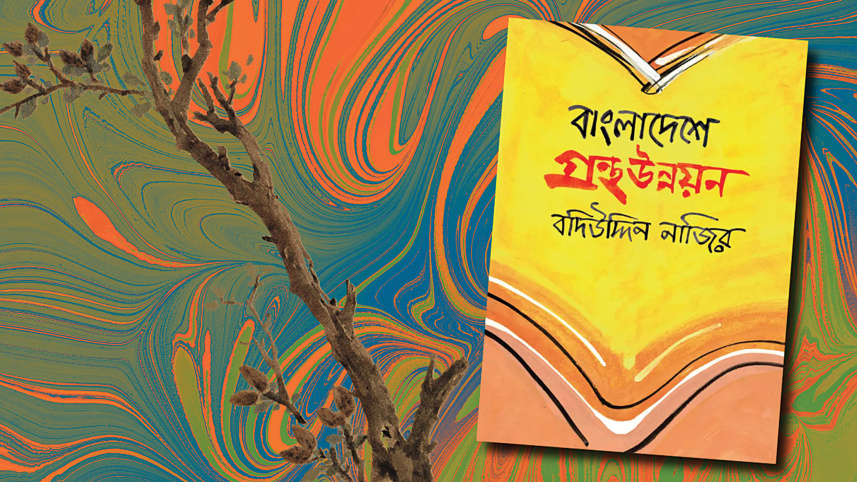
This was not the only little-known story surrounding attempts to absorb the National Book Centre into Bangla Academy. Influential bureaucrats in the parent ministry were reportedly determined to abolish the institution and, on an earlier occasion, had almost succeeded in persuading Ershad to approve the merger. Equally intriguing is the account that the Pir of Atroshi intervened and urged Ershad to resist such efforts. Although the military ruler initially agreed with his revered pir, bureaucratic pressure nearly prevailed—until the publication of the poem altered the outcome. These stories, among many others, are revealed in the newly published book Bangladeshe Grontho Unnayan.
 For all latest news, follow The Daily Star's Google News channel.
 Few in Bangladesh, if any, have attempted to make the complex world of books and publishing so accessible to a broad readership. The third and latest volume in a remarkable three-part series has now reached the market, offering detailed analysis and vivid accounts of every stakeholder in the book ecosystem—authors, publishers, booksellers, librarians, readers, organisers of reading movements and book fairs, as well as government and private policymakers. In contemporary Bangladesh, perhaps no one is better suited to undertake such a project than the noted bibliophile Badiuddin Nazir. As with the previous two volumes, Kathaprakash has published his latest work, Bangladeshe Grontho Unnayan, which arrived in bookstores only last week.
Nazir’s first book, Boi Prokashe Lekhoker Prostuti (Kathaprokash, 2022), earned widespread acclaim among both aspiring and established writers. The third impression of its second edition is now available—an uncommon achievement for a specialised work outside the genres of fiction or biography. Readers were likely drawn to the author’s engaging prose, lucid language, and wealth of lesser-known information.
The book also presents a continuous narrative of the origins and evolution of the Ekushey Book Fair, which has since become one of Bangladesh’s most emotionally and politically significant cultural events. Nazir reminds readers that concerns now voiced about factional aggression and intimidation, known as “mob culture”, at the fair were also present even in the years immediately following independence.
The second volume, Bangladeshe Grontho Prokashona (Kathaprokash, 2025), stands as an invaluable chronicle of the country’s publishing sector. Although publishing is often described as an “industry”, the book explains why it has yet to mature into one in the fullest sense. Tracing the history of Bengali book printing in this region, Nazir recounts how publishing began in Dhaka and gradually evolved over time. By examining the experiences of East Bengal during the British period, East Pakistan, and later Bangladesh, he highlights the structural weaknesses, recurring crises, and enduring limitations of the publishing world. The book also documents the initiatives, achievements, and setbacks of four pioneering figures in Bangladeshi publishing: Haji Mohiuddin Ahmad, Mohammad Moslem Khan, Chittaranjan Saha, and Mohiuddin Ahmad.
This three-volume series on books—described by some as a trilogy—is neither purely academic research nor straightforward memoir. Rather, it is a compelling synthesis of both. Richly supported by research and documentation, the books avoid the distortions and gaps that often accompany memory-based narratives, while retaining the readability and narrative flow of autobiographical writing.
The newly published Bangladeshe Grontho Unnayan uncovers many fascinating behind-the-scenes stories about important government decisions. Why, for instance, was the National Book Centre established in Gulistan rather than another site proposed by the Ministry of Land in Segunbagicha where Matsya Bhaban now stands? Throughout the volume, Nazir offers firsthand observations on the constructive and destructive roles played by governments, policymakers, academics, and publishing leaders in shaping initiatives such as the National Book Policy and library-centred reading movements.
The book also presents a continuous narrative of the origins and evolution of the Ekushey Book Fair, which has since become one of Bangladesh’s most emotionally and politically significant cultural events. Nazir reminds readers that concerns now voiced about factional aggression and intimidation, known as “mob culture”, at the fair were also present even in the years immediately following independence. He recounts incidents such as attacks on the US stall accompanied by anti-American slogans, as well as controversies surrounding the inclusion or exclusion of prominent poets and writers from events such as poetry recitals and seminars.
Another major theme running through the book is the author’s disappointment over the government’s abandoned plans to expand public libraries at the upazila level. Throughout his writings, Nazir conveys a strong sense of urgency about cultivating a book-oriented society while simultaneously strengthening the country’s publishing sector. At a time when the present government appears to be considering new initiatives to promote books and reading, the experiences and insights documented in this volume deserve close attention from policymakers.
Kamal Ahmed is consulting editor at The Daily Star. He led the Media Reform Commission under the interim government. His X handle is @ahmedka1.
Comments