


Eight wins for ‘Dui Shaw’, Nuhash Humayun responds with gratitude

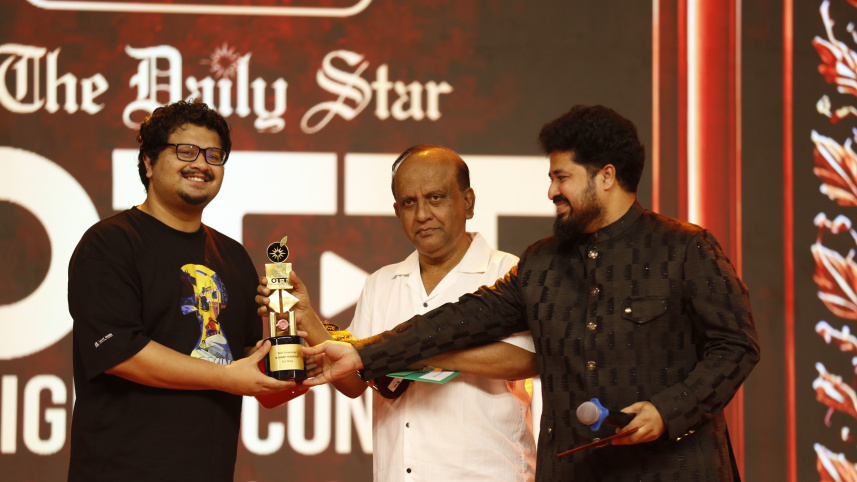
Nuhash Humayun’s “Dui Shaw” swept the Critics category, winning all eight awards, including Best Director, at the Blender’s Choice–The Daily Star OTT & Digital Content Awards 2025. Despite earning numerous international accolades, the filmmaker was pleasantly surprised by the overwhelming recognition his psychological horror series received at home.
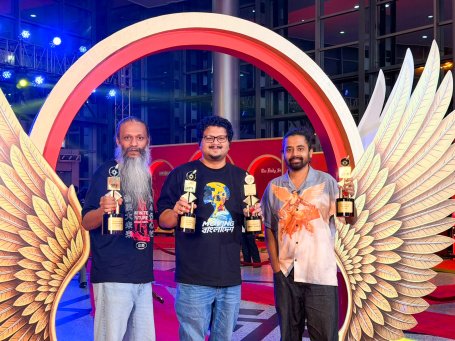
In an interview with The Daily Star, the director discusses the popularity of the “Shaw” franchise, the technical efforts behind bringing “Dui Shaw” to life, and collaborating with his mother, writer Gultekin Khan, on the screenplay.

“Most of the awards I have won are from international festivals. But receiving awards in Bangladesh feels great because it is really special. I don't expect much from Bangladeshi award shows because the industry is small and everybody knows everybody, so there can be biases. I knew we might win something because we make unique work, but the result was still surprising and nice,” he said.
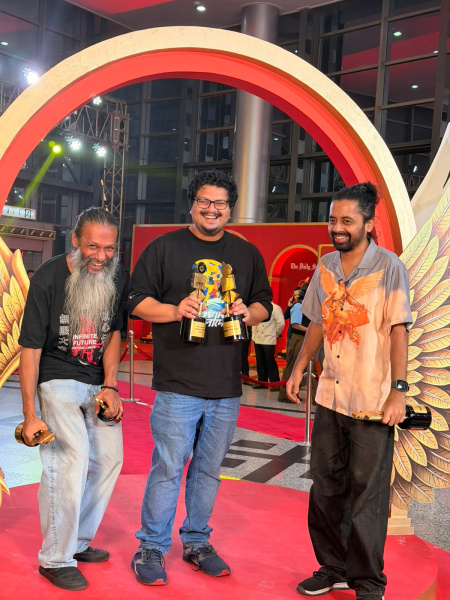
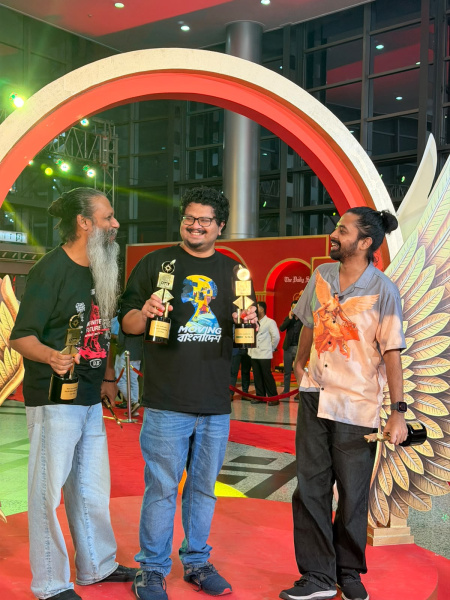
For Nuhash, the awards were also an opportunity to reunite with the team behind “Dui Shaw”, a project that took more than a year to complete. “Seeing everyone again after all that time, sharing the joy and bringing some closure to the project, was really nice,” he said.
The recognition follows the international journey of the “Shaw” franchise. The first season, “Pett Kata Shaw”, premiered at the International Film Festival Rotterdam (IFFR), while “Dui Shaw” was screened at the South by Southwest (SXSW) Film Festival in Austin, Texas.
Yet, some of Nuhash’s most cherished responses have come from audiences beyond festival screenings. He recalled meeting a Bangladeshi family in Texas who had rented a cabin for the weekend to binge-watch both seasons with their cousins.
“They said it had become an unforgettable memory. That is the kind of thing I really cherish,” he shared, adding that seeing the series win critical acclaim while becoming part of viewers’ lives was particularly rewarding.
While the Best Director and Best Screenplay awards were gratifying, Nuhash was especially proud of the technical teams recognised for their work in costume design, sound design and editing. Horror, he explained, leaves little room for technical errors.
“With horror, everything has to be absolutely on point. Even a small mistake in the makeup can turn a scene from horror into comedy. Every department has to work together to make the experience believable,” he said.
When “Pett Kata Shaw” was first conceived, exploring horror on screen was a major risk, despite Bangladesh’s rich tradition of folk tales and supernatural stories.
“There is so much potential in Bangla horror, but when we started shooting ‘Pett Kata Shaw’, we were unsure whether it would work. There was an electrifying energy on set amid all that uncertainty,” Nuhash recalled.
By the time they made “Dui Shaw”, the team had gained confidence, making it easier to bring established actors on board, including Jaya Ahsan in a cameo and Mosharraf Karim in a prominent role.
For Nuhash, horror is not simply about frightening audiences; it can also explore social realities. The episode “Bhaggo Bhalo”, which earned Mosharraf Karim the Best Actor award, was filmed in Korail during the July uprising. As helicopters flew overhead and fires broke out, the unfolding events blurred the boundaries between the fictional story and reality.
“It was a strange experience, almost like a mixture of reality and fiction,” he recalled. The episode explores power and the consequences of one person taking control. For Nuhash, the violence and gore in the “Shaw” franchise serve a thematic purpose rather than existing merely for shock value.
The production also presented technical challenges. One of the most difficult sequences was the chainsaw scene in “Waqt”. To avoid using a real blade, the team attached a Styrofoam replacement to an electric chainsaw. However, its speed still posed a risk, requiring several crew members to carefully control the equipment around actor Rizvi Rizu. The heat in Bangladesh also made special-effects makeup difficult to maintain, often requiring repeated applications during filming.
Another highlight was the screenplay, which Nuhash co-wrote with his mother, writer Gultekin Khan. Working from the United States while she was in Bangladesh, they exchanged ideas through emails and calls, even writing dialogues together.
“Beshura” proved particularly challenging, drawing inspiration from Satyajit Ray’s “Hirak Rajar Deshe” and “Goopy Gyne Bagha Byne”. Gultekin’s poetry-writing experience helped shape its distinctive dialogue.
The episode also featured “Amra Koshai”, a song Nuhash imagined as a rap track. Although his mother initially asked for references to understand the genre, she soon found its rhythm and wrote the lyrics. Pritom Hasan composed the song alongside the series’ other original tracks.
From taking a chance on horror to earning critical acclaim at home and abroad, the “Shaw” franchise has demonstrated the potential of Bangladeshi supernatural storytelling. For Nuhash, however, its success is measured not only in awards, but also in the collective effort behind the work and the memories it creates for audiences.
 For all latest news, follow The Daily Star's Google News channel.
Comments