


How negligence and lack of law enforcement led to Sitakunda tragedy
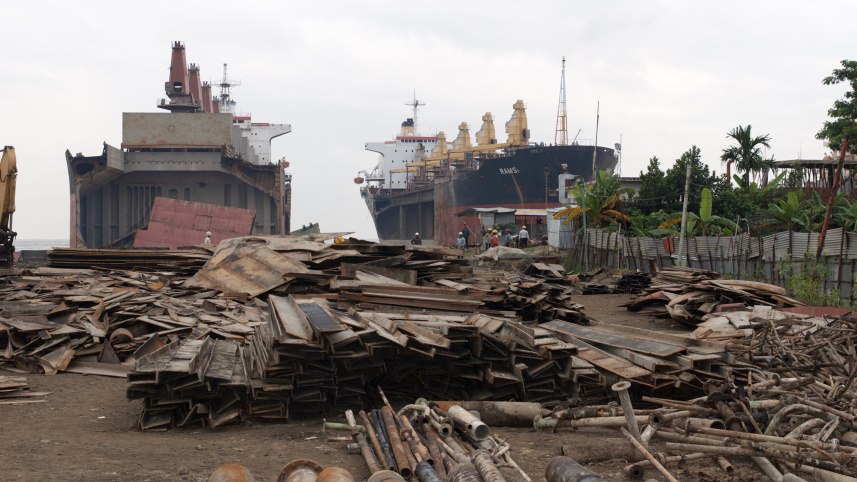
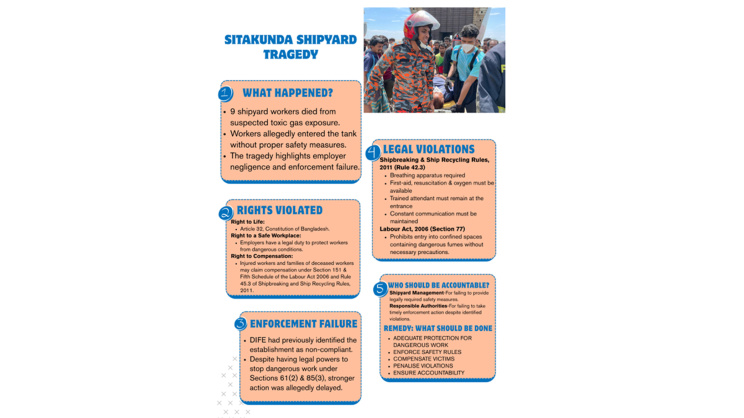
The death of 9 ship breaking yard workers at Sitakunda has left the nation in a shock. It is primarily suspected that the exposure to toxic gas inside a confined tank onboard the vessel has led to this tragedy. Allegedly, the yard management sent the workers inside the tank without taking any precautionary measure for venting and cleaning the tank slowly.
In June 2023, Bangladesh became a party to the Hong Kong International Convention for the Safe and Environmentally Sound Recycling of Ships. The Convention came into force on 26 June last year. The object of the Convention was to ensure safe recycling without posing threat to human health and environment. Yet, there have been 84 accidents since 26 June, leaving 15 workers dead and many more injured.

The Ship Breaking and Ship Recycling Rules (SBSR Rules), 2011 (under Bangladesh Ship Recycling Act, 2018) specifically addresses the situation that arose in Sitakunda ship breaking yard. The Rule requires adequate measures to be taken to guard the worker against the danger when they are required to enter an area in which toxic or harmful substance may be present. Under rule 42.3, when the worker is in the confined space, he should be equipped with facilities and equipment like breathing apparatus, first aid kit, and resuscitation and oxygen should be readily available for rescue purposes. Furthermore, a fully trained attendant should stay at or near the opening, with whom the worker can maintain communication constantly. Similarly, the Bangladesh Labour Act (BLA), 2006, under section 77, strictly prohibits entry into confined spaces (including vessels) containing dangerous fumes unless precautionary measures have been taken. Apparently, none of these provisions were complied with in this case. The negligence of the ship breaking yard’s management is obvious.
Not to mention, every life is precious; its value cannot be calculated in terms of money. However, the injured workers and the families of deceased, being victims to this tragic incident, have the right to obtain compensation from the employers of the ship breaking yard. The BLA provides for compensation for the injured workers and the families of deceased workers under section 151 read with 5th schedule. Section 309 also lays down the penalty for breach of the law with dangerous consequences, which may extend to 4 years’ imprisonment along with fines up to one lac taka in case of death of the workers. Similarly, the SBSR Rules also provide for compensation and strict penal provisions in case of death of the workers due to established negligence (rule 45.3).
To claim the aforesaid remedies, the aggrieved parties (i.e. injured workers and the dependents of the deceased workers) can file a case before the Labour Court for civil compensation as well as penal action against the employer of the ship breaking yard. Again, under the SBSR Rules, the ship-recycler would be bound to pay ex-gratia compensation to the next kin of the deceased. The Ship Breaking and Recycling Board (SBRB) can also, on its own, initiate a penal action against the ship breaking yard owner based on the inquest report of the accident.
Ship breaking has been described by International Labour Organisation (ILO) as one of the world’s most dangerous jobs. It also involves a non-natural use of the land with the potential to cause extensive damage to the people and the environment. Consequently, the principle of strict liability obviously comes into play, imposing extremely high duty of care on the defendant. In other words, a person or a company may be held liable for any injury even if he/she was not negligent or did not intend the harm. Thus, in this case, the victims and the families of the deceased workers can claim damages for tortious liability against the employer of ship breaking yard by filing a suit before the Civil Court. However, if they choose to obtain remedies from Civil Court, they will not be able to claim compensation from the Labour Court.
Surprisingly, the Chattogram Branch of Department of Inspection for Factories and Establishments (DIFE), despite finding the establishment non-compliant earlier in February, filed a case before Chattogram Labour Court only a month ago. Although the Labour Inspectors are empowered, under sections 61(2) and 85(3) of the BLA, to prohibit the employment of any person or the use of any building, plant or machinery which may cause imminent danger to human life or safety, they felt complacent issuing warning letters and reminders until July 15. Thus, the ship breaking yard was allowed to run on hazardous conditions for more than six months.
Again, we have judicial precedent for public law compensation against statutory bodies which can be made applicable in Sitakunda’s case as well. In CCB Foundation v Bangladesh (2016) case, the High Court Division (HCD) recognised the doctrine of constitutional tort where a child named Jihad fell into an uncovered deep shaft left unattended by the Railway authority. The Court held the inaction, negligence and failure of Bangladesh Railway and the Fire Service and Civil Defence to rescue Jihad a violation of the fundamental right to life guaranteed under Article 32 of the Constitution. Importantly, it rejected the argument of sovereign immunity for the acts of state authorities, and directed payment of compensation to the deceased Jihad’s family. Under the same principles, a writ petition against the state authorities responsible for inspection and policing the activities, i.e. DIFE and SBRB can be filed before the HCD for their laxity in enforcing the law.
Indeed, there was negligence on part of the ship breaking yard’s management. But as the facts reveal, the authorities too failed to take a prompt measure which could have saved the workers from the accident. So, if the owners are argued to be negligent, can’t we say the same for the state authorities as well?
The writers are Law Desk Assistant and Law Desk Intern of the Law & Our Rights, The Daily Star, respectively.

 For all latest news, follow The Daily Star's Google News channel.
Comments