


Crimes against humanity
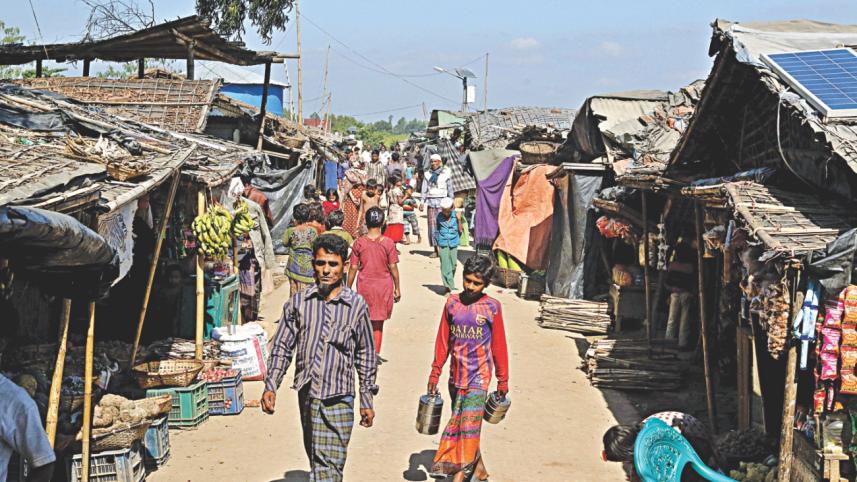
Military actions against Myanmar's Rohingya minority may amount to crimes against humanity, Amnesty International said, as the government called a meeting of regional leaders to discuss the issue.
"The Myanmar military has targeted Rohingya civilians in a callous and systematic campaign of violence," Rafendi Djamin, Southeast Asia director for the rights group, said in a statement yesterday.

"The deplorable actions of the military could be part of a widespread and systematic attack on a civilian population and may amount to crimes against humanity."
The fate of Rohingya minority took centre stage as regional ministers held crisis talks over a security crackdown that has drawn rare criticism from neighbouring nations.
More than 27,000 Rohingya have reportedly fled northwestern Myanmar for Bangladesh since the start of November to escape a heavy-handed counterinsurgency campaign.
The exodus has sparked a rare dispute within the Association of Southeast Asian Nations (ASEAN), the 10-member bloc that prides itself on consensus diplomacy and non-interference.
Foreign ministers from the bloc yesterday met in Yangon for an emergency talks, a gathering Malaysia said was the result of pressure building on Myanmar to resolve the crisis.
"Constant pressure from both the international community as well as Malaysia has led us to this point and to the retreat to be held," Malaysia's Foreign Minister Anifah Aman said ahead of the talks.
Anifah also urged full humanitarian access to the locked-down area, where more than 130,000 people have been without aid for two months.
He warned the crackdown could trigger a repeat of last year's boat crisis, when thousands of starving Rohingya were abandoned at sea by traffickers as they tried to flee southwards to Malaysia.
"We believe that the situation is now of a regional concern and should be resolved together," he told the meeting, according to a statement from Kuala Lumpur.
"Myanmar must do more in trying to address the root causes of this problem."
Malaysia called for an independent ASEAN-led investigation into the allegations of army abuse.
NEW WAVE OF ANGER
The latest crackdown in Rakhine generated a fresh wave of public anger, particularly in Malaysia, where tens of thousands of Rohingya eke out tough and often dangerous lives as undocumented workers.
Earlier this month Malaysian Prime Minister Najib Razak accused Myanmar's de facto leader Aung San Suu Kyi of allowing "genocide" on her watch -- an unusually strong rebuke by one ASEAN state of another.
Myanmar, which has vehemently denied the allegations of abuse, responded by angrily summoning Malaysia's ambassador and banning its workers from going to the country.
At yesterday's talks, ministers warned of the risk of a "spillover effect on Myanmar's neighbours in terms of security and stability" from the Rakhine violence, a diplomat told AFP.
Ministers also took aim at Nobel laureate Suu Kyi for not doing more to rein in the military, which still has a quarter of parliament seats and controls key levers of power in her elected government.
"Her hands are tied because of the military, but she has to shoulder her responsibility as a leader of Myanmar," said the diplomat, who asked not to be named.
Suu Kyi has pleaded for time and international understanding over the incendiary issue.
 For all latest news, follow The Daily Star's Google News channel.
 In a statement after yesterday's meeting, Suu Kyi said talks were "candid and transparent" but also "emphasised the importance of strengthening ASEAN unity and resolving the differences between ASEAN family members".
Myanmar has also faced a cascade of criticism from outside the region over the Rohingya crisis, including from the United States and the United Nations.
Last week, UN rights commissioner Zeid Ra'ad Al Hussein criticised the government's "callous" handling of the crisis, describing it as "a lesson in how to make a bad situation worse".
Ong Keng Yong, a former secretary-general of ASEAN, said neighbouring nations feared the Rohingya crisis could spiral.
"This kind of issue, if it's not well managed, will impact on the general picture of our peace and security in ASEAN," he told AFP.
'ETHNIC CLEANSING'
Between 76 to 400 Rohingya have been killed in a military crackdown since October 9 attacks on police stations left nine officers dead.
Myanmar says at least 93 people -- 17 police officers and soldiers and 76 alleged "attackers" (including six who reportedly died during interrogation) -- have been killed and some 575 suspects arrested.
Rohingya advocacy groups, however, claim about 400 Rohingya -- described by the United Nations as among the most persecuted groups worldwide -- have been killed in the military operations, women have been raped and Rohingya villages torched.
Malaysian Foreign Minister Anifah Aman said events in Rakhine state were a matter of regional security and stability, noting that about 56,000 Rohingya now live in Muslim-majority Malaysia having fled previous unrest in Myanmar.
Malaysia has heavily criticised Myanmar's government and military over the violence, with Najib Razak and his cabinet referring to it as "genocide" or "ethnic cleansing".
"Many analysts are expecting ASEAN leaders to push for some of the things that the international community has been asking for, the most important of which is the full resumption of aid to Rakhine state where an estimated 160,000 people are in need of aid," Al Jazeera's Florence Looi said, reporting from Kuala Lumpur.
Myanmar has denied the accusations, saying many of the reports are fabricated and it insists the strife in Rakhine state is an internal matter.
In addition to fending off diplomatic pressure over the crisis, the Myanmar government has also invited a handpicked media delegation to visit the affected region this week.
Amnesty cautioned that the scale and extent of the violence is unclear, as the military has closed Rakhine to outside observers, including aid workers. But witness accounts detail specific cases of murder, looting and rape.
In one incident on November 12, following an alleged skirmish between the army and villagers armed mostly with swords and other simple weapons, helicopter gunships descended on a village and sprayed bullets indiscriminately, killing civilians fleeing in a panic, Amnesty said.
This was corroborated to an extent by Myanmar army officials, who said helicopters opened fire that day and killed six people, who officials said were "insurgents".
Refugees told Amnesty that the military is torching villages. Satellite images Amnesty obtained show 1,200 burned structures, which they say is in line with images released by Human Rights Watch in November that showed 1,500 burned homes.
Comments