


Tariff cuts, FTAs could add $4b to Bangladesh economy: WB
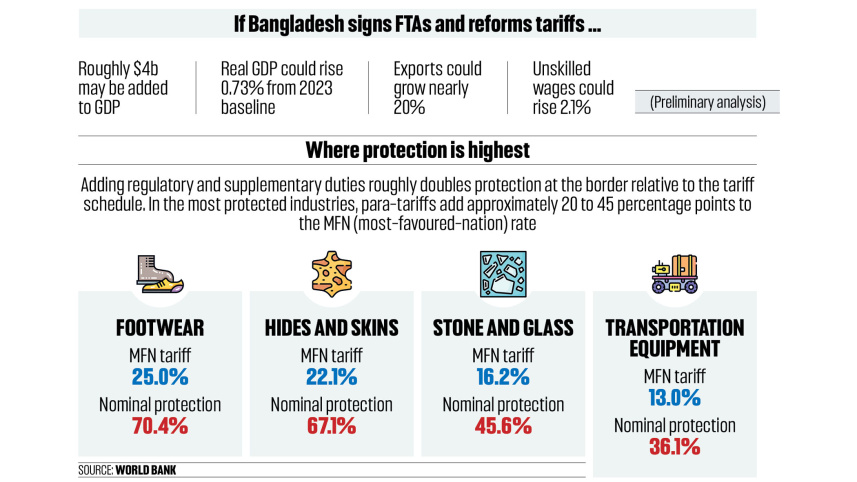
Bangladesh could unlock roughly $4 billion in additional economic output by making imported materials and other goods used in production cheaper for local industries and securing better market access through free trade agreements (FTAs), according to a preliminary World Bank analysis.
The country could also lose roughly $1.1 billion in economic output if it loses existing trade preferences after graduating from the least developed country (LDC) category without securing replacement arrangements, the WB estimates.

The findings come from the study “Bangladesh Trade Policy at a Crossroads: Evidence for the National Tariff Policy, LDC Graduation, and the Next Generation of Trade Agreements,” presented at an event hosted by the Policy Research Institute of Bangladesh (PRI) in Dhaka yesterday.
The study comes as Bangladesh prepares to graduate from the LDC category on November 24 this year. The government has sought to defer the graduation by at least three years. An initial decision on the deferment is expected later this month.
THE GAINS
The potential gains, WB estimates, would come from two sets of reforms.
Deeper cuts in tariffs on imported intermediate goods and the removal of additional import duties could raise real GDP by up to 0.52 percent, as per the report.
Intermediate goods are products that businesses use to make other products. They include raw materials, components and other goods used in production.
Separately, a broad FTA strategy with major trading partners could raise real GDP by 0.73 percent, or about $3.2 billion. The analysis assumes that the agreements would be as comprehensive as those signed by Vietnam.
About two-thirds of the gains from the FTA strategy could come from deeper agreements with countries in the Regional Comprehensive Economic Partnership (RCEP) and the Association of Southeast Asian Nations (ASEAN), the WB said.
THE LOSS
The World Bank warned that the cost of inaction could be significant.
If existing trade preferences disappear without replacement arrangements, real GDP could fall by 0.24 percent, or roughly $1.1 billion, according to the analysis.
The losses could be greater if Bangladesh takes no action while rival exporters secure deeper market access.
In that scenario, GDP could fall by a further 0.21 percent. Total exports would decline by 2.48 percent and wages of unskilled workers by 0.83 percent.
HIGH PROTECTION AT HOME
The study also highlights the high level of protection given to domestic industries through Bangladesh’s import tariff system.
Bangladesh’s trade-weighted average most-favoured-nation (MFN) tariff, or standard import tariff, is 7 percent across 5,666 tariff lines. But the level of protection rises to 15.4 percent when additional duties, known as para-tariffs, are included.
Protection is particularly high in some sectors. For instance, footwear faces total tariff protection of 70.4 percent. For hides and skins, the figures are 67.1 percent and 22.1 percent respectively.
TARIFF CUTS ALONE NOT ENOUGH
 For all latest news, follow The Daily Star's Google News channel.
 Economists and industry players agreed that reducing tariffs is necessary, but warned that it would not by itself make Bangladeshi industries competitive in export markets.
MA Razzaque, chairman of the Research and Policy Integration for Development (RAPID), said weak domestic standards and trade infrastructure also shield local industries from foreign competition.
“Dismantling tariff barriers is not going to automatically generate export competitiveness, given the weak domestic standards we have,” he said.
Zaidi Sattar, chairman of PRI, said the tariff structure creates a strong incentive for businesses outside the ready-made garment sector to sell in the domestic market rather than export.
“The divergence between the profitability of exports and domestic sales is not marginal. It is highly significant and creates a very strong disincentive to export,” he said.
Sattar backed lower tariffs on imported inputs as well as final goods. “Unless you do that simultaneously, you are only increasing the effective rate of protection, which means you are intensifying the anti-export bias.”
He described the gap as a “crocodile tariff” and said para-tariffs accounted for roughly half of total protection.
Md Fazlul Hoque, administrator of the Federation of Bangladesh Chambers of Commerce and Industry (FBCCI), said tariff reform must be accompanied by measures to address weaknesses in energy, infrastructure and access to finance.
“Tariff reform is one part of many other reforms. It is not the only thing that can change the whole game,” he said.
FTAs OFFER OPPORTUNITIES, BUT WITH CONDITIONS
Razzaque questioned whether the potential gains would be enough to persuade policymakers to undertake difficult reforms.
He also cautioned that the benefits of FTAs would depend on what Bangladesh secures in negotiations with individual trading partners.
Fazlul called for greater consultation with the private sector, including small and medium-sized enterprises, before Bangladesh signs new trade agreements.
Selim Raihan, executive director of the South Asian Network on Economic Modeling (SANEM), said export diversification would be crucial for Bangladesh to benefit from FTAs.
“Some of this growing protectionism at the global scale also gives them some kind of comfort zone… not to really go for drastic reform in the trade policy,” he said.
He said Bangladesh would need to diversify its export basket to make better use of new market access.
IMPLEMENTATION, REVENUE REMAIN CONCERNS
Selim said weak implementation capacity could undermine trade-policy reforms. “We are very good at talking and formulating policies, but the implementation capacity is low.”
He called for lower para-tariffs and stronger capacity to meet non-tariff requirements, including sanitary and phytosanitary standards. He also urged better coordination among trade, industrial and exchange-rate policies.
Fahmida Khatun, distinguished fellow at the Centre for Policy Dialogue (CPD), cautioned that not all supplementary duties were necessarily protectionist, as some serve health, environmental and revenue purposes.
“The FTA gains are attractive, but they represent an ambitious upper bound, given the realities,” she added.
She called for greater clarity on the revenue impact of tariff reform and urged policymakers to distinguish between legitimate bonded-warehouse facilities and opaque, firm-specific exemptions.
Fahmida also warned that aggregate economic gains would not show who bears the costs of adjustment.
“Aggregate gains do not reveal who gains, who loses and how quickly the adjustment occurs,” she said.
Comments