


Defiant May vows to stay as PM
"We will fulfil the promise of Brexit.... I will now form a government, a government that can provide certainty and lead Britain forward at this critical time for our country.”
Theresa May

It was supposed to be the Brexit Election.
When Theresa May announced back in April she was calling a risky snap election, three years before it was necessary, she invited British voters to increase her Conservative government's majority and give her the strengthened mandate she needed to go into Brexit talks and get a good deal for the country.
It was a battle between what she defined her "strong and stable" leadership and a "coalition of chaos" under her opponent, the Labour leader Jeremy Corbyn.
In the end, it was the Brexit Election -- just not in the way everyone predicted.
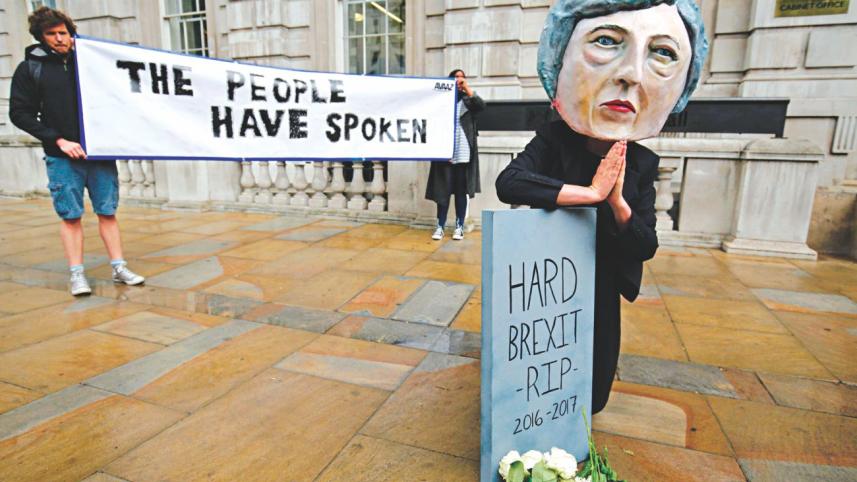
Having pledged to be the strong prime minister fighting for Britain in the negotiating room in Brussels, May appears to have lost her majority because of voters rejected the type of Brexit she had proposed.
She had set out a plan for a "hard Brexit", with Britain severing almost all ties with the European Union. Instead, voters preferred the "softer Brexit" proposed by Labour under Jeremy Corbyn, or the "no Brexit" line touted by the Liberal Democrats, still fighting the cause for Remain.
However, a defiant May vowed to form a new government to lead Britain out of the EU despite losing her majority and facing calls to resign.
"What the country needs more than ever is certainty," May said after the shock outcome of Thursday's vote.
Although winning the most seats, her centre-right party lost its majority in parliament, meaning it will now rely on support from Northern Ireland's Democratic Unionist Party (DUP).
Sterling plunged against the dollar and the euro yesterday as the election result created even more uncertainty over the whole Brexit process.
But May vowed to "fulfil the promise of Brexit", in a statement outside her Downing Street office after seeking permission from the head of state Queen Elizabeth II to form a new government.
"I have just been to see Her Majesty the Queen and I will now form a government -- a government that can provide certainty and lead Britain forward at this critical time for our country," she said after returning from Buckingham Palace to her Downing Street office.
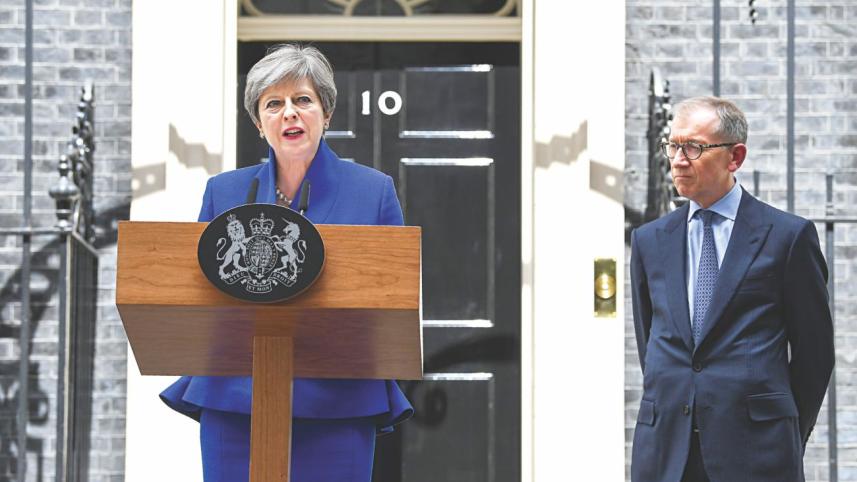
She also said, "It is clear that only the Conservative and Unionist Party has the legitimacy and ability to provide that.
"This will allow us to come together as a country and channel our energies towards a successful Brexit deal."
She also confirmed she would keep her senior ministers in the same posts, according to AFP.
May made no reference to her party's damaging losses, leading the Evening Standard, edited by former Tory finance minister George Osborne, to splash the front-page headline "Queen of Denial".
'LOST CONFIDENCE'
Corbyn, whose Labour party surged from 20 points behind in the opinion polls, told May to quit, saying she had "lost votes, lost support and lost confidence".
 For all latest news, follow The Daily Star's Google News channel.
 Labour has picked up the support of two crucial groups of voters: Leave supporters in the north of England who at the 2015 election had backed the anti-EU party Ukip, and Remain voters in the south of England who switched from both Conservatives apparently in protest at Brexit.
Barely a month ago, Corbyn's centre-left party seemed doomed to lose the election, plagued by internal divisions over its direction under the veteran socialist.
But May's botched announcement of a reform in funding for elderly care, plus a strong grassroots campaign by Corbyn which energised the youth vote, gave him momentum.
With all but one constituency declared, the Conservatives won 318 seats -- short of the 326 needed for an overall majority and down from 331 at the 2015 election -- while Labour was on 261, up from 229.
May, a 60-year-old vicar's daughter, is facing questions over her judgement in calling the election three years early and throwing away her party's slim but stable working majority of 17.
She has faced calls to quit from within her own party, with Anna Soubry saying she should consider her position after a "disastrous" campaign.
However, other MPs have urged her to stay on, with Iain Duncan Smith saying a leadership contest would be a "catastrophe".
Labour said they were the "real winners" while the Lib Dems said May should be "ashamed" of carrying on.
The Conservatives and the pro-Brexit DUP are expected to team up on a vote-by-vote basis rather than enter a formal alliance after the result left Britain with a hung parliament.
DUP leader Arlene Foster confirmed that she had spoken to May and that they would speak further to "explore how it may be possible to bring stability to this nation at this time of great challenge", writes BBC.
While always striving for the "best deal" for Northern Ireland and its people, she said her party would always have the best interests of the UK at heart.
With the London seat of Kensington yet to declare, the SNP won 35 and the Lib Dems 12. The DUP won 10 seats.
As it stands, the Tories and the DUP would have 328 MPs in the Commons, giving it a wafer-thin majority although as Sinn Fein will not be taking its seven seats, the new administration will have slightly more room for manoeuvre.
The Conservatives have argued in the event of a hung Parliament, May gets the opportunity to form a government first, as her predecessor David Cameron did in 2010 when there was also no clear winner but the party had comfortably more seats than their nearest rival.
Labour has said it is also ready to form a minority government of its own, after far exceeding expectations by picking up 29 seats in England, Wales and Scotland.
But even if it joined together in a so-called progressive alliance with the SNP, Lib Dems, Green Party and Plaid Cymru, it would only reach 313 seats -- well short of the 326 figure needed.
'MAYHEM'
The result is "exactly the opposite of why she held the election and she then has to go and negotiate Brexit in that weakened position", said Professor Tony Travers of the London School of Economics university.
Newspapers reflected the political tumult, with headlines such as "Britain on a knife edge", "Mayhem" and "Hanging by a thread".
In a night that redrew the political landscape once again, the UK Independence Party (UKIP) lost millions of voters, triggering the resignation of leader Paul Nuttall.
The Scottish National Party of First Minister Nicola Sturgeon, which has dominated politics north of the border for a decade and called for a new independence vote after Brexit, lost 21 of the 56 seats it won in 2015.
Sturgeon said the result showed that "the reckless Tory pursuit of a 'hard Brexit' must now be abandoned."
May, who took over after the June 2016 Brexit referendum, began the formal two-year process of leaving the EU on March 29, promising to take Britain out of the single market and cut immigration.
Officials in Brussels were hopeful the election would allow her to make compromises, but this has been thrown into question by the prospect of a hung parliament.
"It creates another layer of uncertainty ahead of the Brexit negotiations," said Craig Erlam, senior market analyst at OANDA currency traders.
Comments