


Girls outshine boys

Girls have outperformed boys in all scales in primary and junior school certificate exams this year.
From their participation and success rate to achieving the highest grade, they are well ahead of their counterparts, according to results of the public examinations published yesterday.

For the last several years, girls' performance in class-V and class-VIII terminal exams had an upward trend with them lagging behind in one or two scales, but this year they outshone boys on all counts.
In primary terminal examinations, 98.51 percent children came out successfully, which is close to the last year's pass rate -- 98.52 percent. The number of GPA-5 (Grade Point Average) achievers rose to 2,81,898 from 2,75,980 last year.
The success rate in Ebtedai (primary level of madrasa) examinations, held along with the primary-level exams, is 95.85 percent.
In Junior School Certificate (JSC) exams, the pass rate hit a record high of 92.89 percent with 2,35,059 students securing GPA-5 under eight general education boards across the country, up by 47,557 from last year.

The pass rate in Junior Dakhil Certificate (JDC) examinations is 92.46 percent.
The combined pass rate of JSC and JDC in eight general boards and one madrasa board beat previous records with 93.06 percent students being successful. The pass rate was 92.33 percent in 2015.
Schools across the country had a festive look yesterday. Students got their results from their schools, websites and through text messages.
GIRLS OUTSHINE BOYS
A total of 15,40,439 girls and 12,90,295 boys took the primary terminal exams this year. The pass rates of girls and boys are 98.56 and 98.44 percent.
When it comes to the highest achievement, 25,674 more girls achieved GPA-5 than boys.
A similar picture is there in JSC exam results.
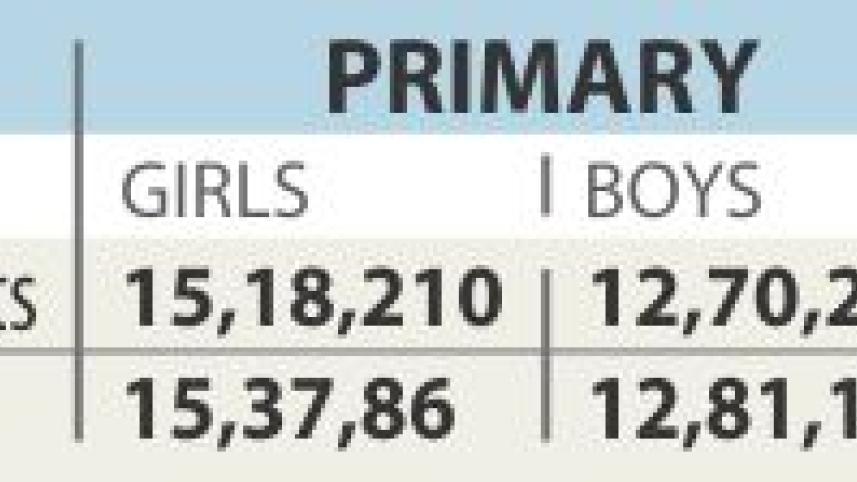
A total of 10,61,362 girls and 9,31,954 boys took the tests and their success rates are 92.96 and 92.80 percent.
As many as 1,34,388 girls got GPA-5 against 1,00,671 boys.
“Education plays the pivotal role in women empowerment and results of girls make us optimistic,” said Education Minister Nurul Islam Nahid.
Pointing out the reasons, noted educationist Rasheda K Choudhury said girls do well as they are more attentive to their studies.
"Apart from the fact that girls spend more time at home than boys, they are more interested in education.”
Girls get stipends and other facilities from the government, which encourage them to be more sincere in studies. Besides, they need to meet some criteria to get stipends, Rasheda said.
 For all latest news, follow The Daily Star's Google News channel.
 It is worrying that the drop-out rates of girls increase in higher classes, she said. “This is where the government needs to look into.”
PRIMARY TERMINAL EXAMS
This year, some 29.34 lakh class-V students had registered for the exams conducted by the Directorate of Primary Education. Of them, 28.30 lakh took the tests of six subjects from November 20. Students must pass all the exams to enrol in class-VI.
Except 42,302 students, others passed the exams.
Officials and teachers attributed combined effort of all to the success. They said better care of students by teachers and guardians, and awareness among them of rising competitiveness played a significant role.
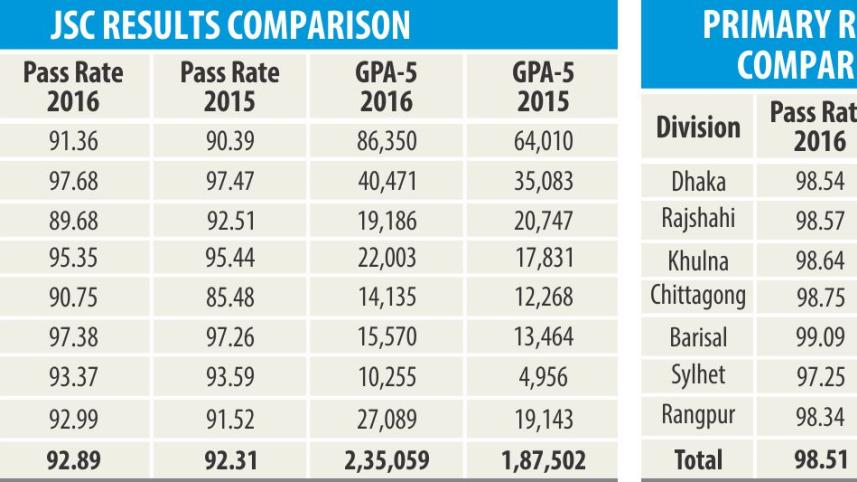
According to the data provided by the primary and mass education ministry, students did well in all six subjects, especially in English and mathematics.
The pass rate in English was 99.27 percent and in mathematics 99.33 percent.
Primary and Mass Education Minister Mostafizur Rahman announced the results formally at a crowded press conference around 1:00pm at his secretariat office in the capital.
Asked if teachers had been instructed to give pass marks, he said, "There were no such instructions.... In my three-year tenure, I didn't give any instruction to increase marks.
"The results were not fabricated.”
Barisal topped the list of seven divisions, with 99.09 percent success rate while Sylhet remained at the bottom with 97.25 percent pass rate.
Like previous years, Munshiganj ranked first among all districts.
More than 95 percent of 4,332 children with special needs, who participated in the exams, passed.
Asked why government schools were lagging behind, the primary education minister said many public schools suffered a shortage of teachers. The ministry would try to appoint teachers to vacant positions next year, he added.
Rasheda K Choudhury stressed the need for more efforts to help students become more competent in all subjects.
JSC EXAMS
This year saw a significant improvement in JSC results.
Apart from the number of examinees and GPA-5 scorers, the number of schools with cent percent pass rate increased while the number of schools with zero pass rate came down.
A total of 19.93 lakh students took the exams, of whom 18,51,496 passed.
And 623 out of 626 students, who sat abroad for the tests from November 1, passed. Of them, 84 obtained the highest grade.
Students have consistently been doing well in JSC exams introduced in 2010.
Like in previous year, the highest number of examinees, 97.68 percent, passed from Rajshahi board. Chittagong board is at the bottom among the eight boards with 90.75 percent pass rate.
Officials and teachers attributed the success to students' better performance in English and maths.
“Usually it's English or maths that makes the difference in the results. Students have done well in these subjects,” said an official of Dhaka board.
Free and on-time textbook distribution, video lectures of best teachers at schools, and use of technology in imparting lessons made it possible, he said.
“Our standards of education have improved, but we still could not achieve the world standards,” Nahid said.
Comments