


Govt Officials’ Performance: AI-driven review in the works

The government plans to replace the manual evaluation method used for civil servants’ annual confidential reports (ACRs) with an artificial intelligence (AI)-driven review mechanism aimed at assessing them on merit, integrity and job performance.
“The prime minister wants to place the administration’s best officers in responsible positions. At present, it is difficult to select qualified candidates in the absence of a sound method. That is why work is underway to devise a new system,” Abdul Bari, state minister for public administration, told The Daily Star.

His ministry has drafted a proposal for introducing a digital peer review mechanism involving up to 45 superiors and subordinates to evaluate each officer, replacing the current method in which only two supervisors carry out the evaluation.
Under the existing manual ACR system, an officer scoring between 85 and 100 is rated “excellent”, while one receiving 71 to 84 is graded “good”, and one scoring 50 to 70 is considered “average”. The scores are based entirely on assessments by the officer’s two immediate superiors.
The ACR, a confidential assessment of an officer’s performance, integrity, conduct and leadership, serves as the main basis for promotions, key postings and selection for advanced training.
There have been allegations that the current method fails to reflect true performance as personal preferences or dislikes of two superior officers often affect a subordinate’s ACR score.
Seeking anonymity, several former and current officials in the ministry’s Confidential Report Branch said more than 80 percent of officers get above 90 marks, even though most of them do not deserve such high scores.
To move away from this, the ministry drew up the proposal to make the post-mass uprising civil bureaucracy more dynamic, accountable, efficient, and transparent, said several officials involved in the process.
Policymakers at the public administration ministry believe that if the new assessment model is introduced, it will promote “meritocracy” in the civil bureaucracy in line with the ruling BNP’s electoral pledge.
“Work is underway to carry out necessary administrative reforms in line with our electoral pledge, and the initiative regarding a digital ACR is part of that effort,” Bari told this correspondent recently.
The proposal does not explain how AI will be integrated into the government’s digital civil service platform, the Government Employee Management System (GEMS). It also does not say whether any AI tools will be developed internally or purchased from a private entity for the integration.
GEMS is a centralised digital platform of the ministry, which stores and manages all human resource management data, including personal data sheets (PDS) of civil servants, and information on their leave, promotions, transfers, and online evaluations.
The proposal mentioned that the introduction of the peer review system will reduce reliance on intelligence reports about officers being evaluated.
It also noted that Pakistan significantly curtailed corruption in its revenue sector and boosted revenue by rolling out a peer review system.
HOW WILL IT WORK?
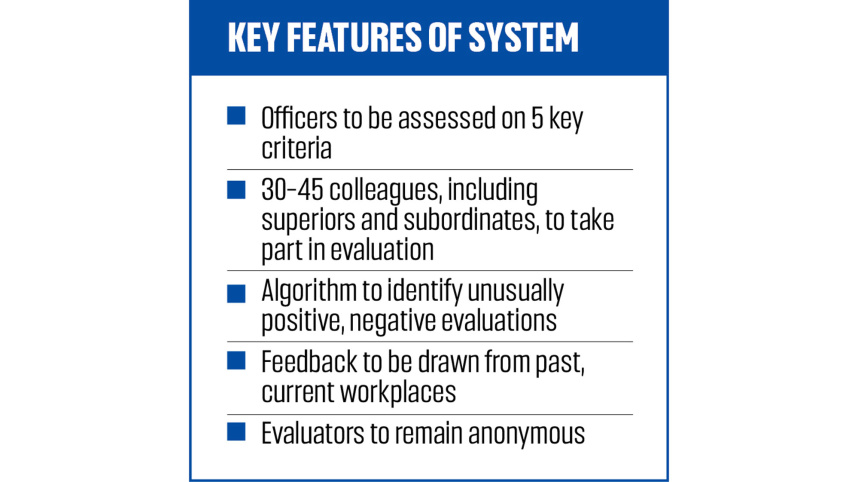
Under the proposed mechanism, an officer will be evaluated by 30 to 45 colleagues -- both superiors and subordinates from former and current offices -- on five key criteria: integrity, official conduct, leadership capacity, political bias and competence.
The evaluators will answer at least 23 questions across the five criteria.
An officer’s integrity will be evaluated first, determining whether the officer is involved in corruption or displays a tendency to please superiors and others.
There will be an assessment of professional conduct towards superiors, peers and subordinates across current and previous workplaces.
Besides, leadership capacity will be gauged by evaluating the officer’s ability to make swift decisions, outspokenness, courage and crisis-resolution skills.
 For all latest news, follow The Daily Star's Google News channel.
 Information will be gathered on whether the officer has campaigned for or against any political party or wielded political influence.
Lastly, professional competence will be assessed by examining the officer’s capacity to make prompt decisions; commitment to simplifying public services; and whether he or she frequently changes decisions.
The evaluations will not involve any human intervention or manual handling. The GEMS module will randomly select 30 to 45 peers or evaluators for each officer every year, using algorithmic logic.
The identity of the evaluators and their feedback will remain strictly confidential and anonymous.
Links will be sent to the designated evaluators to submit feedback. AI will then process and analyse their feedback alongside digital ACR data. Based on the analysis, decisions regarding promotions, postings and training will be made.
The system’s automated algorithm will identify unusually positive or negative reviews submitted out of personal bias or grudges, said officials of the ministry’s Career Planning Wing.
This correspondent spoke to at least seven officers with ranks ranging from deputy secretary to additional secretary across three ministries. Almost all of them supported the initiative but expressed doubts about its implementation.
A deputy secretary at the LGRD ministry said inefficient officers have always wielded considerable influence in the administration, regardless of which party was in power. They are likely to resist the introduction of the new system, as the proposed peer-review mechanism could undermine their dominance.
Citing an example, an officer at the public administration ministry said that more than a decade ago, the then Awami League government moved to implement a new career development mechanism to streamline promotions and postings. However, the initiative could not be implemented due to opposition from a section of influential officials.
Implementation of such initiatives would reduce politicisation in the administration, which is why inefficient officials and those who benefit from the existing system would never want that to happen, the officer added.
Welcoming the government’s move, public administration expert and writer Feroz Mia said, “Fundamental changes can be brought to the administration through the introduction of a peer review system, which will help the government select efficient officers [for promotions and postings].”
However, mere digitisation of the existing system will not bring much benefit, he added.
Comments