


IMED smells graft in Karnaphuli tunnel

The Implementation Monitoring and Evaluation Division (IMED) has identified financial irregularities amounting to Tk 1,616 crore in the Tk 10,689.42 crore Karnaphuli tunnel project, raising serious questions about procurement, cost management, and the tunnel’s long-term viability.
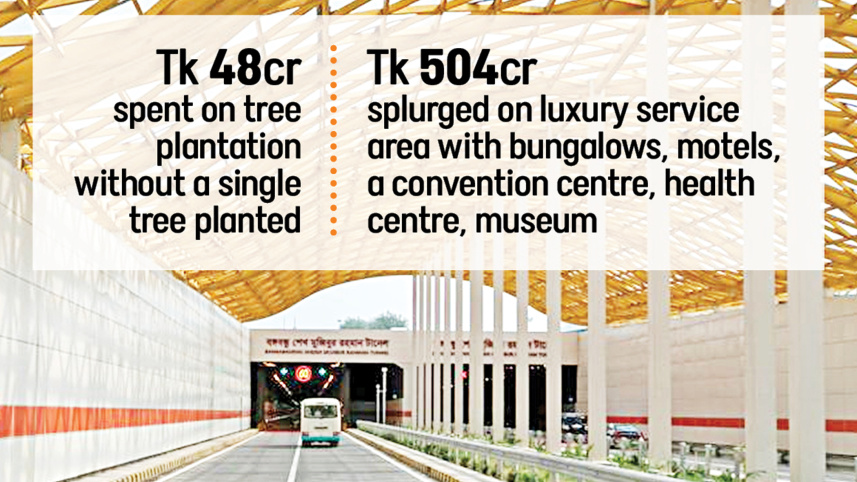
The irregularities include Tk 48 crore spent on tree plantation without a single tree being planted, the government watchdog said in an evaluation report released on Thursday.

The report identified 68 audit objections unresolved over the last three fiscal years, of which 48 were classified as Serious Financial Irregularities.
“As these objections remain unresolved, they pose a severe risk to financial discipline, transparency, and accountability,” the report said.
Among the most glaring findings was the construction of a sprawling service area at a cost of Tk 504 crore, which IMED said was unnecessary and unrelated to the tunnel’s core purpose.
The facility includes bungalows, motels, a convention centre, a healthcare centre, and a museum. IMED said these establishments have no direct road connectivity or meaningful link to the tunnel, describing the expenditure as “sheer wastage and a policy-level irregularity”.
The report also flagged Tk 49.36 crore spent in FY2022-23 on landscaping and tree plantation, although no evidence of such work was found in either the revised Development Project Proforma (DPP) or the final project completion report.
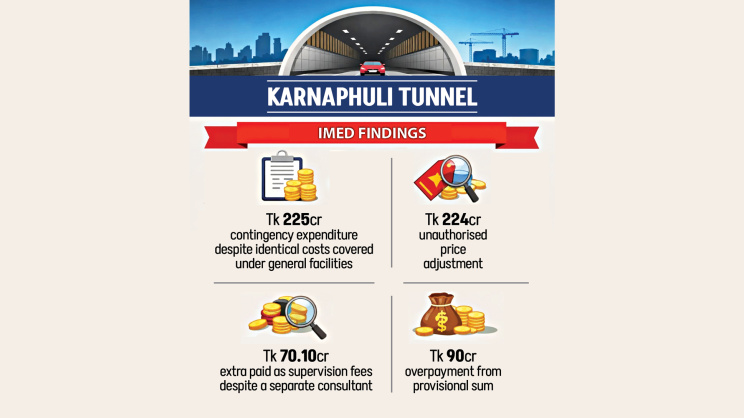
Other anomalies included Tk 225 crore spent under contingency despite similar costs being covered under general facilities, Tk 224 crore in unauthorised price adjustment, Tk 70.10 crore in excess supervision fees despite the appointment of a separate consultant, and Tk 90 crore in overpayments from the provisional sum.
According to the IMED, most of the anomalies stemmed from violations of the Public Procurement Rules, unjustified price adjustments, and breaches of contract terms.
The watchdog called for a prompt investigation into the 68 audit objections and questioned why the project’s final cost rose by 26.56 percent while its implementation period doubled.
The report also criticised weak asset management and administrative oversight. Of the 29 vehicles procured under the project, only six were handed over to the Bridges Division, while the remaining 23 have yet to be disposed of because of red tape.
It further noted that government rules require projects costing more than Tk 50 crore to have a dedicated and experienced full-time project director. Instead, the Karnaphuli tunnel project had four project directors during implementation.
During a crucial phase of the project, the chief engineer of the Bangladesh Bridge Authority served as project director on additional charge for two years, which IMED said disrupted continuity in decision-making.
The Executive Committee of the National Economic Council in November 2015 okayed the project at an initial estimated cost of Tk 8,446.64 crore.
Of the total project cost, Tk 5,913.19 crore came as a loan from the Export-Import Bank of China, repayable over 15 years with a five-year grace period.
TRAFFIC BELOW PROJECTION
The report painted a bleak picture of traffic through the tunnel, warning that the tunnel is losing money.
While the feasibility study projected that 28,305 vehicles would use the tunnel daily by 2025, actual traffic has remained far below expectations. Since the tunnel opened in October 2023, monthly traffic has fallen from around 5,000-6,000 vehicles to between 3,422 and 3,488 in the first months of 2026, the report said.
At present, only around 4,000-4,500 light vehicles use the tunnel each day, just 14 percent of the original projection, while heavy goods vehicles are largely avoiding the route.
As a result, the tunnel is running a daily deficit of around Tk 10 lakh.
 For all latest news, follow The Daily Star's Google News channel.
 Its daily operation and maintenance cost stands at about Tk 22 lakh, against toll earnings of Tk 12 lakh, leaving the government to subsidise roughly Tk 36.50 crore a year.
IMED cautioned against raising toll rates sharply, saying such a move could further reduce traffic because of the “price elasticity of demand”. It warned that a toll hike of 50-100 percent could drive more users away and deepen the financial strain.
ACCELERATE COMPLEMENTARY INFRASTRUCTURE
To improve the tunnel’s commercial viability, IMED recommended accelerating complementary infrastructure and industrial projects around the facility.
These include fast-tracking the Special Economic Zone, the deep-sea port, Karnaphuli Dry Dock, and the Chinese and Korean export processing zones to generate more commercial traffic through the tunnel.
The report also recommended integrating the Dhaka-Chattogram highway with Matarbari port and Cox’s Bazar through the tunnel, rationalising toll rates, and running awareness campaigns to highlight time and fuel savings for commuters.
It further suggested commercialising the Tk 484 crore service area either through private management or the Bangladesh Parjatan Corporation, and developing urban amenities, logistics hubs, and planned settlements near the tunnel to support the “One City, Two Towns” vision for Chattogram.
MILESTONE SHADOWED BY RISK
Despite the irregularities and operational weaknesses, IMED described the Karnaphuli tunnel as a landmark project, noting that it is South Asia’s first underwater tunnel and a major engineering achievement for Bangladesh.
The report said the project has opened up opportunities for industrialisation, investment, tourism, and strategic connectivity with deep-sea ports.
However, it warned that those benefits may remain unrealised unless complementary infrastructure is completed, traffic increases significantly, and operating costs are brought under control.
It also pointed to risks such as accidents at entries and exits, delays in building surrounding infrastructure, and competition from existing road links.


Comments