How old Bengali advertisements sold the dream of fair skin
Kazi Saheb’s dark-skinned daughter was furious. The poet himself could not fathom who had insulted her. The girl was so enraged that she smeared even more ink over her body. She was Kazi Saheb’s proud, resentful daughter. Having provoked her, the poet himself began to weep in sorrow. Moved by his tears, the compassionate girl then threw herself onto the chest of her worshipper.
This immensely popular Shyamasangit (devotional songs dedicated to Goddess Kali) by Kazi Nazrul Islam concludes with the poet himself draping a garland of hibiscus flowers around that dark-skinned girl. But my mind wanders elsewhere. Time and again, I wonder—is this song merely a hymn to Mother Kali? Or does a brutal truth lie hidden within this devotion? It is a truth I observe in line after line of the matrimonial advertisements of yesteryear, where, by market standards, a highly valued bride absolutely had to be beautiful and fair. If she was exceptionally graceful and fair, she was priceless. It was acceptable if the bride had studied only up to the School Final, but the groom's preference remained for a beautiful, fair-complexioned bride. Dangling the bait of a two-storied house in the suburbs of Kolkata, the groom's side would announce: unless she is genuinely fair and beautiful, please do not bother writing to the box number!
Now is the era of matrimonial apps. Everything is digital. Dating app stories are everywhere. Seekers no longer sit down to sift meticulously through newspapers for their desired partners. This section is virtually disappearing from newspapers. Yet, if someone were to pick up an old newspaper and spread out that once impossibly popular matrimonial page before their eyes, they would feel the sigh of countless, infinite Krishnakalis (dark-skinned women) of our Bengal. They had absolutely no value in the marriage market (and still don't). Just like Nazrul’s resentful girl, they refuse even to bind their hair out of pride—no matter how much light they bring into the dark hearts of men by lighting a lamp. Rabindranath Tagore might long to see the dark, deer-like eyes of that girl on a cloudy day, but she holds no value for a twenty-seven-year-old foreman groom from Kolkata. A groom from the Basu clan of Dakshin Rarhi residing in Bagerhat, earning five hundred rupees, lusts after a fair-skinned, Matric-pass girl. The girl with loose tresses cascading down her back—Tagore's bustling, anxious creation—never inspires any romanticism in him.
So, what was to be done? According to the theories of a hundred years ago, she had to apply creams like Himani religiously. According to the simpler formula of twenty years ago, she had to keep Fair & Lovely with her. Even Bollywood and Hollywood star Priyanka Chopra, during her teenage years, regretted having a dusky complexion. As a child, she was restless to become fair. Therefore, when she got the opportunity to model for a 'fairness' cream, she grabbed it. She reportedly didn't think much of it then. Later, of course, she felt remorse and admitted she had made a mistake. Following the 'Black Lives Matter' movement in America, there was a major uproar, particularly regarding advertisements for such creams. In India, Shah Rukh Khan found himself in an awkward position. He faced severe criticism for being the brand ambassador for a skin-lightening product. It wasn't just foreign brands or their subsidiaries; even companies claiming to make Ayurvedic products beat the drum about how effective sandalwood and turmeric were for skin whitening. This desperate global effort to exploit skin colour in advertising took many, many years to spark a counter-protest.
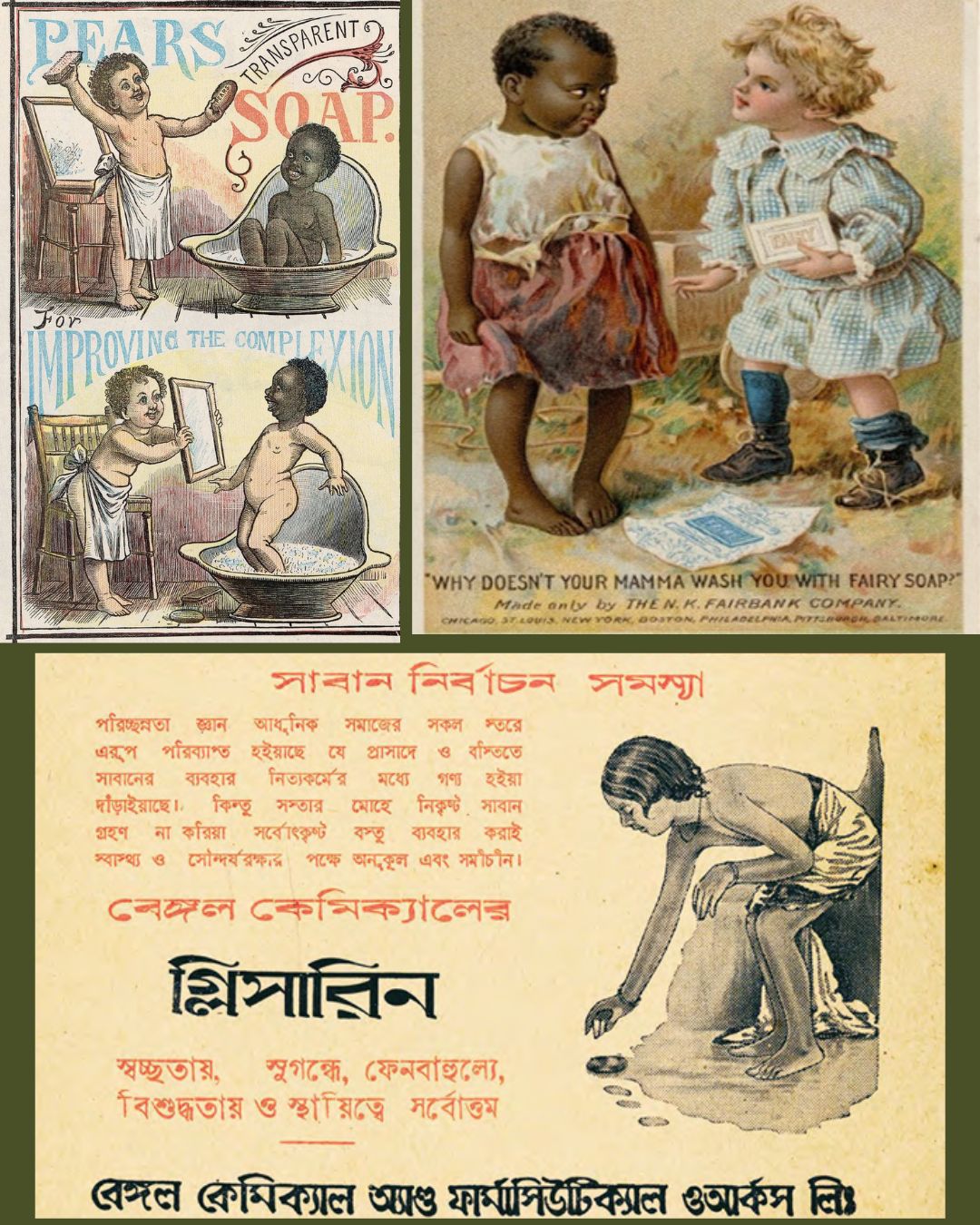
People finally woke up in the sixties and seventies of the last century. Like creams, soap advertisements were at one time promoted in many countries, including America, through bizarre, unscientific, and racist advertising messages and illustrations depicting Black people turning white. In 1884, Pears’ soap’s most controversial advertisement depicted a story in two panels. The first panel showed a Black child sitting in a bathtub, while a white child stood outside. The white child was handing a bar of Pears’ soap to the Black child. The second panel showed that after bathing with that soap, the Black child’s entire body below the neck had become stark white, while his face remained as black as before! He was looking at his 'whitened' body in the mirror with immense curiosity and wonder.
Around 1899, another highly well-known advertisement for Pears’ soap showed a white sailor washing his hands with Pears’ soap in a basin on a ship. Written in large letters above the advertisement were the words: "The first step towards lightening The White Man's Burden is through teaching the virtues of cleanliness." This advertisement featured a photographic illustration.
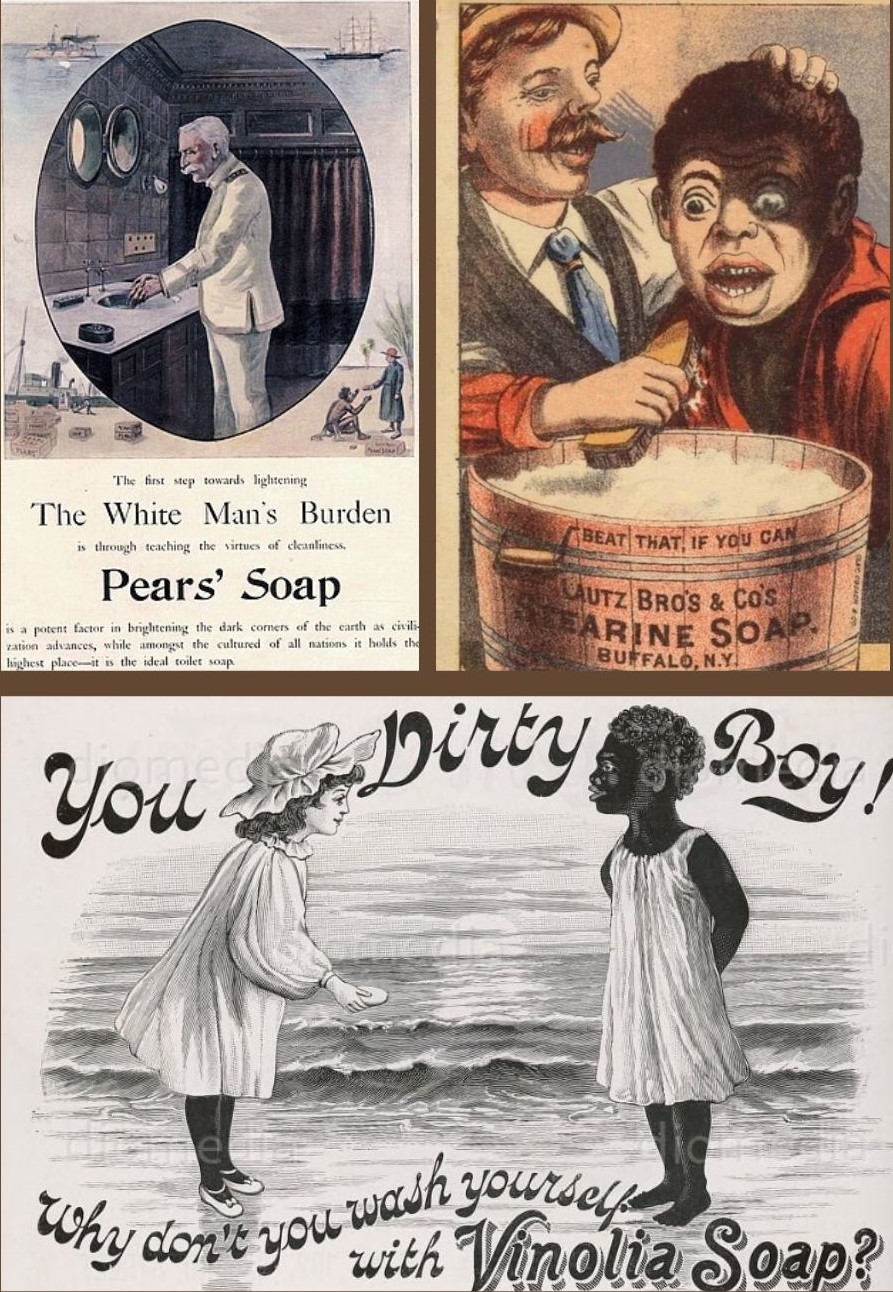
In those days, European and American imperialists believed that God had given white people the responsibility to 'civilise' the Black or non-white people of the world—what the poet Rudyard Kipling termed the 'White Man's Burden'. Pears’ soap very shrewdly turned that political and racist mindset into a tool to sell its product. The advertisement claimed that Pears’ soap was 'an exceptional medium for spreading the light of culture and civilisation,' helping to clean primitive or uncivilised people.
In another advertisement, addressing a Black child as 'Dirty Boy,' a white child asks, 'Why doesn't your mother wash you with this soap?' In 1890, an advertisement created by a New York printing company for cigar boxes bizarrely depicted Charles Darwin’s theory of evolution. A Black man was placed closest to the monkey, followed by an Asian and an indigenous person, with the white man positioned at the top as the supreme being.
Those early foreign advertisements featured realistic illustrations somewhat in the style of caricature. The illustrators were undoubtedly artists working in the Victorian style. In the case of children’s pictures, a soft, mellow, magical fairy-tale ambiance was fully maintained. And the use of colour was so refined and minimalistic that one could not help but be mesmerised. Yet, the message of all these beautiful drawings was horrifyingly bad. To put it clearly, it was racist. Inhuman. Sometimes, it even carried the banner of supporting slavery. Standing beside those advertisements, looking at an advertisement for Bengal Chemical’s own soap from the 1930s brings genuine comfort to the eyes and mind. There, too, the character in the picture is a child. And how beautiful the artist's concept was! Little children cannot hold a bar of soap in their hands; it slips away. That scene was drawn so beautifully that words fail. While Pears’ soap’s colonial advertisements promoted white supremacy and racism by showing black skin as 'dirty' and whitening it, this Bengal Chemical advertisement was the complete opposite and entirely natural. There was no claim of artificial whitening; instead, the emphasis was on cleanliness and health preservation. The picture in the advertisement showed showed an ordinary child bathing in a very natural posture, capturing the scene where the soap accidentally slips from the child's hand and falls. At that time, the renowned artist Jatindra Kumar Sen was employed at Bengal Chemical. It is possible that he brought this picture to life aesthetically with the touch of his signature style.
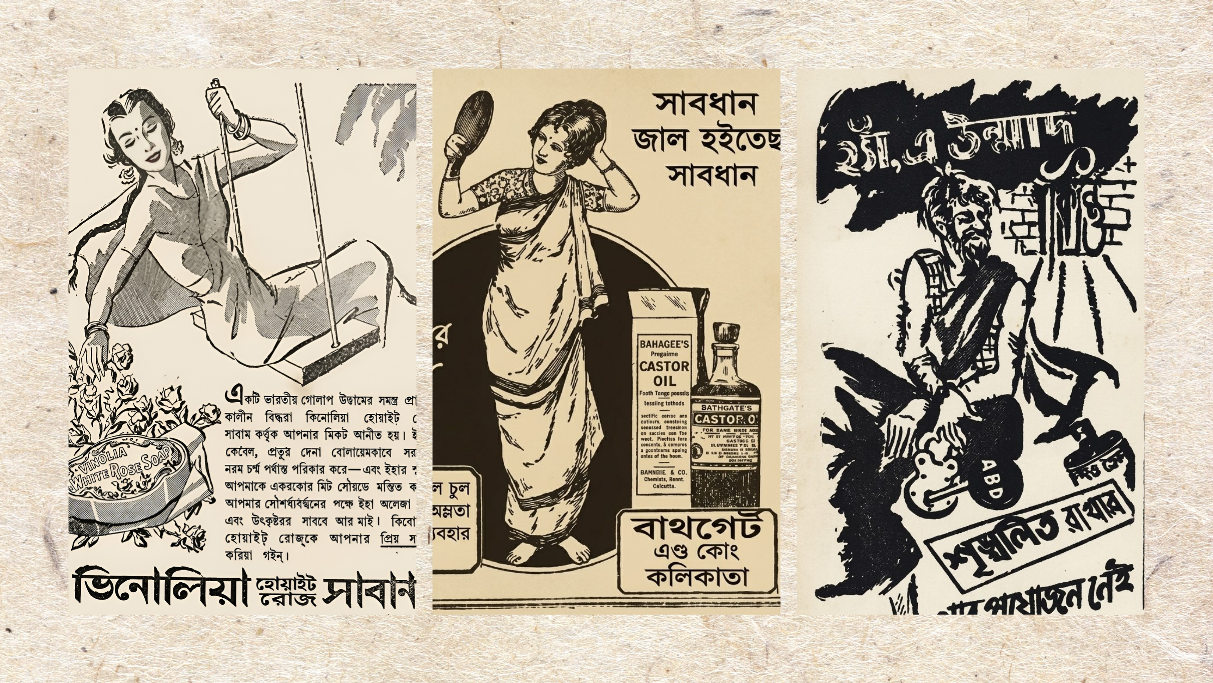
Although Bengal Chemical set an example, some racist advertising illustrations were regularly drawn in our subcontinent, or more specifically in undivided India, during the 1920s and 1930s of the last century. Looking back at them today, they appear highly unseemly and uncomfortable. It wasn't as if the artists of ad agencies were forced to draw those advertisements solely to promote the products of foreign companies. Domestic enterprises were not far behind in certain cases. They, too, understood the racist attitude of the majority of ordinary Bengalis and the psychological distress experienced by Bengalis because of their dusky complexion, and they tried to exploit it to sell their own products. Sukumar Ray had written a rhyme characterising an eligible groom: "The groom is not bad, he is quite good, though his complexion is terribly dark" (‘মন্দ নয় সে পাত্র ভাল, রঙ যদিও বেজায় কালো’), through which he satirised the Bengali attitude towards skin colour. I have already mentioned the bride and groom columns in classified advertisements, where the demand for a fair bride exists in every line. In that respect, our attitude closely mirrors that of foreign nations, a trend that has persisted since the era of the Aryans and non-Aryans. Let me try to share a few words about two racist advertising illustrations drawn by Bengali artists.
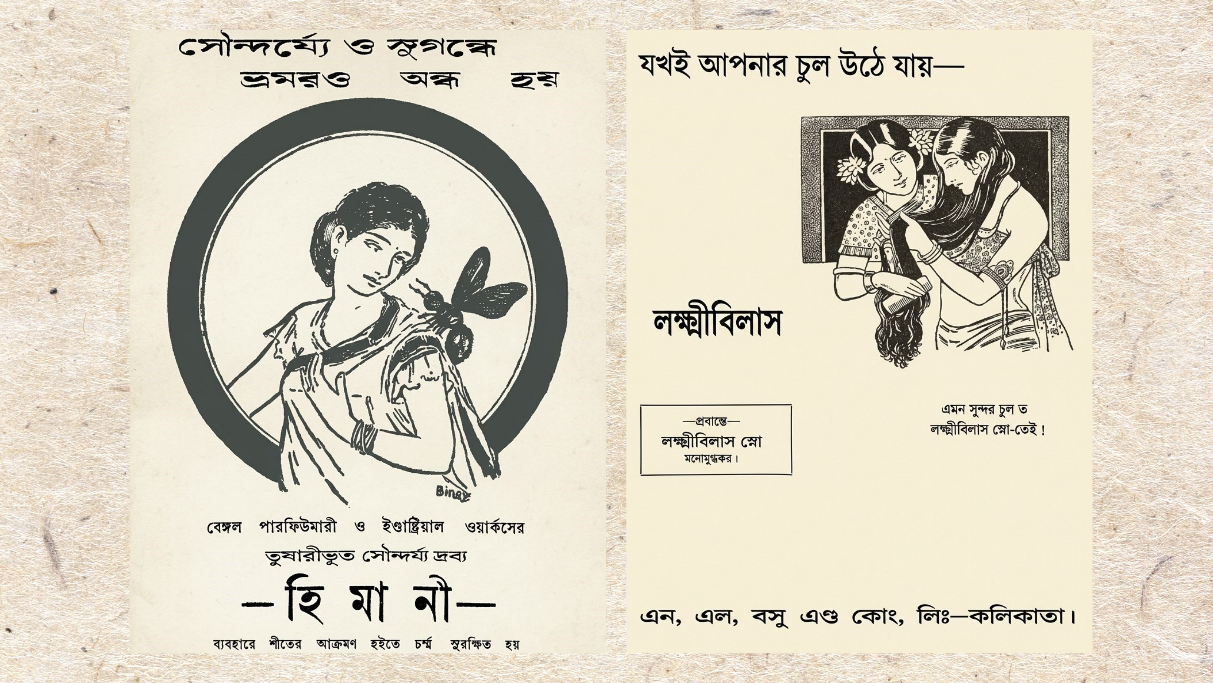
Both advertisements were for fairness creams. The main character in both pictures was a man—not some dark-skinned girl from the matrimonial columns of newspapers. I spotted these two advertisements in newspapers from 1922 and 1929. In one picture, an affluent man wearing a shirt, trousers, and suspenders is sitting in front of a mirror. The woman standing beside him is deeply concerned about her master's looks. Speech bubbles emerge from the sides of both their faces, just as we see in comics or cartoons. The master says, "What a permanent colour, good heavens! Even rubbing it with an eraser doesn't fade it!" (‘কি পাকা রং বাবা! ইরেজার ঘষেও ফিকে মারে না!’). To this, the woman replies, "Nothing will come of that. Rather, try applying a little Himani every day, and see if your skin doesn't become fair and glowing like milk blended with altā..." (‘ওতে কিছু হবে না। বরং রোজ একটু করে হিমানী মেখে দেখো দুধে আলতা না হয়...।’).
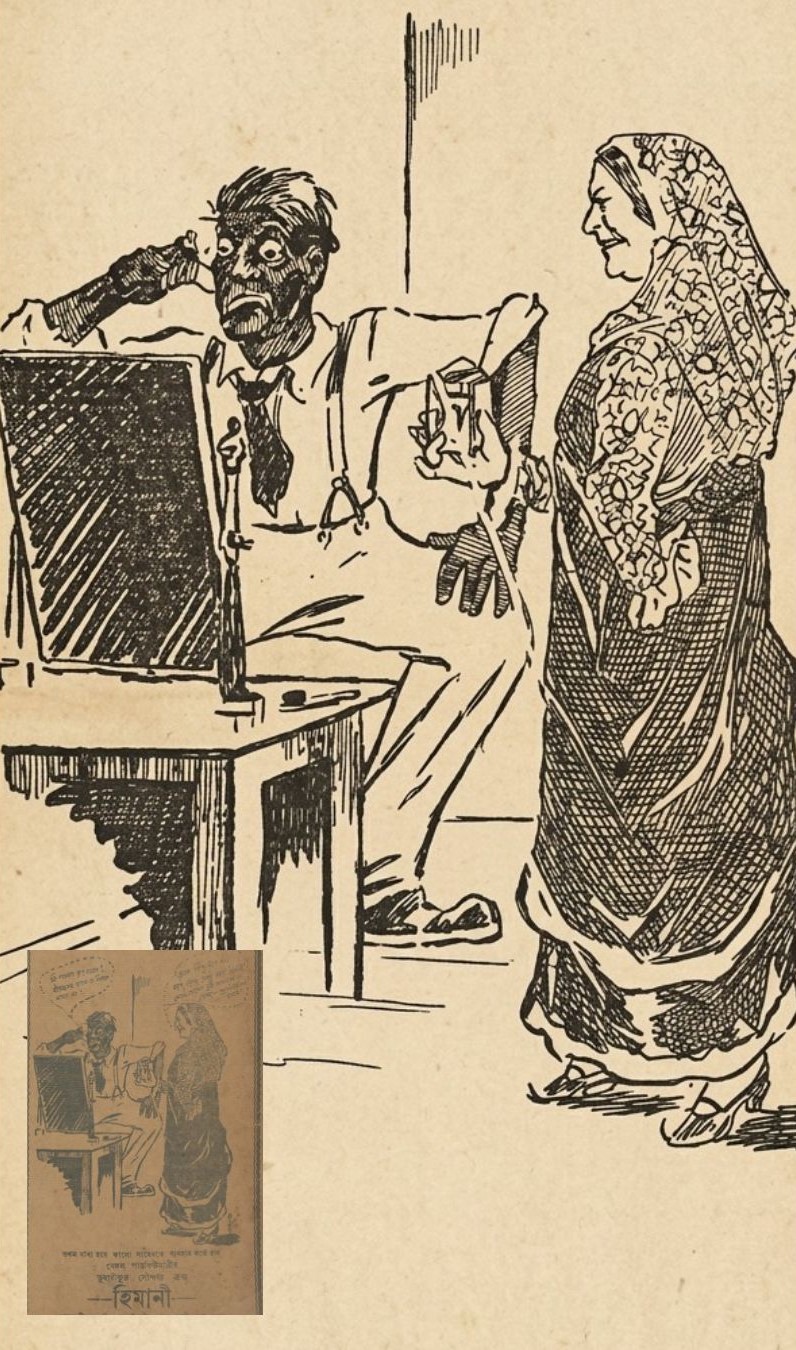
At the top of the advertisement, above the picture, the following words are written in large letters: "When nothing else worked" (‘যখন কিছুতেই কিছু হলো না’), the continuation of which appears below the picture: "Then, out of desperation, the dark gentleman had to use Bengal Perfumery’s frozen beauty product—Himani—because on winter days, it stops cracked skin and chapped cheeks, removes pimples and blemishes, and makes the face beautiful like a cloudless moon... Price twelve annas. Sharma Banerjee & Co., No. 43 Strand Road, Kolkata." (‘তখন বাধ্য হয়ে কালো সাহেবকে ব্যবহার করতে হল বেঙ্গল পারফিউমারীর তুষারীভূত সৌন্দর্য্য দ্রব্য—হিমানী—কারণ শীতের দিনে মুখ ফাটা গাল ফাটা বন্ধ করে, ব্রণমেচেতা দূর করে, মেঘমুক্ত শশধরের মত মুখখানি সে সুন্দর .. করে। দাম বারো আনা শর্ম্মা ব্যানার্জ্জী অ্যান্ড কোং ৪৩ নং স্ট্রান্ড রোড কলিকাতা।’).
From the signature, I realised that this picture was also drawn by Binay Bose. I surmised that he was highly sought after for drawing such cartoonish advertisements. On August 7, 1959 (the day after his death), his obituary was published in the Anandabazar Patrika, which read: "The renowned artist has passed away. On August 6, one of Bengal's finest artists, Binay Krishna Bose, passed away at the age of 65 at his residence at 2C, Satkari Lane, Bagmari, Kolkata. For a long period of 33 years, he had served efficiently as the Art Director of the Premier Publicity Society. At a time when there were hardly any caricaturists in Bengal, numerous caricatures by Binay Bose published in monthly, periodical, and some daily newspapers brought great joy to cultured society. Everyone was charmed by his good conduct and amiable behaviour. At the time of his death, he left behind his widow, three sons, two daughters, and many relatives and friends."
The historical value of this death notice is immense. Beyond the fragments of personal information regarding Binay Babu, the major discovery is the mention of the ad agency called the Premier Publicity Society, where this forgotten artist was the highest authority in the art department. So, in that advertisement for Himani, he heavily layered dark colour onto the face of the 'dark gentleman'. Yet, there is no difficulty in understanding his expressive face; the woman wears an ordinary saree, but she has a veil (ornā) over her head. In everyday situations, Hindu Bengalis do not put a veil over their sarees; they draw a modesty veil (ghonghat). Even in advertisements from over a hundred years ago, I have seen pictures of veiled women where the face is not even visible. That advertisement is a different matter, though; I will come to that later. Regarding the woman under discussion, drawn by Binay Babu in 1922, I can say that even if Hindu girls put a veil over their heads, they generally do so at a social event like a wedding. Rather, the custom of wearing a veil is more prevalent among Muslim women, especially in rural areas. This is not exactly a hijab, though. In the picture, I cannot tell whether the woman is the dark gentleman's wife or a maidservant. However, whoever she may be, and whatever the religious identities of the two characters, the copywriter and the artist intended to show that this woman is well informed about Himani cream. But overriding such analyses, the racist message remains starkly evident here. It is clear that, for a very long time, sentiments of racial arrogance or despair have been directly exploited in Bengali advertisements. It is possible that such practices in the subcontinent date back a hundred years or more, displaying a mentality that exactly matched that of foreign advertisements. I do not know whether copywriters or artists like Binay Babu were inspired by those foreign advertisements!
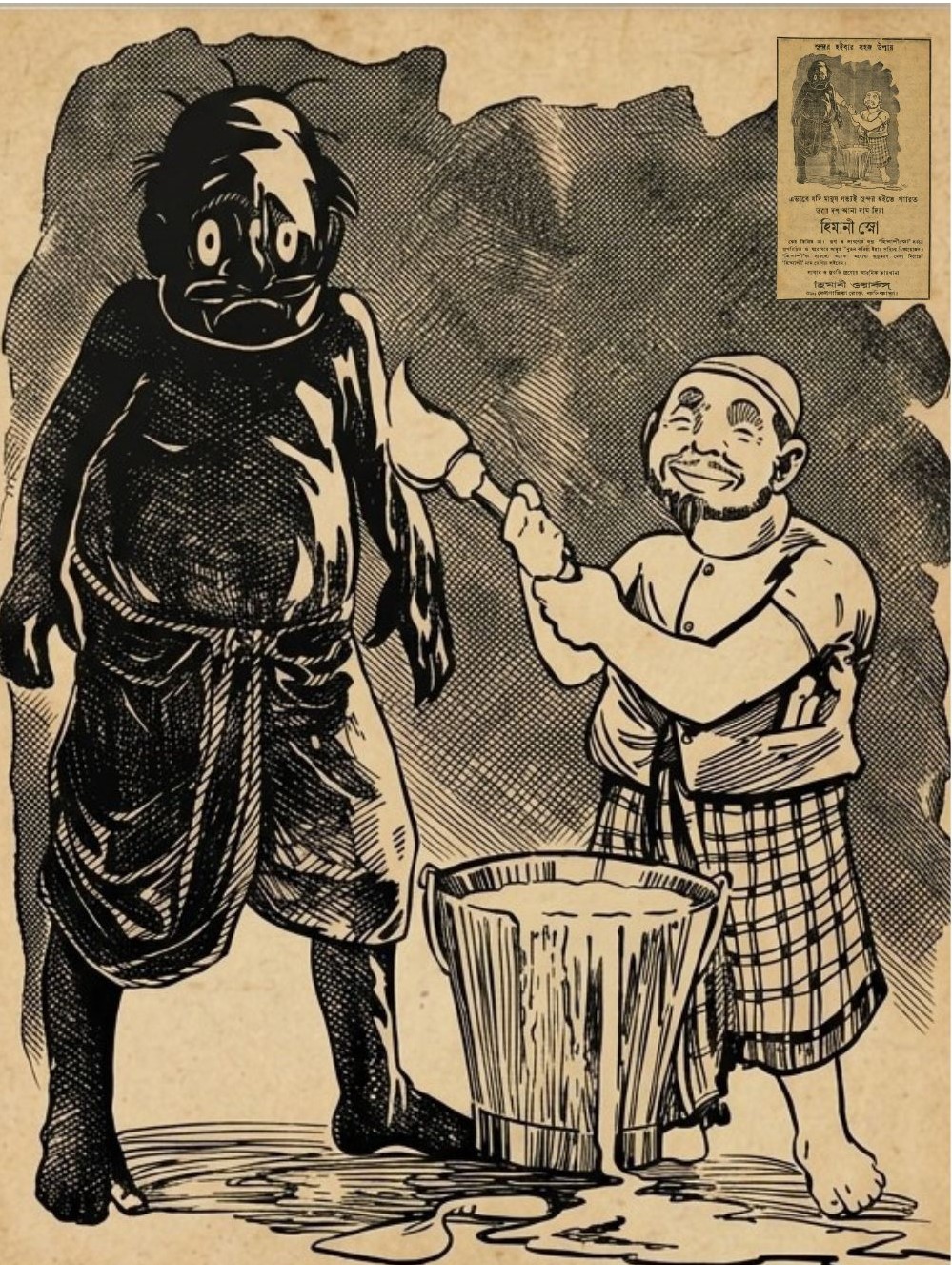
Now let us come to the second advertisement. Here, a corpulent Bengali man is drawn in an utterly humiliating manner. The man is wearing only a dhoti around his waist. His body is extremely dark. He has a flat nose and dishevelled hair. The Muslim character standing beside him appears quite cheerful. As I mentioned before, in most Bengali advertisements of that time, Muslim or non-Hindu characters were depicted in advertisements in occupational roles. It is the same here. The short-statured house painter is wearing a fez cap, a vest (fatuā), and a checked lungi. He holds a bucket full of white paint. An attempt is being made to whiten the skin of the dhoti-clad dark gentleman with that paint. It is apparent that the artist thought of drawing a representative of Muslims, assuming they excelled at painting jobs. This is a 1929 advertisement for Himani Works, whose 'modern soap and perfumery' factory was located in the Muslim-dominated neighbourhood at 59 Belgachia Road.
The catchline of this extremely racist advertisement was "The easy way to become beautiful" (‘সুন্দর হইবার সহজ উপায়’). Written below the picture was: "If humans could truly become beautiful this way, no one would buy Himani Snow for ten annas. For beauty and grace, ‘Himani Snow’ is well known everywhere and cherished in every home; it needs no new introduction. Many unworthy imitations have been seen due to Himani’s success..." (‘এভাবে যদি মানুষ সত্যই সুন্দর হইতে পারিত তবে দশ আনা দাম দিয়া হিমানী স্নো কেহ কিনিত না। রূপ ও লবাণ্যের জন্য ‘হিমানী স্নো’ সর্বত্র সুপরিচিত ও ঘরে ঘরে আদৃত ‘নুতন করিয়া ইহার পরিচয় নিষ্প্রয়োজন। হিমানীর সাফল্যে অনেক অযোগ্য অনুকরণ দেখা গিয়াছে...’) and so forth. Normally, one does not feel inclined to judge the artistic quality of such subjects, because these pictures represent a genuine misuse of art. Yet, to understand the character and mindset of a society, they cannot be entirely ignored either. As far as I can tell, this advertisement also bore the artist's signature. But deciphering whose signature it was would baffle even the gods. Generally, Binay Bose drew a vast number of cartoon-based advertising pictures during that period. Perhaps this picture was his creation too!
Now, let us turn to the advertising picture of that veiled woman, which reminded me of Rassundari Devi. In the second introduction to her autobiography, Dinesh Chandra Sen wrote a poignant line: "Women of yesteryear were completely subservient to society." Just how subservient they were can be understood simply by looking at this picture. That Dinesh Chandra Sen, one of the pioneers of literary history in the Bengali language, preferred that women remain so subservient also becomes clear from another comment of his towards the end of this preface, where he states: "It is requested that the women of our present times view with care the portrait of the ancient matrons contained in this book. May we not become averse to the Annapurna of the home while showering excessive praise upon Kundanandini—this is my wish."
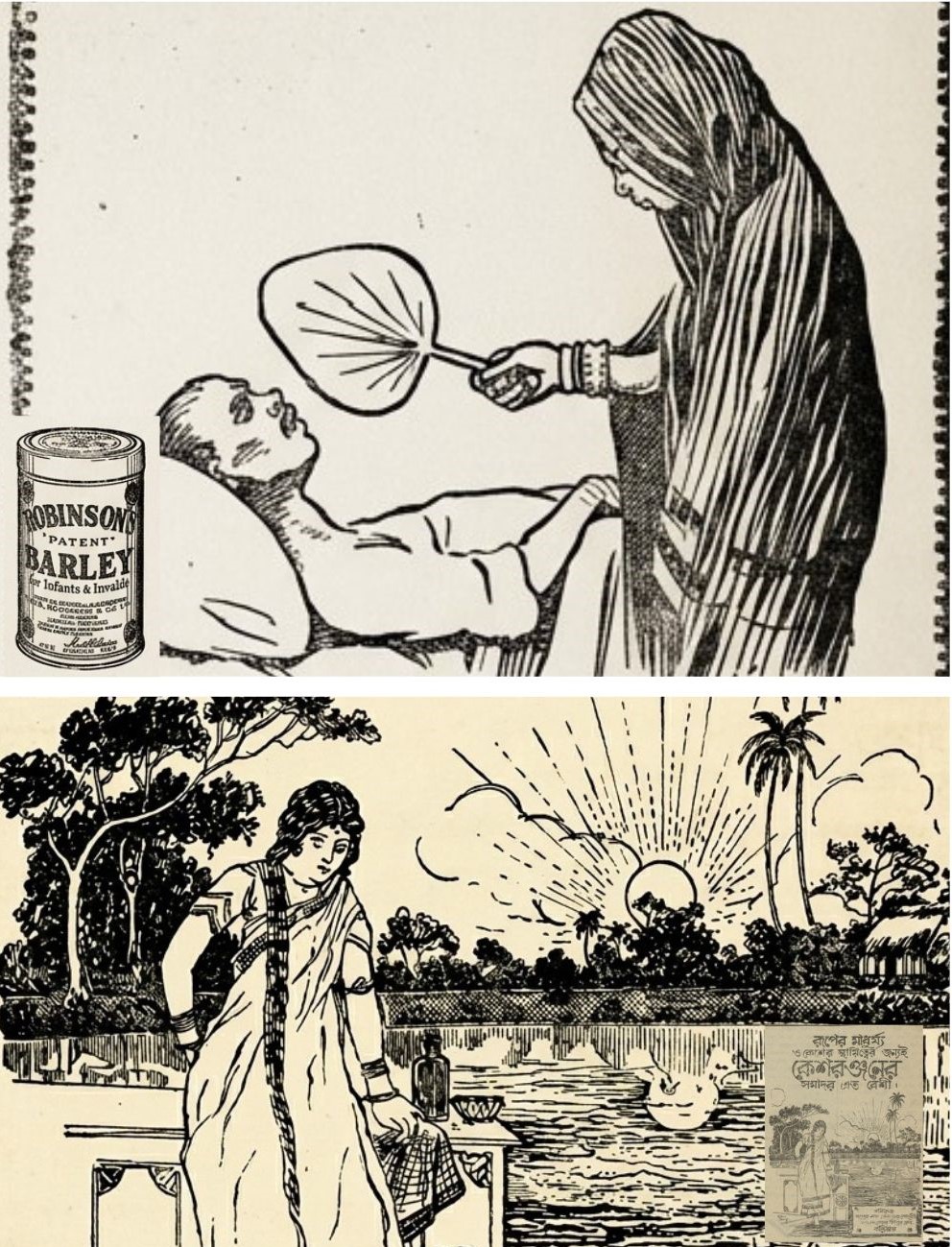
Viewing the woman’s image in this advertisement through modern eyes clearly reveals a form of traditional subjugation to men. Simultaneously, it embodies the enduring form of domestic service characteristic of that era: fanning an ailing relative (husband?) while keeping the veil perfectly in place. I saw this advertisement in a Bengali daily from 1929. The line drawing in the picture is undoubtedly flawless. Specifically, the folds of the cloth, the intricate weaving of the hand fan, the body language of the two characters, and the play of light and shadow created by the artist cannot be dismissed as an ordinary realistic sketch.
This advertisement did contain the artist's signature—a brief one. Looking very closely, it seemed to me that the first two letters were 'W' and 'S'. I could not be certain about what followed. The problem was that the folds of the saree intersected with that brief signature. Imagine how difficult a task it is to decipher it! I could not do it. I wondered why everyone could not write their names as clearly as Binay Bose did. Even in the Bottala-style illustrations of almanac advertisements, the renowned woodcut artist Priyagopal Das sometimes used a brief signature. Though very small, he would write it clearly in an empty space on the image.
Be that as it may, in the preface to Rassundari’s autobiography, Dinesh Chandra Sen wrote that Bengalis should not cross limits while praising Kundanandini. Every connoisseur of Bengali literature knows that Nagendra, a married man, falls madly in love with this young orphan widow in Bankim Chandra Chattopadhyay’s novel Bishabriksha (The Poison Tree), leading to countless complications throughout the novel! Here, with a bit of humour, I feel compelled to ask whether any of those women repeatedly drawn in Bengali advertisements while fetching water from the ghat or bathing were creations of Bankim's imagination—women whom Dinesh Chandra, at least publicly, was unlikely to admire.
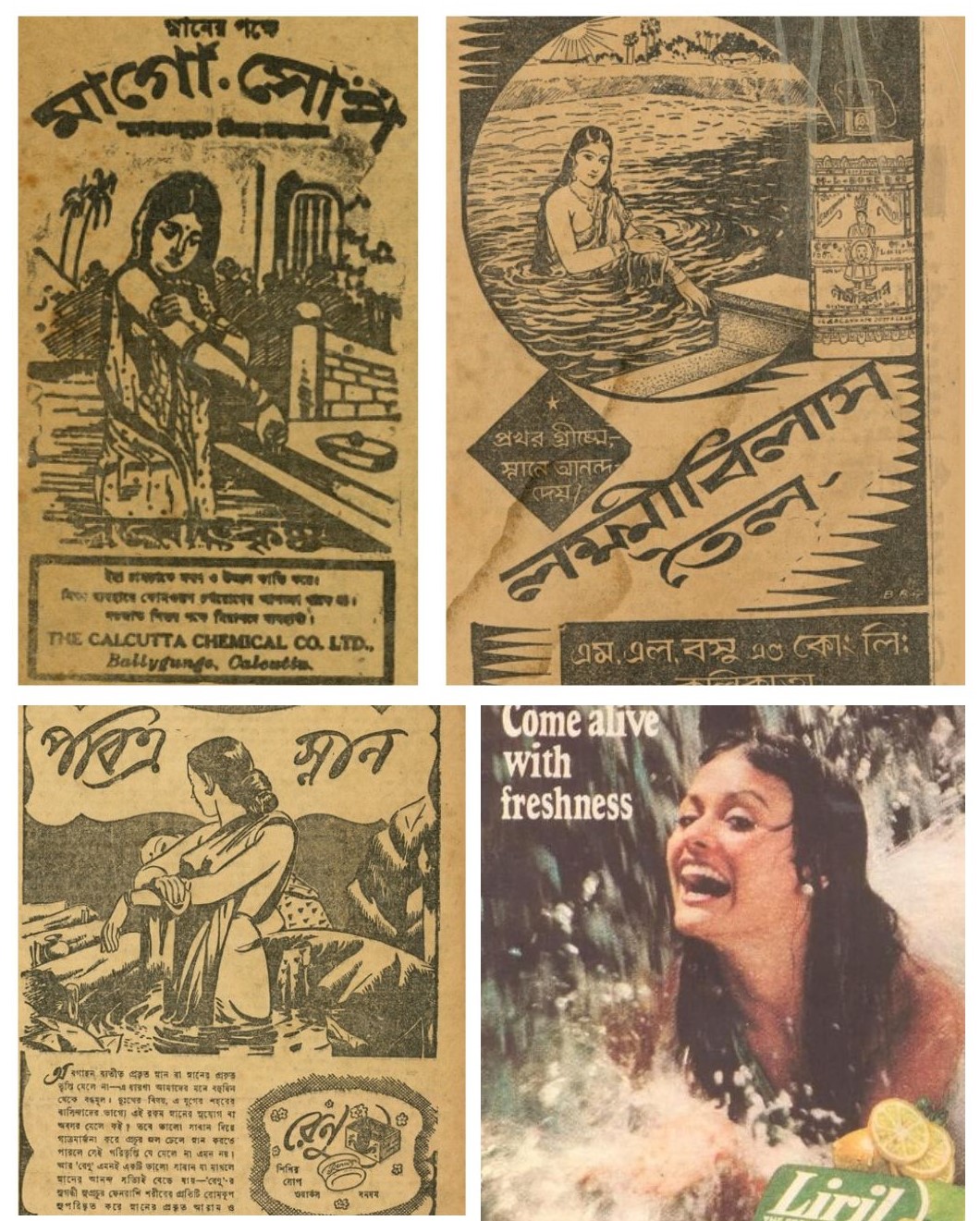
Many who, like me, were thrilled by the sight of the woman bathing in that green waterfall on the television screen in the Liril soap advertisement might not know that Bengali artists repeatedly drew pictures of women bathing for toilet soap advertisements even a hundred years ago. And why should they not? People use soap while bathing. In that Liril soap advertisement (1974), the bikini-clad model's name was Karen Lunel, an air hostess by profession. The shoot took place at the Pambar Falls in Kodaikanal. The creator of the advertisement was Alec Padamsee’s Lintas International Advertising Agency. So, regarding the bathing women I am speaking of in advertisements from a century ago, it is possible that the artists enjoyed drawing them. The advertisers’ instructions must have been similar. Consequently, a picture of a man applying soap to his body cannot be found in Bengali advertisements from a hundred years ago. To our fathers and grandfathers, the 'Liril Girl' was merely those Bengali women at the pond ghat drawn by lost, anonymous artists!
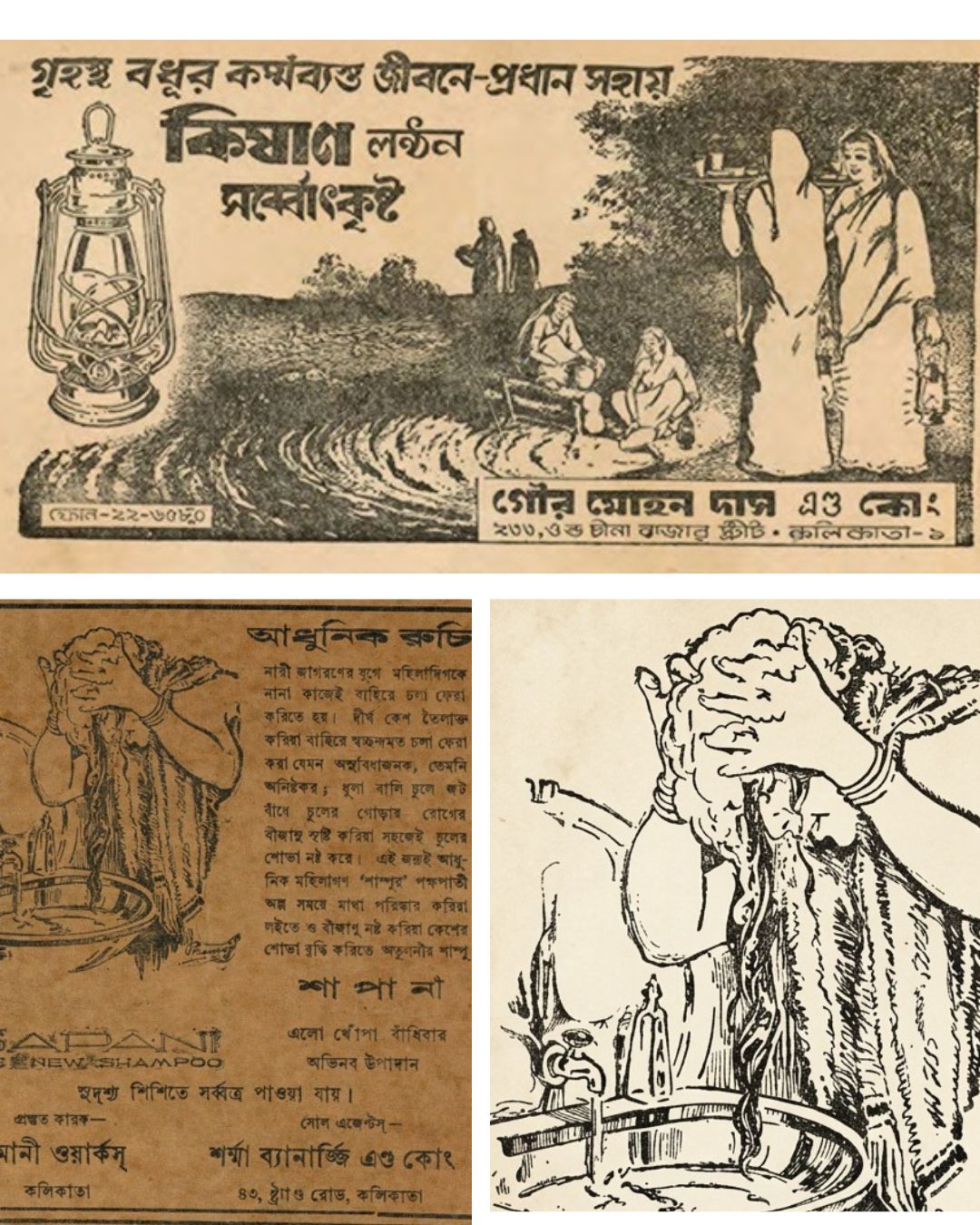
But did women go to bathe only in ponds back then? Why should they? I also managed to see a picture drawn by an artist for an advertisement showing a woman applying shampoo to her head in a thoroughly modern bathroom. I was even fortunate enough to find out who the artist was—the famous Pratul Bandyopadhyay. He had signed in English as 'P. Banerjee'. Who else could it be but Pratul Babu? Oh yes, I was quite startled to see a picture of several women together at a pond ghat in one advertisement. Two of them were washing utensils, while the other two, having finished washing, were conversing before returning home. The message of the advertisement was: "In the busy life of a housewife, the primary helper is the Kisan Lantern. They are the best in this regard." (‘গৃহস্থ বধূর কর্মব্যস্ত জীবনে-প্রধান সহায় কিষাণ লণ্ঠন। তারাই এই ব্যাপারে সবার সেরা।’).
From Shobha Sen to Suchitra Sen, and from Madhubala to Sabina Khanum—at one point, film stars began modelling for soaps. Multinational product sellers, in particular, believed that people would prefer the faces of Rekha and Hema Malini over an anonymous artist's drawing of a woman with a face like Kusum from Tagore’s story Ghaater Katha (The Tale of the Ghat)! Today, when I see pictures of bathing scenes, a woman returning from the ghat with water in a pitcher, or a young girl in similar solitude in ancient advertisements, the Liril Girl does not cross my mind at all. It feels as if I, too, am peeking at that ghat where Kusum used to go. When Kusum’s small shadow fell upon the water, the ghat longed to hold her to its chest. Closing my eyes, I feel exactly the same way.
The long-abandoned, lonely Pandora's box lying in the dark tunnel where the entrance to Bengali advertising is virtually closed still holds the Kusums within its chest. In the story, we read that Tagore’s ghat did not see Kusum for nearly a year; she must have been married off. Later, one day, the ghat feels Kusum’s soft feet stepping onto its brick stairs, which resemble broken ribs—once again. But anklets no longer chime on those feet; Kusum is an untimely widow. She, too, has become Bankim’s Kundanandini. The artists of lost advertisements have preserved Kusum, and countless women like her, at the river ghat, against the light of the rising sun on the distant horizon. Is the long-haired woman against the backdrop of palm trees not Kusum as well? The woman with a knee-length braid in the advertisement for 'Kesho Ranjan Oil' is indeed the model conjured by the artists of that era, rising from the soil—whether that drawing is good, bad, or mediocre.
Generally, in the 1930s, 'line blocks' or 'halftone blocks' had to be crafted to print advertisements in newspapers. Artists of that era drew with bold lines or hatching in such a manner that block-makers could easily engrave them onto linoleum or wooden blocks, creating material suitable for direct printing. Because the image was engraved on a hard block rather than drawn with the fine strokes of a brush or pen, every line and letter of Margo’s advertisement from that era appeared quite wide and deep black, which cannot be achieved with an ordinary pencil or brush sketch. The picture brought out light and shadow through a sharp contrast of white and black. Furthermore, the specific texture created by parallel chisel-like cuts or 'hatching' on the background and the saree is fundamentally the signature style and undeniable proof of the linocut or woodcut medium.
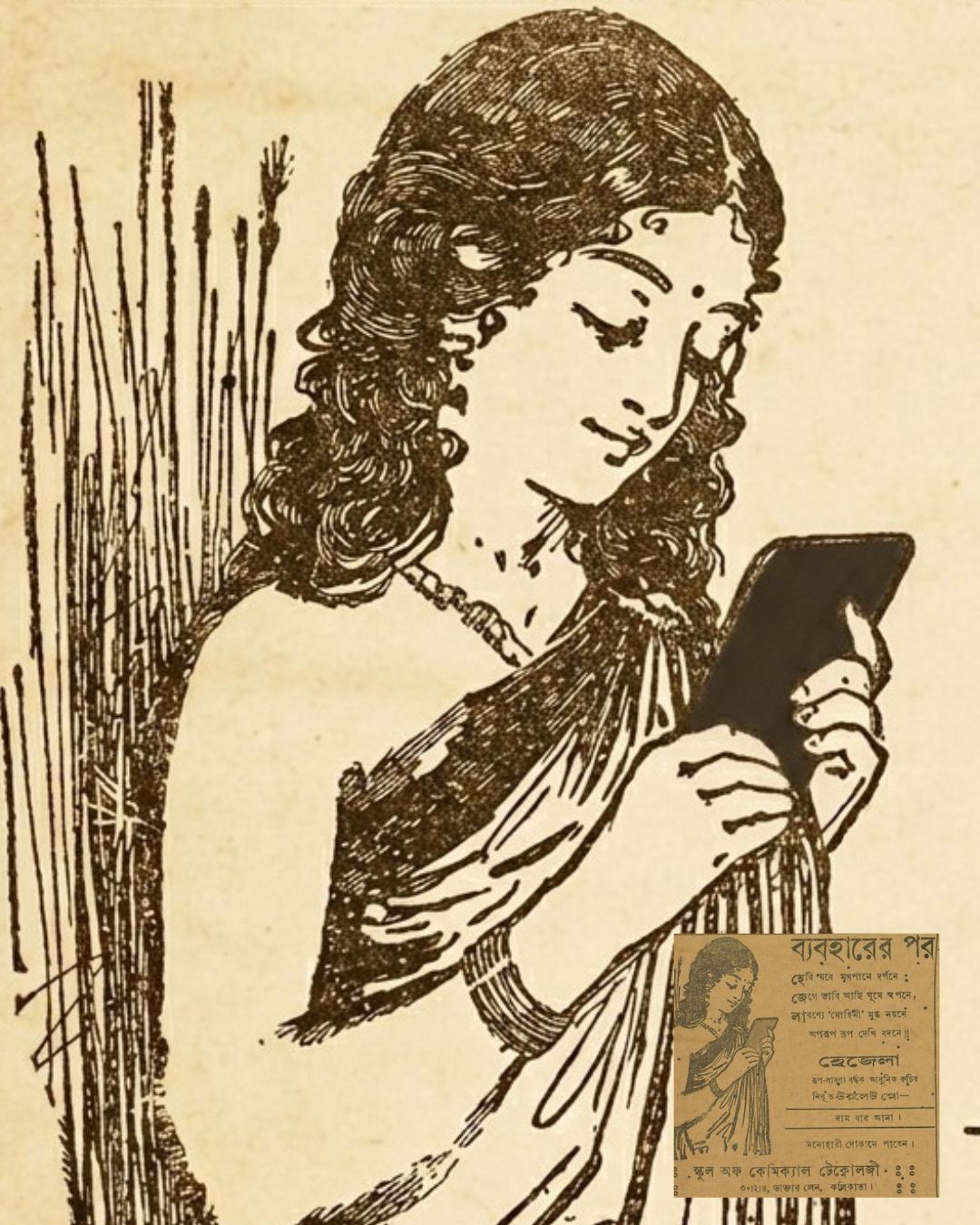
In any case, the quality of the picture certainly did not matter to Bengalis a hundred years ago. It is possible that the people of undivided Bengal during the youth of Dinesh Chandra Sen felt romantic about the ancient model of Margo soap—the woman at the pond ghat drawn in the linocut genre. At the same time, I found the closest resemblance to Kusum in that young girl of 1923, who applies Hazela Toilet Snow purchased from a stationery shop for twelve annas and loves to see her glowing and shining face in a small mirror held in her hand. How beautiful that picture is! It makes me want to rush right now to wherever Doctor Lane is in Kolkata, to the School of Chemical Technology there. I feel like summoning the factory owner through a planchette just to ask: Who drew that girl? Why did the copywriter capture her feelings after using Hazela in this manner—
When I gaze upon my face in the mirror, I wonder if I am awake or dreaming in a slumber,
With enchanted eyes fixed on the grace and charm,
An exquisite beauty I behold upon my countenance.
(হেরি যবে মুখপানে দর্পণে
জেগে ভাবি আছি ঘুমে স্বপনে,
লাবণ্যে ‘মোহিনী’ মুগ্ধ নয়নে
অপরূপ রূপ দেখি বদনে)।
Sandip Dasgupta has spent nearly three decades working in the editorial offices of newspapers and news portals. He has authored several history-based books, and a subject particularly close to his heart is the illustrations created by Bengali artists.
Send your articles for Slow Reads to slowreads@thedailystar.net. Check out our submission guidelines for details.
Beyond 1947 / A personal essay
Abul Mansur Ahmad / A global quest in search of a nation

Chand Bibi and the forgotten history of Muslim women’s political resistance

Women’s voices in Nazrul’s Dhumketu

How Milad-un-Nabi shaped Muslim cultural life in colonial Bengal
What Rashomon teaches us about truth and human behaviour

Why Chittagong never became a maritime city

The many worlds of Ghulam Murshid

Operation Jackpot: How Bangladesh’s naval commandos struck at Pakistan’s lifeline in 1971