


PM’s China trip: Dhaka eyes funds for infrastructure, investment


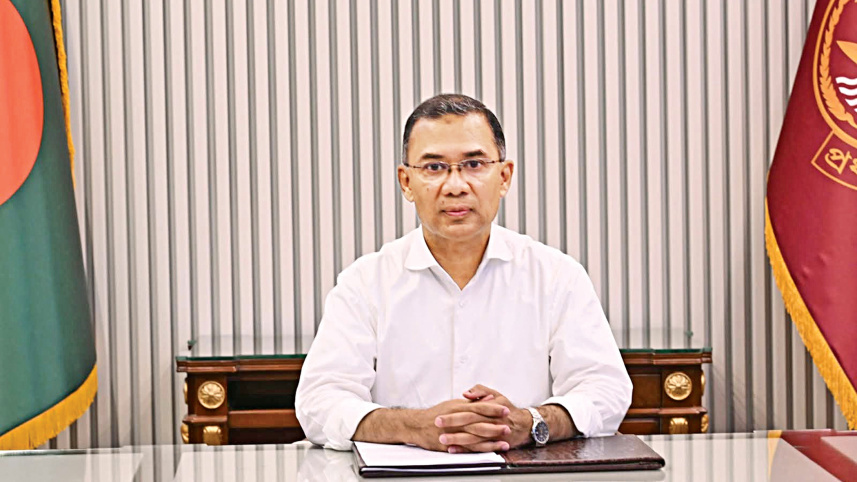
After nearly two years of slowdown following the 2024 political changeover, Bangladesh is looking for a fresh boost in Chinese investment and infrastructure financing as Prime Minister Tarique Rahman prepares for his first official visit to China from June 23–26.
Officials at the foreign and finance ministries said Dhaka will seek nearly $6 billion in Chinese funding for a range of infrastructure and development projects.

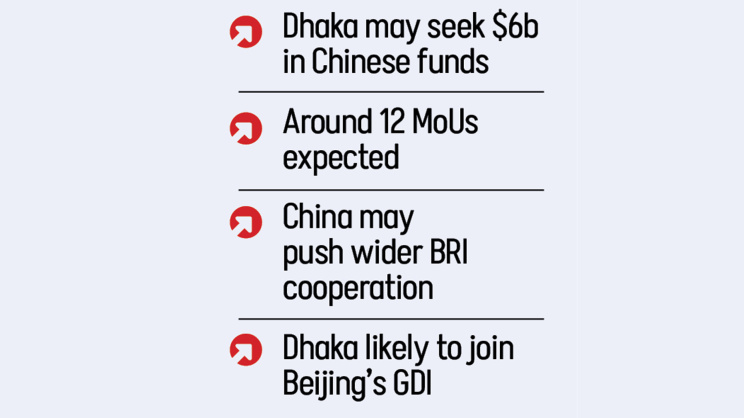
Bangladesh is also expected to announce its decision to join China’s Global Development Initiative (GDI), Beijing’s flagship development framework linked to the UN Sustainable Development Goals (SDGs).
“Our main thrust during the prime minister’s visit will be attracting Chinese investment,” a foreign ministry official told The Daily Star.
After completing a two-day visit to Malaysia, Tarique will travel to Dalian to attend the World Economic Forum’s 17th Annual Meeting of the New Champions 2026, known as the Summer Davos, on June 23.
He will then head to Beijing for bilateral meetings with Chinese President Xi Jinping and Premier Li Qiang at the Great Hall of the People.
The prime minister is also scheduled to attend an investment summit for Chinese investors and meet officials of major companies including Chery, Honda and Chinatex.
While Dhaka’s stated priorities are trade, investment, technology transfer and renewable energy, analysts say the visit carries broader geopolitical significance amid intensifying competition among China, India and Western powers in the Indo-Pacific.
INFRASTRUCTURE FINANCING
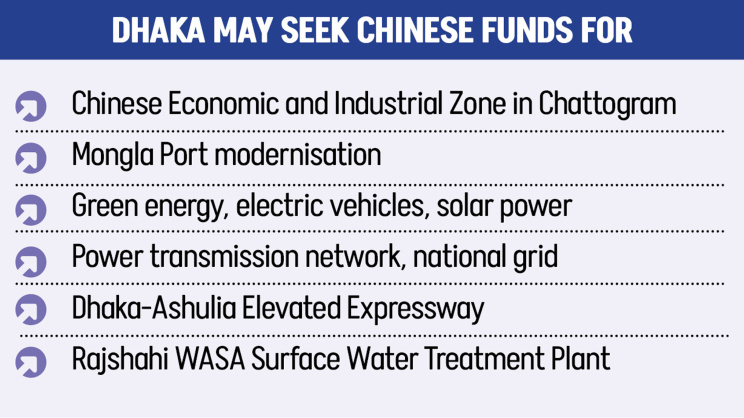
Bangladesh and China are expected to sign around a dozen memorandums of understanding (MoUs) covering green energy, electric vehicles, solar power, Mongla Port modernisation, media cooperation, training programmes and development of the Chinese Economic and Industrial Zone in Chattogram.
Bangladesh may seek around $2 billion for those initiatives.
Another $4 billion in financing may be requested for expanding the national power transmission network, strengthening the power grid, constructing the Dhaka-Ashulia Elevated Expressway, building the Rajshahi WASA Surface Water Treatment Plant and procuring four vessels.
An MoU may also be signed to establish the Bangladesh-China Friendship 1,000-bed General Hospital, likely to be financed through a Chinese grant.
Officials said discussions are continuing on larger projects, including a second Padma Bridge and a second Jamuna Bridge, although no major agreements are expected during this visit.
The Teesta River Management Project may also feature in talks, though discussions are likely to focus on feasibility rather than financing because of the project’s geopolitical sensitivity and India’s objections.
Bangladesh may additionally seek lower interest rates and extended repayment and grace periods for existing Chinese loans.
JOINING GDI
Government officials said Bangladesh is likely to formally join the Global Development Initiative, a Chinese-led framework aimed at accelerating implementation of the UN’s 2030 SDGs.
At least 82 countries, mostly from the Global South, have joined the initiative, which Washington views as a parallel development platform led by Beijing.
China has long encouraged Bangladesh to join, but the previous Awami League government remained cautious.
 For all latest news, follow The Daily Star's Google News channel.
 “Bangladesh is thirsty for economic and social development. China has both the funding and technological know-how to support us,” a foreign ministry official said.
DEEPER COOPERATION
Ahead of the visit, Chinese officials have been advocating a broader “Cooperation Plan on Jointly Promoting the Belt and Road Initiative” between the two countries.
The proposed framework includes regular institutional exchanges among ministries and agencies involved in commerce, education, tourism, agriculture, environment, finance and science.
Officials said China is also likely to encourage Bangladesh to join several Chinese-led financial and trade platforms, including the Shanghai Cooperation Organization Development Bank and the International Economic and Trade Cooperation Initiative on Green Mining and Minerals.
Beijing may additionally propose introducing Panda Bonds and China’s Cross-Border Interbank Payment System as part of efforts to internationalise the yuan.
Bangladesh’s position on these proposals remains unclear.
INVESTMENT, EXPORT
Mohammad Abdur Razzaque, chairman of Research and Policy Integration for Development (RAPID), described the visit as a major opportunity to expand investment, trade and technology transfer.
“China has both the capital and technical expertise to support developing countries, but Bangladesh’s engagement must be strategic,” he said.
“We should prioritise projects that help build export-oriented industries and generate foreign currency.”
Razzaque said Bangladesh should attract Chinese investment into sectors such as man-made fibre, leather goods and footwear through the Chinese Economic and Industrial Zone already approved by the government.
On China’s push for wider use of the yuan, he said Bangladesh’s current trade imbalance makes such a move difficult.
Bangladesh exports roughly $1 billion worth of goods to China annually, while imports exceed $23 billion.
“If Chinese companies invest here and export back to China, then wider use of the yuan could eventually become feasible,” he said.
Prof Sk Tawfique M Haque, director of South Asian Institute of Policy and Governance at North South University, said Bangladesh should capitalise on China’s efforts to relocate labour-intensive industries amid tariff tensions with the US.
“Bangladesh should be an attractive destination for those industries, and Dhaka must negotiate accordingly,” he said.
GEOPOLITICAL BALANCING
The visit is expected to be closely watched by India, the United States and other regional powers as Bangladesh’s strategic importance grows.
Analysts say Dhaka will need to balance relations carefully among competing powers.
The Reciprocal Agreement on Tariff recently signed between Bangladesh and the US includes provisions related to non-market economies, indirectly reflecting concerns over China and Russia.
“China is definitely concerned about it, but Beijing also understands Bangladesh’s limitations,” Prof Tawfique said.
Analysts also noted that India had invited Tarique for an official visit before China extended its invitation.
Razzaque said Bangladesh should avoid becoming entangled in geopolitically sensitive projects.
For projects such as the Teesta barrage, Bangladesh should consider joint ventures involving countries like Japan alongside China, he said.
Prof Tawfique said maintaining equilibrium would remain essential.
“The US is Bangladesh’s largest export market, while India shares a 4,000-kilometre border with Bangladesh and remains a major source of imports,” he said.
Comments