


Prisons bursting at twice their capacities


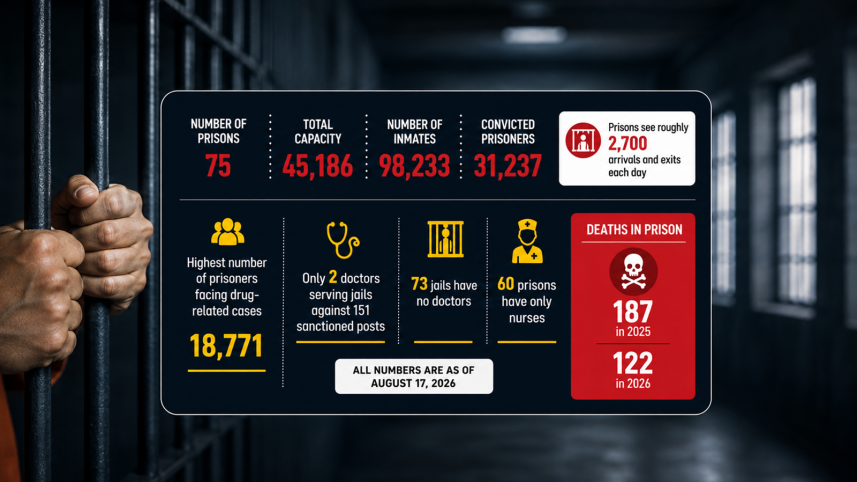
Bangladesh’s 75 prisons are holding 98,233 inmates against a combined capacity of 45,186, more than double the designed limit, putting severe pressure on accommodation and healthcare.
The tally is believed to be the highest in recent history, with prison data showing that 66,835 inmates are under trial and 31,237 convicted prisoners.

Although the figures are from the prison database, the numbers of undertrial and convicted prisoners combined fall short of the total inmate population by about 161.
Contacted, Prison Headquarters jailer Mashud Hassan Jewel said the figures were accurate, as the prison population includes other categories of inmates, which account for the difference.
Around 18,771 inmates are being held in drug-related cases, while 239 are held in cases involving JMB and other militant outfits, the data show.
On average, prisons receive about 2,700 inmates each day, while around the same number secure bail or are otherwise released, prison officials said.
“As far as I know, a figure close to 99,000 would be the highest. I have never heard of the prison population crossing one lakh,” Shamsul Haider Siddiqui, a former deputy inspector general of the Department of Prisons, told The Daily Star yesterday.
Prison officials said the inmate population tends to rise when trials are delayed and arrests increase during special law enforcement drives or for other reasons.
The number has risen sharply since the fall of the Awami League government on August 5, 2024, amid cases filed over alleged crimes against humanity, killings and attempted killings during the suppression of the mass uprising.
Prison data show around 88,000 inmates were in jail nationwide on August 4, 2024 -- a day before the government fell. Within a week, the number dropped to around 49,000 before rising to around 60,000 by year-end.
It stood at 77,291 in July last year and 93,440 in July this year, before climbing to 98,233.
Of the current inmates, 2,591 are on death row.
According to Inspector General of Prisons Brigadier General Syed Muhammad Motahar Hussain, one reason behind the recent rise was the number of people sentenced by mobile courts.
“More than 26,000 people were sentenced to jail by mobile courts between June 1 and July 31 [this year]. Their sentences ranged from one day, five days and seven days to one month or three months.”
He added that the matter had already been brought to the government’s attention.
Rights activist Nur Khan Liton told The Daily Star the rising inmate population was making it increasingly difficult for prison authorities to ensure prisoners’ basic rights, including adequate accommodation, food, healthcare and safety.
ENSURING TREATMENT A CHALLENGE
The strain is particularly evident at Dhaka Central Jail in Keraniganj, which has a capacity of 4,590 but holds 13,958 inmates.
“We have only two attached doctors and no permanent doctor,” Faruk Ahmed, senior jail superintendent of Dhaka Central Jail, told The Daily Star.
At least 500 inmates seek treatment at the jail’s outpatient facility every day, he said, adding that the two doctors and prison authorities face enormous pressure to treat such a large population.
The shortage extends across the prison system.
 For all latest news, follow The Daily Star's Google News channel.
 Of 151 sanctioned doctor posts, only two are filled -- one each at Manikganj jail and the Rajshahi training centre, according to prison authorities.
The remaining 73 prisons depend on part-time doctors from civil surgeon offices. Sixty prisons have nurses, while guards trained in medical care perform nursing duties at the others.
There are only 25 ambulances across 22 prisons, while sick inmates elsewhere must be taken to hospital in hired vehicles, prison officials said.
A Department of Prisons official, requesting anonymity, said doctors are generally unavailable at night, while the lack of ambulances at many facilities makes it difficult to quickly transfer critically ill inmates. “In some cases, inmates die on the way to hospital.”
IG Prisons Motahar acknowledged the doctor shortage but rejected allegations of negligence in treatment. He said 122 inmates are currently receiving treatment at hospitals outside prisons.
A total of 187 prisoners died in 2025, while 122 have died so far this year, he said.
The IG said every prison death is investigated and documented, with forensic examinations conducted where necessary. He said he had found no case so far in which an inmate was denied treatment or died because of inadequate treatment.
However, Motahar acknowledged problems in transferring critically ill prisoners, saying he had taken punitive action in two cases where officials took longer than expected to transfer sick inmates.
“We have recently taken steps to buy 77 ambulances to address the crisis.”
CALLS FOR REFORM
A recently released inmate who spent about a month at Dhaka Central Jail from mid-July over a family conflict case before securing bail last week said overcrowding had made sleeping the hardest part of prison life.
He told The Daily Star he had been kept on the second floor of the Karnaphuli building, where wards designed for 20 to 25 inmates held 70 to 75.
“Staying there was the biggest struggle,” he said, adding that conditions were far worse than during an earlier spell in jail three years ago.
He alleged that inmates with money could secure better sleeping arrangements, while those who could not pay faced harsher conditions and were sometimes made to clean toilets or carry food.
He said he paid Tk 680 during the month to secure a better place to stay and avoid such pressure.
“Food was another concern,” he said, adding that breakfast usually consisted of one roti with vegetables, which he found insufficient.
He said he spent around Tk 6,000 at the prison canteen during the month, mainly to supplement the meals provided by the authorities.
Another inmate’s son said his mother’s health had deteriorated since she was jailed, suffering recurring stomach problems and body aches, while her family felt she was not receiving adequate medical care.
Liton said overcrowding was a longstanding problem, but inmate numbers had been rising faster than capacity despite expansion of prisons over the past 10 to 15 years.
“The growing population is affecting prisoners’ physical and mental health and making prison management increasingly difficult.
“The government should consider prison reforms through a commission and move towards a correctional and rehabilitation-oriented system, rather than treating prisons merely as places of punishment.”
Former prison official Shamsul Haider, however, said the high inmate population could be managed if available space and resources were systematically distributed.
“Official capacity is calculated based on designated accommodation, but prisons have additional spaces that can be used when needed.
“Food, blankets and other supplies are also generally procured based on the actual inmate population rather than official capacity.”
However, he identified bathing and sanitation as serious problems, recalling instances where around 50 inmates depended on a single water source.
“It depends entirely on prison management,” he said, adding that inmates could be kept in better conditions if available space and facilities were fairly distributed.
Transparency International Bangladesh Executive Director Iftekharuzzaman told The Daily Star the situation violated prisoners’ human rights and reflected deeper problems in the prison system.
“Modern prison systems worldwide are not merely about punishment. One of their key objectives is rehabilitation. Prisoners should be provided with an environment where they can reform during their time in custody,” he said, adding that the problems could not be addressed by improving prison infrastructure alone.
“These issues have never received adequate priority or resources,” Iftekharuzzaman said, calling for comprehensive reforms to protect prisoners’ rights.
Home Minister Salahuddin Ahmed acknowledged in parliament in June that overcrowding had created a serious accommodation problem.
He said several new prison facilities had already opened, while others were under construction or awaiting inauguration. Once the ongoing projects are completed, 2,995 spaces are expected to be added.
Reconstruction projects have also been undertaken in Rajshahi, Rangpur, Noakhali, Rangamati and Khagrachhari to increase capacity, he added.
Comments