


Record measles deaths warrant introspection
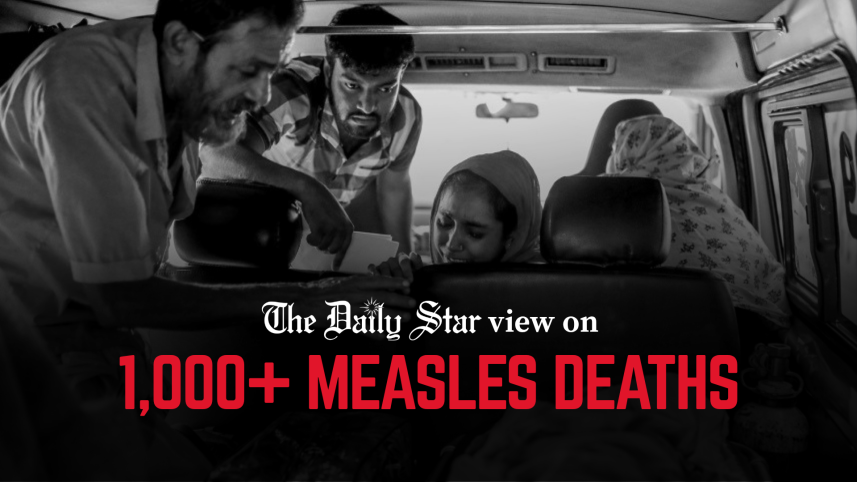
When more than 1,000 children have died from a single preventable disease over six and a half months, playing the old blame game is unacceptable. The BNP government may not be entirely responsible for the measles outbreak, but the deaths are occurring under this administration. So, it cannot afford to leave any stone unturned to rein in the disease. Yet, what we see is more effort going into controlling the narrative surrounding the outbreak than into ensuring that measures to contain it are implemented with the accuracy, efficiency, and effectiveness they demand.
While the BNP government has carried out emergency measles-rubella vaccination campaigns nationwide, along with other measures such as upgraded critical care capacities (mostly at tertiary hospitals), the outcome has not been satisfactory. Measles fatalities and cases declined temporarily in June and July, but peaked again in August.

The procession of tiny coffins could not be stopped because gaps remained in vaccination coverage; the role of primary healthcare and local private health facilities was largely overlooked; and the level of pandemic-era-like intervention required to contain a disease as highly infectious as measles was not implemented. For instance, we have not seen mass-media campaigns on handwashing, isolation, early detection, and contact tracing as we did during the Covid pandemic. We are not suggesting lockdowns, but where is the constant messaging, debunking of social media anti-vaccine mis-and-disinformation, or an initiative to involve local community and religious leaders in creating awareness?
Even experts claim that the government has not properly implemented many of the interventions that have been suggested. For instance, an outbreak investigation by the Institute of Epidemiology, Disease Control and Research (IEDCR), conducted in two upazilas in May, shows that most measles cases first contact local pharmacies, clinics, village doctors, and community hospitals. Patients were taken to tertiary facilities only when their conditions grew worse, by which point it was often too late to save the child. Yet, there has not been any visible attempt to integrate these first-contact facilities into efforts to contain the outbreak. The prevalence of the disease was also found to be higher among families who travel more. But no notable messaging on this issue appears to be relayed to parents. Besides, the persistent lack of doctors and equipment to provide critical care at rural facilities makes the situation worse for the child patients and their parents. People often have little choice but to hop between hospitals desperately, sometimes draining all their savings or borrowing money at high interest rates.
The government must, therefore, conduct a thorough and honest assessment of the measures taken so far to contain the disease, evaluate the performance of the agencies, departments, and ministries involved in this fight, and identify and address the gaps before they empty yet another mother’s lap. Admitting missteps and correcting them is not costlier than a child’s life.
 For all latest news, follow The Daily Star's Google News channel.
Comments