


Keep politics away from Family Card
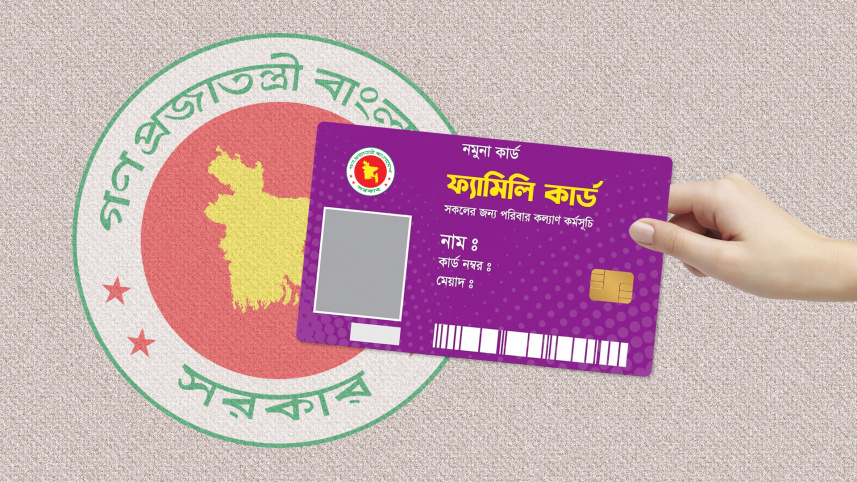
The success of a project primarily, and most importantly, depends on how it was planned. Considering this, the piloting of the Family Card Programme, a massive initiative of the newly elected BNP government to streamline the weak social safety net, has passed with little or no controversy.
However, even as the programme embarks on a full-scale rollout today, some disturbing developments cast a shadow over the selection of beneficiaries—no less than 16 million households by 2030.

Over the last week there have been reports of protests, vandalism and even of disgruntled applicants laying siege to upazila council offices. There have been at least nine sub-districts that witnessed such disturbance over recruitment exam results for the Family Card Programme. And the number of such disturbance grows with every passing day.
In most of the incidents, student and youth wings of the ruling BNP along with aggrieved applicants were involved, prompting the authorities to suspend the published recruitment results at some upazilas. The common allegation of all the protests was that successful examinees had close ties with either the fallen fascists (meaning Awami League) or were linked with Jamaa-e-Islami instead of “actual” contenders.
The UNOs and social welfare officials, however, claimed that the recruitment process was transparent and have asked the aggrieved protesters to come with specific allegations instead of making sweeping remarks.
Field-level information collectors and their supervisors are critical for the success of the much-vaunted family card project. There have been many instances when deserving beneficiaries were left out of social safety net programmes due to nepotism, corruption, and political considerations.
According to a Daily Star report, the administration is set to deploy 66,815 information collectors and 6,681 field supervisors for the baseline survey.
Not surprisingly, as many as 469,103 applications were submitted through 583 social welfare offices nationwide. It only speaks to the competition for even a temporary job that offers an enumerator Tk 165 for each household surveyed, and supervisors Tk 30 for each entry.
However, the burning issue is the transparency in recruitment of the field staff. If there is nepotism or bias at the grassroots, as alleged by the demonstrators, then the project may face a blow in selecting the actual beneficiaries.
More alarmingly, however, if the demonstration is merely a means of political pressure at the grassroots to select party loyalists irrespective of merit, it could be detrimental to what BNP has been showcasing as its flagship project from even before the election campaign.
Last Thursday, the Department of Social Services of Rajshahi Division directed the local authorities in Lalpur, Bagatipara, Gurudaspur, and Boraigram upazilas to suspend the results immediately.
This order will invariably disturb an initiative that officials describe as the country’s most comprehensive overhaul of its social welfare system in decades, often plagued by administrative leakages and political patronage.
Besides, the novelty of the Family Card Project is that it aims to empower women with a monthly allowance of Tk 2,500 to be paid to the eldest female member of each eligible household.
According to a presentation at the cabinet committee, the programme will cover 4.1 million families till 2027, another 8.1 million by 2028, and 12.1 million by 2029, before reaching its target of 16.1 million households by 2030.
One can only hope that the controversy around the field staff recruitment in no way taints the Family Card Programme that the BNP government wants to turn into a cornerstone of its social protection initiative.
It is important for the government to resolve the transparency disputes swiftly, decisively and convincingly so that the project’s credibility does not begin to erode even before it has been launched in earnest.
 For all latest news, follow The Daily Star's Google News channel.
Comments