


AI can transform our health system, but are we ready for it?

How AI can drive public awareness and clinician empowerment in Bangladesh
Suggested: How AI can reduce the rural-urban healthcare gap
Clinical AI tools can transform our health system, but are we ready for it

Sumit Banik
Bangladesh’s healthcare sector has long grappled with severe structural limitations—acute physician shortages, a massive rural-urban divide, rising burdens of non-communicable diseases, and high out-of-pocket medical expenses that push vulnerable families into poverty. Traditional models of healthcare delivery are struggling to keep pace with these challenges. In this context, digital transformation can help build a resilient health system. By strategically integrating Artificial Intelligence (AI) not as a replacement for human clinicians, but as an interactive public educator and a clinical co-pilot, public health awareness and the knowledge levels of our healthcare workers can be elevated.
For decades, the primary bottleneck in Bangladesh’s public health has been a profound lack of health literacy. Misinformation, reliance on uncertified local healers, and social stigma frequently delay critical diagnoses. Here, interactive AI applications and localised digital health assistants can serve as the first line of defence. By translating complex clinical jargon into accessible, culturally resonant Bangla, AI can empower citizens to make informed decisions about their well-being.
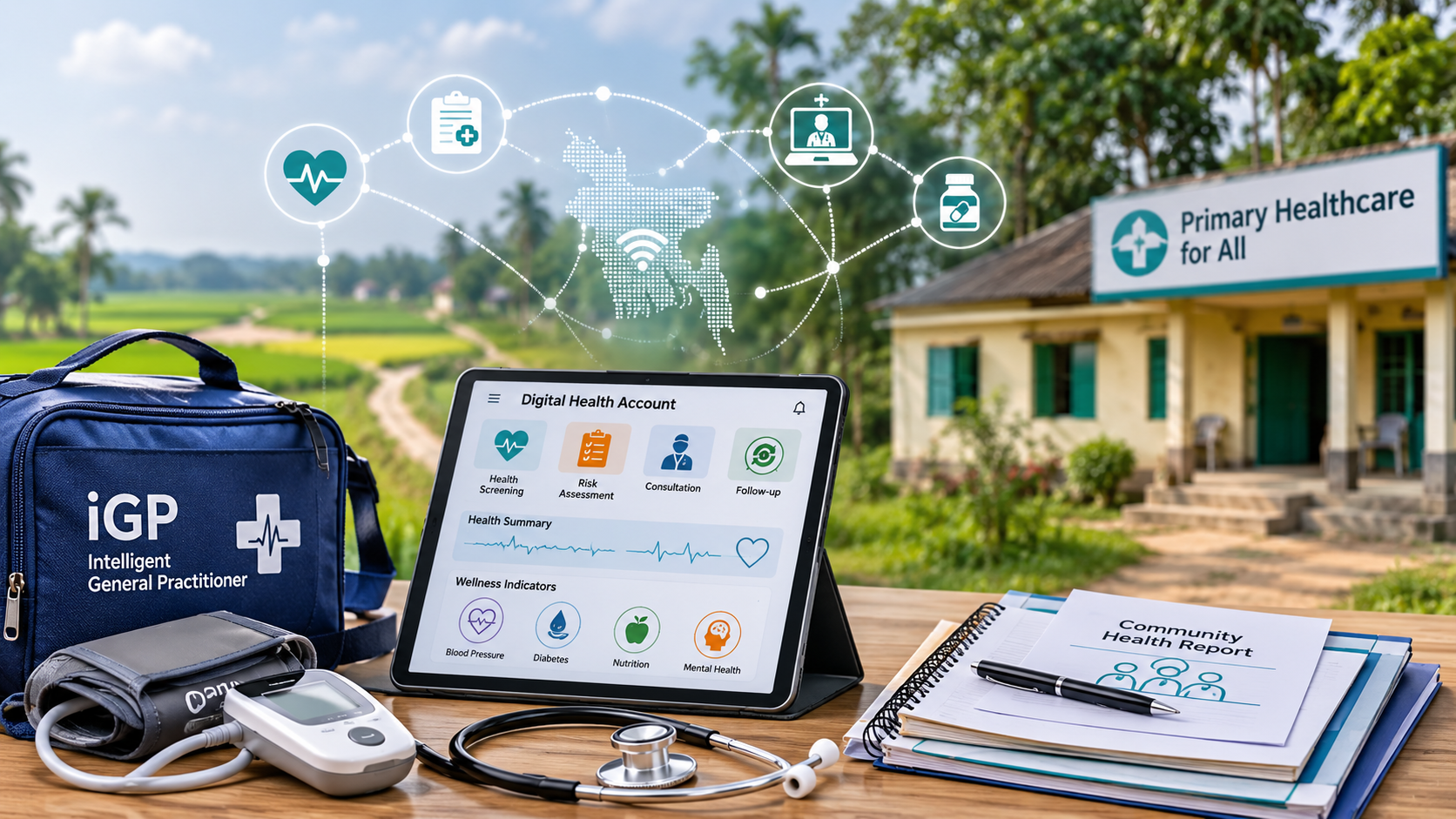
Consider the country's silent mental health crisis. Data from the 2019 National Mental Health Survey indicates that nearly 19 percent of the adult population in Bangladesh suffers from mental health disorders. Yet, due to severe social stigma and a chronic shortage of psychiatric professionals—with only 1.17 mental health workers per 100,000 people—over 90 percent of those needing care receive no formal treatment. AI-powered conversational interfaces and virtual health assistants can bridge this massive gap. An anonymous, text-or-voice-based AI tool can provide individuals with a safe, stigma-free environment for basic mental health screenings and preliminary guidance. Far from replacing psychiatrists, these digital touchpoints act as empathetic navigators, educating users about their symptoms and actively directing them to professionals when necessary.
However, the health system will not be efficient if its primary workforce remains overwhelmed and under-equipped. In Bangladesh, primary care doctors and community health workers face gruelling workloads with limited access to continuous medical education or real-time diagnostic support. This is where clinical AI can be put into use. Studies show that these advanced systems can analyse clinical images, laboratory markers, and historical patient records simultaneously, mirroring the complex decision-making of real-world medicine.
However, a pioneering study titled “Physician perspectives on utilization of AI for medical assistance in Bangladesh: Knowledge, attitudes, and practices” found that while theoretical awareness of AI is high among local clinicians, practical integration remains heavily constrained by a lack of structured training and institutional support. This is further reinforced by another localised study, “Evaluating the Acceptance and Awareness of GPT-Based AI for Health Assistance in Clinical Practice among Registered Physicians of Bangladesh,” which revealed that while 71.11 percent of surveyed physicians are aware of generative AI tools, only 26.13 percent actively accept or utilise them in their clinical workflows.

To bridge this gap, AI must be reframed as an educational asset. A rural practitioner can use an AI-assisted diagnostic tool to evaluate a chest X-ray for tuberculosis or analyse an electrocardiogram (ECG) for cardiovascular anomalies, to discern subtle patterns and gather evidence-based clinical reasoning. Over time, this collaborative workflow can act as a form of continuous, on-the-job training. By assisting with diagnostic triaging and administrative paperwork, AI will free up valuable time, allowing doctors to focus on patient interaction and complex clinical decision-making.
The true test of healthcare equity in Bangladesh lies in our rural sub-districts, where specialised doctors are rarely available. AI can serve as a powerful equaliser to bridge this rural-urban healthcare divide. Studies have found that AI-enabled portable ultrasound technology can revolutionise maternal healthcare. By utilising handheld devices equipped with diagnostic algorithms, local, mid-level community healthcare workers can conduct essential obstetric screenings in remote villages. AI will automatically flag high-risk factors, such as placental abnormalities or breech presentations, allowing rural workers to refer expectant mothers to tertiary facilities well ahead of complications.
However, for Bangladesh to successfully transition into an AI-enabled healthcare ecosystem, a robust regulatory and educational framework must be established. We cannot build a high-tech health system on a fragile legal foundation. First, the government must address the legal vacuum surrounding health data and enact comprehensive health privacy or data protection laws before these technologies are deployed at scale. Clinical AI relies on vast pools of sensitive patient data; without strict guidelines on consent, data anonymisation, and security, basic patient rights and confidential medical records will remain at risk of exposure.
Besides, the critical issue of clinical liability must be addressed. If an automated algorithm fails to spot a life-threatening anomaly, or if a physician over-relies on a flawed recommendation due to "de-skilling," it must be clearly defined who bears the legal responsibility. Finally, the Bangladesh Medical and Dental Council (BMDC) must take a proactive role by integrating basic medical informatics, digital ethics, and AI literacy into the undergraduate medical curriculum, training doctors not to fear AI as a threat to their livelihood, but to master it as a clinical tool.
The future of Bangladeshi healthcare does not lie in a binary choice between human touch and cold algorithms. AI possesses the computational speed to analyse billions of data points, detect subtle patterns, and deliver rapid educational insights to both patients and providers, but lacks the empathy, ethical judgment, and deep contextual understanding that define the art of healing. By deploying it to raise public health literacy and support our frontline healthcare workers, we can construct a more equitable, proactive, and resilient health system.
Sumit Banik is a public health professional and content writer focusing on human rights, equity, and compassionate healthcare. He can be reached at sumitbd.writer@gmail.com.
Views expressed in this article are the author's own.
Follow The Daily Star Opinion on Facebook for the latest opinions, commentaries, and analyses by experts and professionals. To contribute your article or letter to The Daily Star Opinion, see our guidelines for submission.
 For all latest news, follow The Daily Star's Google News channel.
Comments