


Building stronger institutions is key to post-LDC growth


Since independence, Bangladesh has transformed from one of the world’s poorest nations into a more stable and diversified economy driven by manufacturing, exports, remittances, and services, alongside notable social progress. But its development momentum has slowed significantly in recent years. Growth has declined, inflation remains high, private investment is weak, revenue collection is poor, and banking-sector vulnerabilities have grown. The national poverty rate increased from 18.7 percent in 2022 to 21.4 percent in 2025, while about 62 million people—roughly one third of the population—are vulnerable to falling back into poverty. By June 2026, non-performing loans made up 32.78 percent of the total disbursed loans, and the tax-to-GDP ratio is projected to be only 8.55 percent in FY2026. These pressures are unfolding amid persistent geopolitical tensions, global trade uncertainties, and energy-market fallouts, limiting policy options to mitigate further shocks.
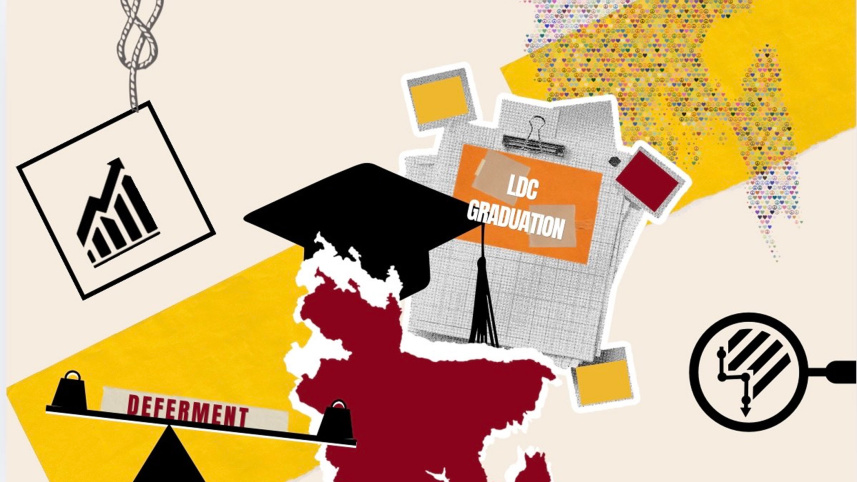
Against this backdrop, Bangladesh has requested a three-year extension to its timeline for graduation from the United Nations’ Least Developed Country category, which is likely to be resolved in the coming weeks. Through its roadmap for 2026-2029, the government is determined to use the period to tackle structural weaknesses and strengthen Bangladesh’s readiness for graduation. The agenda is to restore macroeconomic stability, strengthen institutions, raise productivity, diversify exports, and build a more resilient, inclusive, and sustainable economy.

This is also the central focus of the SDG Facility Project—a partnership between the embassy of Denmark and the Centre for Policy Dialogue (CPD)—implemented in 2025-26. The project established a platform for evidence-based, multi-stakeholder policy dialogue on governance, institutions, inclusion, and sustainable development. It reflects the view that Bangladesh’s success in using its preparatory period and eventually graduating depends not only on strong economic policies but also on the institutions that implement them.
Denmark brings a particular perspective to this discussion. Political scientist Francis Fukuyama used the expression “getting to Denmark” as a metaphor for one of development’s central challenges: building a society characterised by capable government, the rule of law, accountability, and effective institutions. Denmark is not a model that Bangladesh should simply replicate, but the underlying principle matters: sustainable prosperity rests on institutions that citizens and businesses can trust.
Denmark’s experience illustrates how strong institutions, public trust, and sustainable development can reinforce one another. Denmark sits at the top of the global Liberal Democracy Index. It has ranked first in Transparency International’s Corruption Perceptions Index for eight consecutive years, and topped Robeco’s latest Country ESG Ranking. But such rankings should be treated with care. No society is perfect, and Denmark continues to face its own political, economic, and social challenges. Therefore, Bangladesh must find its own path, rooted in its own political economy, social structures, and development experience. Reform is part of its economic agenda, as strong institutions are essential to mobilise revenue, allocate finance, ensure efficient investment, and provide transparent, fair and predictable taxation, customs, regulation, and enforcement.
What does smooth graduation look like?
Bangladesh’s graduation date matters because trade preferences, transition periods, and international support affect the economy. However, delaying graduation will not solve structural challenges. The key is how Bangladesh uses the additional time. Its next transformation requires shifting from an economy reliant on low-cost labour and preferential access to one focused on productivity, skills, technology, diversification, and innovation.
If Bangladesh strengthens institutions, gains investor trust, creates better jobs, mobilises local resources, and promotes greener, inclusive growth, graduating from LDC status could signify more than a classification change. It may mark a new phase of development with prosperity rooted in the capabilities of its people, strong institutions, and confidence in the future.
Over the years, as Bangladesh’s economy expanded and its development priorities changed, the relationship between Denmark and Bangladesh has gradually moved beyond traditional development cooperation towards a broader partnership encompassing trade and investment, the green transition, renewable energy, labour rights, responsible business practices, and institutional cooperation. This reflects a wider change in Bangladesh’s engagement with international partners. As the country now moves towards a more productive, diversified, and competitive economy, cooperation will increasingly focus on trade, investment, technology, knowledge, skills and institutional strength, while retaining targeted development support where it is still needed.
Denmark is well positioned to support this transition due to its expertise in renewable energy, energy efficiency, green technologies, sustainable production, and responsible business. Collaboration on labour standards and responsible practices is also increasingly vital as markets prioritise ESG standards. Stronger partnerships can support Bangladesh’s competitiveness and sustainable development.
Although graduation marks a significant achievement, the gradual erosion of trade preferences and other support measures will pose new challenges. International cooperation will remain important for expanding productive capacity, diversifying exports, attracting investment, transferring technology, developing human capital and strengthening institutions. Such partnerships should ultimately help Bangladesh build its capabilities and resilience.
Why dialogue matters?
The collaboration between the Embassy of Denmark and the CPD shows how a partnership can support better policymaking through inclusive, multi-stakeholder dialogue. The discussions addressed various development challenges: reducing food loss through improved infrastructure, regulation, and farmer empowerment; enhancing industrial sustainability through worker safety, representation, and social dialogue; strengthening land governance, justice, Indigenous rights, and accountability in the Chittagong Hill Tracts; advancing women’s rights through family law reform and anti-discrimination measures; and promoting energy sovereignty through renewable energy, affordable financing, and better governance.
Through a series of multi-stakeholder dialogues and public-facing events, the programme brought together policymakers, government officials, diplomats, researchers, civil society organisations, trade unions, private sector representatives, journalists, development partners, and representatives of affected communities. The discussions covered interconnected issues related to human rights-based development, democratic reform, and sustainable economic growth.
One clear lesson from the series is that complex development challenges cannot be addressed effectively from a single institutional or sectoral perspective. The dialogues connected policy questions with implementation challenges, institutional accountability, and the experiences of people directly affected by public decisions. They also sought to generate practical recommendations, while media engagement helped carry key messages beyond the immediate participants. After all, sustainable reform needs more than good policy; it requires coordination, participation, transparency, accountability, and the capacity to turn recommendations into results.
Bangladesh has repeatedly demonstrated resilience, adaptability, and ambition. Its next transformation will depend on whether its institutions support these qualities by fostering innovation, attracting productive investment, creating better jobs, and maintaining public trust. Denmark and Bangladesh can continue to work together towards that goal. Graduation will change Bangladesh’s status; stronger institutions will determine its future.
Christian Brix Møller is ambassador of Denmark to Bangladesh.
Dr Fahmida Khatun is an economist and distinguished fellow at the Centre for Policy Dialogue.
Views expressed in this article are the author's own.
Follow The Daily Star Opinion on Facebook for the latest opinions, commentaries, and analyses by experts and professionals. To contribute your article or letter to The Daily Star Opinion, see our guidelines for submission.
 For all latest news, follow The Daily Star's Google News channel.
Comments