


Our climate budget must prioritise the displaced

A record-breaking Tk 51,746 crore budget allocation for climate-relevant interventions, marking a 26 percent surge from the previous fiscal year, seems like an unmitigated triumph for a nation on the frontlines of environmental precarity, until one looks closely at where the money actually goes. According to the latest national climate budget data, a staggering 75.2 percent (Tk 38,906 crore) of this total allocation is earmarked solely for adaptation measures, with the bulk concentrated across the Local Government Division, the Ministry of Agriculture, and the Ministry of Water Resources.
While the government spends a large share of money on engineering defences like coastal embankments, excavated canals, and storm regulators to keep the water out, a severe institutional blind spot remains. Addressing the plight of human beings who are already displaced by the water. This is the “brick-and-mortar” bias in our climate policy—a strategy built entirely on the premise of protecting geography, while systematically neglecting the deep crisis of human mobility.

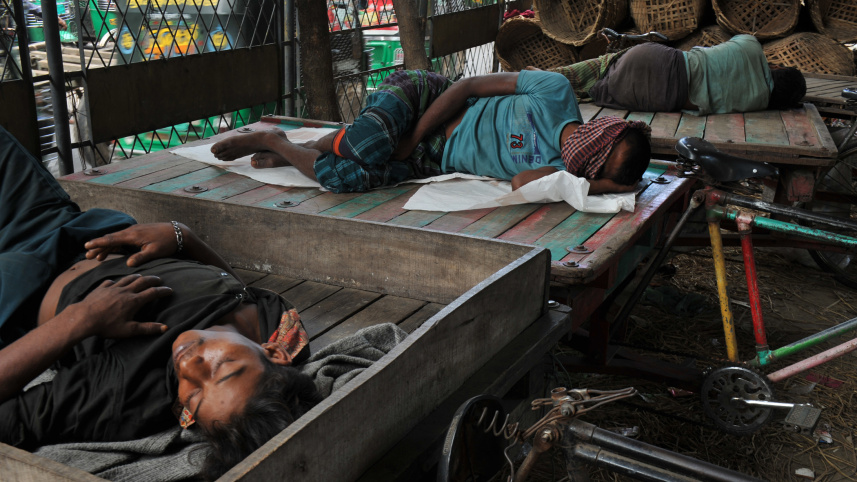
According to data from the World Bank and the International Organization for Migration (IOM), an estimated 2,000 climate migrants arrive in Dhaka alone every single day. Thousands more are forced to stream into the overstretched informal settlements in Khulna or the railway slums of Chattogram. They are not economic migrants who are chasing an urban dream; they are victims of climate displacement fleeing an unravelling ecosystem.
Under our current fiscal architecture, these individuals undergo a kind of administrative deletion when they migrate. While they remain in their rural coastal or riverine villages, they are visible to the state. They are categorised as “disaster-stricken populations” who are eligible for local social safety nets, emergency relief, or water-management interventions. But the minute they cross an invisible municipal boundary into a major metropolis to survive, their climate-vulnerable status vanishes.
In the eyes of urban planning and municipal budgeting, these displaced internal migrants are instantly re-categorised. They become part of the generic, undifferentiated mass of the “urban poor” or “informal settlers.” As Bangladesh lacks a rights-based legal framework that explicitly tracks, defines, and protects an individual’s status as a climate-induced migrant, there is no dedicated, trackable domestic budget line designed to facilitate their transition, secure urban housing for them, or finance their vocational reskilling. They are left to navigate the precarity of the urban informal economy entirely on their own. This policy failure stems from a fundamental conceptual flaw: treating migration strictly as a “failure of adaptation” that can be engineered away with enough concrete.
While structural protection for agriculture and coastal zones is important, the scale of global environmental change makes large-scale displacement an inevitability. It is also projected that environmental degradation and climate shocks could displace up to 13.3 million people within Bangladesh by 2050. Megacities like Dhaka are already bursting at the seams, and their capacity is already exhausted, relegating urban slums to secondary zones of climate vulnerability where migrants face a grim new reality of intense heatwaves and chronic water scarcity.
If our national climate fiscal policy continues to invest the vast majority of its resources into rural brick-and-mortar while ignoring urban resettlement, it will simply be postponing an inevitable socioeconomic crisis.
To break this cycle, Bangladesh must urgently pivot from defensive engineering to proactive, rights-based climate budgeting. Our fiscal strategy must start investing in the dignity and survival of the people. To turn this vision into reality, the government must bridge the structural gap in policies and enhance cooperation between key ministries by embedding distinct, dedicated budgets for “loss and damage resettlement” and “urban integration” directly into the national climate framework. In addition, this funding should target secondary cities equipped to integrate migrants sustainably. For this reason, local governments in Mongla, Rajshahi, and Bogura need consistent fiscal support to develop resilient low-income housing, improve public infrastructure, and create sustainable jobs tailored for climate migrants.
True climate resilience cannot be measured merely by kilometres of embankments or the raw expansion of budgetary allocations. It should be judged by the dignity, rights, and security we extend to those who have lost everything to the tide. If our climate budget fails to balance its focus on structural infrastructure with a rights-based framework for human mobility, our green development will remain an illusion.
Mst. Asma Mahmud is senior civil judge and MPhil fellow at the Institute of Bangladesh Studies in University of Rajshahi.
Views expressed in this article are the author's own.
Follow The Daily Star Opinion on Facebook for the latest opinions, commentaries, and analyses by experts and professionals. To contribute your article or letter to The Daily Star Opinion, see our guidelines for submission.
 For all latest news, follow The Daily Star's Google News channel.
Comments