


Why can’t farmers get fertiliser despite adequate government stocks?

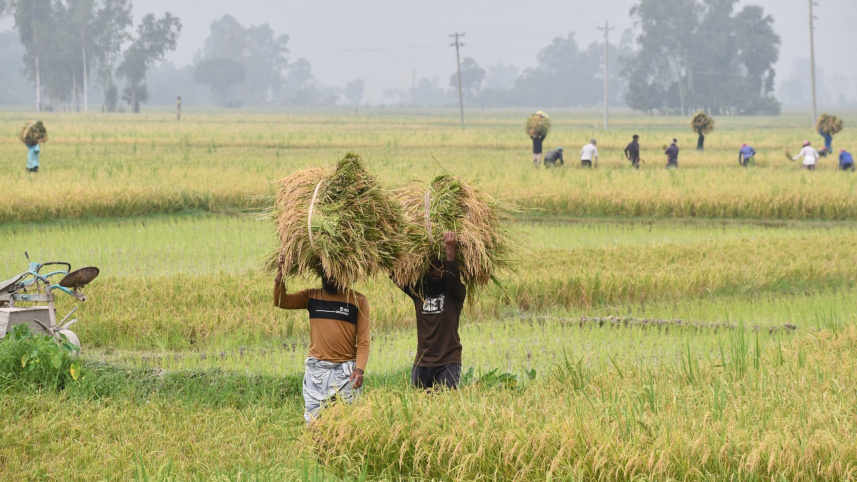
Farmers across the country have been facing a fertiliser crisis for more than a month. Although the government says the country has adequate stocks, farmers are unable to buy fertiliser according to their needs and on time at government-fixed prices. Yet, for farming, fertiliser must be used in the right quantities at the right time; otherwise, expected yields cannot be achieved. The ongoing shortage is therefore putting agriculture and food security at risk.
After planting Aman rice, farmers are usually busy applying fertiliser, clearing weeds, and tending their fields. Instead, they are now running from one shop to another in search of fertiliser. Farmers stand in queues for hours at dealers’ shops and still cannot buy what they need. Even when fertiliser is available, farmers are often allowed to purchase less than what they require. In some places, they have to pay Tk 400-600 more for each 50-kg sack than the government-fixed rate. Elsewhere, dealers turn farmers away during the day, citing shortages, but supply fertiliser at night if they pay extra.

Over the past month, farmers in different parts of the country have staged protests by forming human chains, surrounding government offices, and blocking roads and highways. In some areas, the shortage has become so severe that agitating farmers have broken into dealers’ warehouses and taken away fertiliser.
Bangladesh had experienced fertiliser crises at various times under both the previous Awami League and interim governments. But the current shortage is more widespread and prolonged, recalling the fertiliser crisis under the BNP government in 1995. In March that year, a severe shortage developed during the Boro season. Farmers protesting for fertiliser at fair prices were shot at in different places around the country. At least 12 farmers were killed across the country in a single month.
During the current crisis, there have been instances of cases and arrests against farmers. On September 7, farmers in Bhurungamari, Kurigram demonstrated and blocked a road demanding fertiliser. A case was filed over the alleged confinement of the upazila agriculture officer. It named 11 people and accused another 50-60 unidentified persons. Police have arrested two of the accused, while the inclusion of unidentified accused persons has left farmers fearing arrest and harassment.
The government has taken several measures, including appointing a monitoring officer for each district, forming committees to oversee distribution, creating WhatsApp groups involving district agriculture officers, conducting mobile courts, and setting up a fertiliser management control room. But these measures have failed to address the underlying causes, which is why farmers’ protests are still being reported everyday.
Among the reasons behind the recent crisis are fertiliser allocations that do not match actual demand; dealers not collecting their allocated fertiliser on time and thereby creating artificial shortages; inadequate monitoring at the field level; a shortage of dealers; and uncertainty over the appointment of new dealers.
The gap between demand and allocation
Over the years, agricultural production has changed significantly. Farmers are producing more than one crop a year on the same land, vegetable cultivation has increased, and fish farming in ponds has expanded. Fertiliser demand has therefore risen, but these realities have not been adequately reflected in allocations.
In Roumari upazila of Kurigram, the area under rice cultivation has increased by 1,625 hectares, but fertiliser allocations have not increased accordingly. Roumari reportedly needs 2,095 metric tonnes of urea and 1,676 tonnes each of TSP (Triple Super Phosphate) and DAP (Diammonium Phosphate) fertilisers. In reality, the allocations were 2,040 tonnes of urea, 510 tonnes of TSP, and 900 tonnes of DAP. Thus, TSP and DAP allocations are far below actual requirements.
Similarly, in Rajshahi district, the allocation for 2026-27 reportedly falls short of the demand for all three major fertilisers. Against a demand for 77,470 metric tonnes of urea, 71,109 tonnes have been allocated. Similarly, against demand for 25,880 tonnes of TSP and 54,530 tonnes of DAP, allocations have been made for 17,274 tonnes and 49,578 tonnes, respectively.
Rajshahi has 17,774 hectares of ponds, and although 1,991 metric tonnes of DAP are required every three months to increase natural fish-feed production in ponds, no fertiliser has been allocated. As a result, the demand for fish farming in ponds has to be met by taking from fertilisers allocated for crop fields. This further contributes to the shortages.
Also, under the current allocation policy, equal quantities are given to unions regardless of the number of farmers or the amount of agricultural land. But numbers of farmers differ significantly between unions. For example, Bandaber union in Roumari has 8,528 farmers, while Shaulmari has 6,858. Yet, both receive the same amount of fertiliser. Thus, the union with more farmers receives no additional allocation. Notably, it was in Bandaber that protesting farmers broke through the fence and doors of a dealer’s warehouse and took away fertiliser on September 7.
Not collecting the allocated
fertiliser on time
In many areas, dealers have created artificial shortages by not collecting their allocations on time. Gazipur was reportedly allocated 1,876 metric tonnes of urea in August. But by August 20, only 800 tonnes had been distributed to farmers. Kurigram, where there have been several incidents of farmers breaking into dealers’ warehouses, had an allocation of 5,875 tonnes of urea for August, but dealers had collected only one-third of the amount by August 20.
Dealers have been able to create such artificial shortages because the government has failed to properly monitor their activities through the involvement of field-level agriculture officials.
Problems with field-level monitoring
Every month, the Ministry of Agriculture allocates fertiliser to districts. The Fertiliser and Seed Monitoring Committee, headed by the deputy commissioner, then allocates fertiliser to dealers. Dealers collect it from designated government warehouses.
Upazila agriculture officers are responsible for monitoring whether dealers collect their monthly allocations on time and distribute them properly. In many cases, however, officials fail to perform this responsibility properly. Some allegedly collude with dealers, allowing them to sell fertiliser illegally on the open market at higher prices.
 For all latest news, follow The Daily Star's Google News channel.
 During the current crisis, it has been reported that agriculture officials in at least 15 districts failed to inform the Ministry of Agriculture in a timely manner that dealers were collecting far less fertiliser than allocated. As a result, dealers were able to collect less fertiliser for two consecutive months without effective intervention, creating artificial shortages in local markets.
Dealer shortages and uncertainty over new appointments
The absence of fertiliser dealers in many unions has also disrupted distribution. Recently, State Minister for Local Government, Rural Development and Co-operatives Mir Shahe Alam told parliament that 3,759 dealers appointed during the Awami League government are now absconding, leaving many dealer points vacant.
Six months after the BNP-led government came to power, the failure to fill so many vacancies reflects serious government negligence. These positions should have been filled much earlier.
The government is now planning to appoint 4,918 new dealers. But the appointment process itself has created uncertainty regarding fertiliser supply and distribution. Many existing dealers fear that they will lose their positions. The activities of current ruling-party leaders and influential individuals around the new appointments have further exacerbated uncertainty. Many dealers also fear that the new appointment policy will undermine their existing influence. As a result, some dealers have become reluctant to distribute fertiliser, contributing further to the crisis.
To resolve the current crisis, allocations must be increased quickly wherever there are shortfalls. Farmers should have easy access to information on how much fertiliser each dealer has in stock. The government must ensure that dealers collect their allocations on time and sell them at the fixed prices, while also taking action against corrupt dealers instead of arresting or suing protesting farmers. Dealer points should remain open every day so farmers can purchase fertiliser when needed. Problems involving supply, transportation, warehousing, or dealer-level irregularities must be addressed immediately.
To prevent future crises, regular surveys should determine farmers’ actual fertiliser requirements, with union-level allocations revised accordingly. The distribution system should be brought under a digital monitoring and real-time tracking system. Through a website and accompanying mobile app, farmers should be able to see how much fertiliser each dealer has been allocated, collected from government warehouses, and how much they have sold.
Multiple dealers should operate in each union so that no single dealer can establish a monopoly. Dealers’ allocations, collection, and sales should also be regularly audited. A 24-hour hotline should allow farmers to report problems, with a mechanism to monitor whether complaints are properly resolved.
Kallol Mustafa is an engineer and writer who focuses on power, energy, environment, and development economics. He can be reached at kallol_mustafa@yahoo.com.
Views expressed in this article are the author's own.
Follow The Daily Star Opinion on Facebook for the latest opinions, commentaries, and analyses by experts and professionals. To contribute your article or letter to The Daily Star Opinion, see our guidelines for submission.
Comments