


Democracy’s new challenges and the difficult road to transition

This year’s International Day of Democracy comes with a sombre reminder that, for the past two decades, the world has been witnessing a continuous decline in democracy. Each year, the number of democratic countries is declining, with fewer countries allowing people to enjoy fundamental rights without hindrance, where liberty is not a distant idea but a reality in practice, where fear is not a defining feature of everyday life, and where participatory governance allows citizens to hold officials accountable.
Indices of democracy, as tracked by organisations such as Freedom House, the Varieties of Democracy (V-Dem) Institute, and the Economist Intelligence Unit (EIU), have been on a downward spiral since 2006. The global economic crisis of 2008 accelerated the pace; the Covid pandemic allowed anti-democratic forces to take advantage; and conflicts, civil strife, and wars have provided a conducive environment for undermining fundamental elements of democracy. The rise of autocratic regimes, further autocratisation of already autocratic governments, the hardening of hybrid regimes, and the decline in democratic quality in previously consolidated democracies have all been hallmarks of the global state of democracy over the past two decades.

Global challenges
There has been an array of persistent challenges to democracy since the decline began, ranging from pernicious polarisation that is tearing societies apart and paving the way for the rise of populism and xenophobia, to disinformation campaigns orchestrated by autocratic regimes globally and anti-democratic forces within the countries. At the global level, the challenges have been far more consequential. Two warrant our attention.
For a long time, autocratic regimes around the world seemed to have remained within their own realms, with their leaders primarily concerned about their own survival. In recent years, however, autocratic regimes have been coming together and creating a “global autocratic ecosystem.” The growing cooperation among Russia, China, North Korea, Iran, Belarus, Azerbaijan, Myanmar, and others is an indication of this. This disturbing development has significant implications for the future of democracy. A research project titled the “Authoritarian Collaboration Index,” under the auspices of Action for Democracy, has documented that while diplomacy is the dominant form of engagement, it is followed by financial ties and military cooperation. And cooperation in information sharing has enabled these regimes to operate more efficiently, both within their respective countries and on the global stage. Apparently, these countries share few similarities in their systems of governance. They lack a centralised system or formal economic integration and occasionally display divergent interests. But they share a common goal: undermining democracy and disrupting the global democratic liberal order.
These countries are “reshaping multilateral institutions, building parallel bodies and influencing existing ones from within, while contesting the liberal norms of transparency and individual rights.” Their cooperative relationships have flourished amid the collapsing of the rules-based global order that emerged after WWII. The behaviour of the United States, particularly under the Trump administration, has expedited this breakdown. The decline in the quality of democracy in the US, Trump’s support for autocratic leaders, and disregard for international norms have widened space for these actors in the global arena.
The second challenge is the growing alignment of far-right forces in Europe and the US. These movements were once limited to domestic anti-immigrant agendas and remained highly “nationalistic” in their discourse. But no more. They are transcending borders and building networks of support. Many of these forces are participating in the democratic process, especially elections, but their commitment to democracy is bereft of inclusivity and equal rights, two pillars of democracy. Collaboration among these organisations and parties across the Atlantic is worrying not only for the West but also beyond, as the role of the US and other Western countries shapes multilateral organisations.
The resilience
While persistent challenges to democracy, coupled with emerging ones, provide a discouraging picture, resistance to autocratisation has been building in recent years. People’s aspirations for democracy have been expressed through elections and popular movements. Autocratic regimes in Poland and Hungary were removed through elections in 2023 and 2026, respectively. Poland returned to a democratic path after eight years of rule by the national-conservative Law and Justice (PiS) party following the 2023 election, while Hungary did so in 2026 after 16 years of rule by Viktor Orbán and his Fidesz party. These developments show that the yearning for democracy remains undaunted.
As elections have been used by many autocratic countries as a tool for autocratisation rather than as a means of expressing popular will, democratic aspirations have also found expression through popular uprisings, as in Sri Lanka in 2022, Bangladesh in 2024, Madagascar in 2025, and Nepal in 2025. These uprisings were mostly driven by Gen Z, who protested corruption, demanded accountability, and challenged the existing political order.
Challenges of democratic transition
The success of reversing democratic backsliding through elections and uprisings is, however, not a guarantee that these countries will transition to democracy. The new Polish government is facing the daunting task of reversing past changes, maintaining unity, and undertaking judicial reforms. The question is whether the government should resort to making decisions disregarding the procedural aspects of democracy. “Proceduralist approaches risk leaving the damage unrepaired and demobilising supporters, while more decisive action may require capitulation to the illiberal playbook,” Stanley Bill and Ben Stanley noted in an article. Hungary’s new government under Péter Magyar has embarked on Operation Clean Sweep, which involves sweeping constitutional, institutional, and media reforms aimed at dismantling the undemocratic legacy of Orbán’s rule.
These two paths pose different challenges. But there is another important challenge witnessed in recent years: regressing to autocracy. Often, a post-uprising situation becomes an authoritarian relapse, either immediately or within a few years. Tunisia, which went through interim governments and elections in the first decade after the downfall of an autocratic regime, saw its democratic constitution unravel and its elected regime under Kais Saied transform into an authoritarian one. The failure to bring about deep-seated institutional changes created this opportunity. The temptation of power and the desire to remain in power indefinitely can encourage rulers to use the authoritarian playbook, restore repressive structures, and employ legal and institutional measures similar to those of the previous regime. The changes, even if adopted, may be merely cosmetic, but they hardly fool the people.
Lessons for Bangladesh
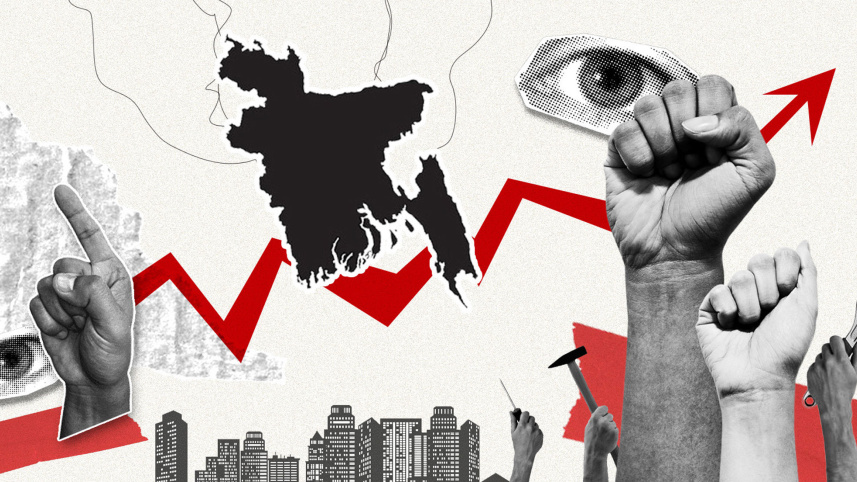
The International Day of Democracy comes with greater significance for Bangladesh this year as the country is undergoing a democratic transition. A government with a popular mandate is in power after around two decades of democratic backsliding, a popular uprising in 2024, and about 18 months of an interim government, with an agenda of state reforms supported by an overwhelming majority of citizens. The government faces daunting tasks, but the central question is whether this historic opportunity will be squandered again, as in the previous three episodes—in 1972, 1991, and 2009.
The global experience of post-autocratic transitions should serve as caution to the new government that democratisation is not only about elections and victory, but instead about dismantling the institutional arrangements of the previous regime, upholding the popular will, creating a new social contract, and eschewing the allure of power. The windows of opportunity during the transition period tend to be very narrow.
Ali Riaz is distinguished professor of political science at Illinois State University in the US. He previously served as a special assistant to the chief adviser of the interim government of Bangladesh and in the Constitution Reform Commission and the National Consensus Commission.
Views expressed in this article are the author's own.
Follow The Daily Star Opinion on Facebook for the latest opinions, commentaries, and analyses by experts and professionals. To contribute your article or letter to The Daily Star Opinion, see our guidelines for submission.
 For all latest news, follow The Daily Star's Google News channel.
Comments