Do great leaders make history, or does history make them?
The age-old debate over the role of individuals in history continues. Do leaders shape history or is history the product of underlying social and economic structures? Can leaders bring about change in society and determine national outcomes? Proponents of the ‘great man theory’ have argued that history is the biography of great leaders. This has been contested by others who insist that economic and social forces are decisive and impose constraints on what individuals can do. But can individuals transcend structures in moments of crisis?
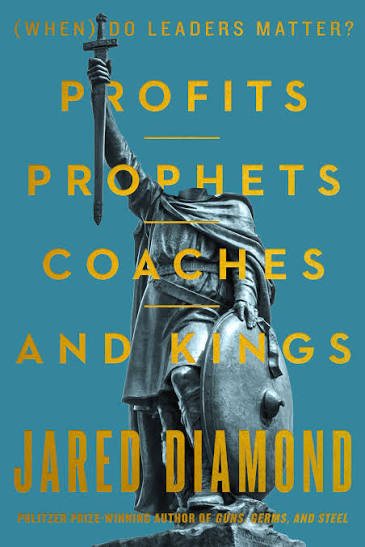
A provocative new book joins this debate. In Profits, Prophets, Coaches, and Kings: (When) do Leaders Make a Difference, Jared Diamond examines whether individual leaders alter the course of their societies. The study marks a break from the American author’s earlier books, which earned the Pulitzer Prize winner much fame. But his bestselling 1997 book Guns, Germs, and Steel and other works also attracted criticism for geographic determinism and playing down human agency. His latest book reverses the lens. Across politics, business and sports, it examines whether individual leaders play a decisive role in shaping the world around them, and under what conditions, if they do. He considers how the interplay between an exceptional individual and historical circumstances determines success or failure.
At the book’s outset, Diamond narrates the incident of March 1930 when Adolf Hitler’s car was hit by a huge trailer truck, in which he survived. Three years later, Hitler became the chancellor of Germany and unleashed the Holocaust and World War II, in which millions of people were killed. He asks whether these horrific events would have happened if Hitler had died in the car crash. Some will argue that things would have turned out differently. Others would point to the humiliation inflicted on Germany by the Treaty of Versailles, by the hyperinflation it suffered and the fact that antisemitism was deeply embedded in the country well before Hitler’s rise. That makes it hard to decide whether Hitler made a difference. This, Diamond says, exemplifies the question of whether leaders determine outcomes, for better or for worse.
He mentions three competing schools of thought in this debate. One sees exceptional and heroic leaders determining history. The opposite view is that leaders are constrained by circumstances and have little influence on events. An in-between view holds that individual leaders sometimes do and sometimes don’t make a difference. His book takes a middle ground in this debate. For the author, the key question is under what conditions leaders can make a difference.
In his discussion of leaders’ impact on history, Diamond sets what he calls the Hamlet test. This refers to whether any contemporary person had comparable qualities to achieve a similar outcome as the individual being assessed. In Shakespeare’s case, his unique talent meant no other Elizabethan could have written Hamlet if Shakespeare hadn’t done so. He cites the example of independent Botswana’s first president as a political figure who passes the Hamlet test. Seretse Khama’s policies made his country well-governed and not consumed by civil wars or diamond revenues being wasted on ostentatious projects. Although he leveraged Botswana’s inherent advantages and his position as a tribal leader, his contributions to his country would not have happened under another founding president. No other figure had comparable skills. He was an effective leader at a particular place and time, and therefore made a difference.
Leaders, however gifted, Diamond says, can be effective only in certain circumstances. For example, Genghis Khan, who established the largest land empire in history, had exceptional qualities but was lucky enough to be born “at the start of the wettest decade in the last 2,000 years on the steppes of Central Asia”. In other words, a military and administrative genius was helped crucially by climatic factors which had favourable economic, social and demographic consequences. Therefore, much turns on enabling conditions.
Diamond draws up a list of 22 modern leaders — familiar names — and asserts that historical figures may be forces for either good or bad. Some leaders led their countries to independence and left lasting legacies. Others established dictatorships and systems that did not outlive them. Some leaders had enough power to execute their policies and make an impact. Being at the right place and at the right time, their context aided them in making a difference.
A leader’s lowest potential for impact is under circumstances making it improbable that a single person could have changed the outcome.
One conclusion he draws is that those who made a difference rarely left office voluntarily — the two notable exceptions being Nelson Mandela and Lee Kuan Yew. He regards education as an important variable in a leader’s effectiveness. He cites the cases of Lee Kuan Yew and South Africa’s president Thabo Mbeki, trained in economics, whose countries’ economies grew spectacularly under their leadership. His account of leaders who contributed positively — and negatively — to national economic growth is particularly insightful.
In discussing business leaders, Diamond notes that many famous names, notably Jeff Bezos, Bill Gates, Elon Musk and Mark Zuckerberg, are credited with changing the world. But were they uniquely qualified to accomplish what they did? He concludes that none of them passes the Hamlet test. They are important and successful risk-takers in modern business, but they were all replaceable. If Bezos hadn’t built an online ‘everything store’, someone else would have, as its time had come thanks to the explosion of the internet. These business leaders made a difference, but not the kind that shapes a society’s trajectory.
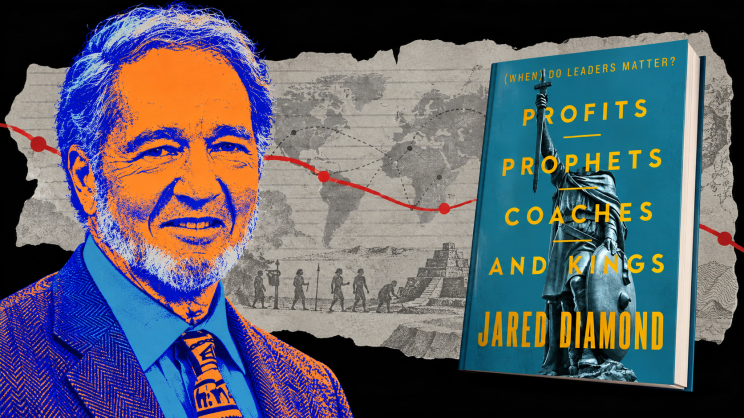
Diamond concludes that context, timing and a leader’s abilities determine impactful leadership. Some situations offer an opportunity for leaders to make impactful decisions, while other situations severely constrain a leader. “A leader’s lowest potential for impact is under circumstances making it improbable that a single person could have changed the outcome,” he writes.
There is much in the book to criticise. In places, Diamond’s what-if counterfactuals confuse rather than clarify. His “natural experiment” methodology of comparing similar societies or business firms facing similar crises but led by different individuals, in order to isolate the leader’s impact, also raises questions. History rarely provides comparable cases. Although he acknowledges the importance of charisma, he says too little about the distinctive qualities that leaders need to be effective. Still, it is an engaging book that makes an important contribution to a debate that will undoubtedly continue for years to come.
This article was first published in The Dawn, an ANN partner of The Daily Star, on September 28, 2026.
Maleeha Lodhi is a former ambassador of Pakistan to the US, the UK, and the UN.
Send your articles for Slow Reads to slowreads@thedailystar.net. Check out our submission guidelines for details.
Poison and cremation: A forensic history of colonial Bengal

Partition, Bor Porong and the Chakmas’ unfinished struggle for belonging
The young radicals who challenged 19th-century Bengal

More men are cooking. But is patriarchy leaving the kitchen?

Everyday secularism and the Bangladesh we rarely talk about
Reading Sarat Chandra at 150, with empathy
Who really owned Britain’s royal jewels?

The 25,000-year history of betel nut chewing
The world map we know is distorted. Why does it matter?