Not love at first sight

Two paintings by the same hand.
At first glance, they seem to be opposites.
The second look reveals something else.
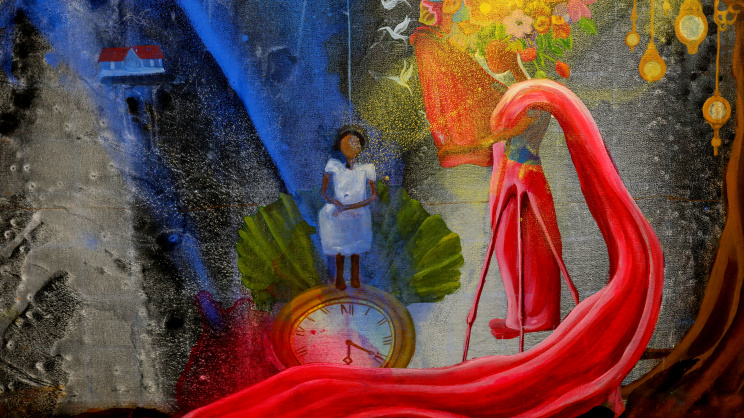
In one painting, a girl in a white dress stands alone at the centre of a deep, oceanic blue. Behind the girl rises a dark mass, or a shadow. Beneath her feet, a clock ticks. To her right, a figure appears in a long red dress, like a folded wing, trailing a ribbon of red that spills off the bottom of the canvas. It is a painting about solitude, or so it seems to me.
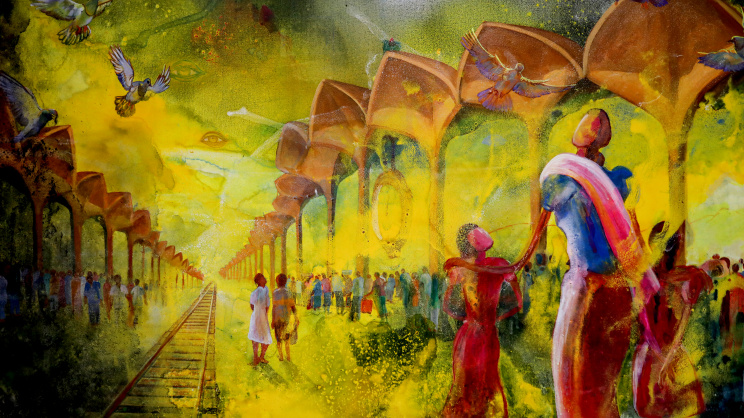
To her right hangs something entirely different: a long avenue of golden light, a crowd of figures walking along a railway track that runs straight through the middle of the scene. It is a city of arches and domes glowing in the haze. Anyone who has stood inside Dhaka's Kamalapur railway station will feel it: the sense of a vast interior space that thousands traverse every day. It is a portrait of what Kamalapur feels like after you have left, the yellow light that lingers long after you have stepped back out into the street.
Look again, and the opposition dissolves.
That is because both paintings are full of birds. In one, small birds rise from the flowers at the upper right, delicate and pale against the dark. In the other, birds fly across the sky in flocks, white wings against the gold. And in both, the light is the same light: a warm, dusty gold that seems to come from somewhere just outside the frame, as if the sun is setting, rising or simply holding still. The solitary girl stands in a pool of that gold, while the Kamalapur crowd walks through a whole sky of it.
A lithograph is an impression pulled from a stone; a woodcut is an impression cut into a block and pressed onto paper. And a memory is an impression too.
They are two registers of the same voice: the solitary and the collective, the private dream and the public theatre, the single figure and the multitude. Both were painted by Rokeya Sultana, an internationally recognised artist known for her abstract and figurative work. Printmaking is one of her media, and it shows: her images are built in layers, as if light itself could be scraped, pressed and coaxed into being.
Both works are part of Second Impression, an exhibition at Bengal Shilpalay that brings together nine artists from three generations.
What does the "second impression" mean in art? The phrase sounds vague, but it signifies what stays after the first glow fades: the meaning we find only when we return, look again and let the work reveal itself. It is the opposite of love at first sight. It is the thing that remains after the first stormy relationship has burnt itself down.
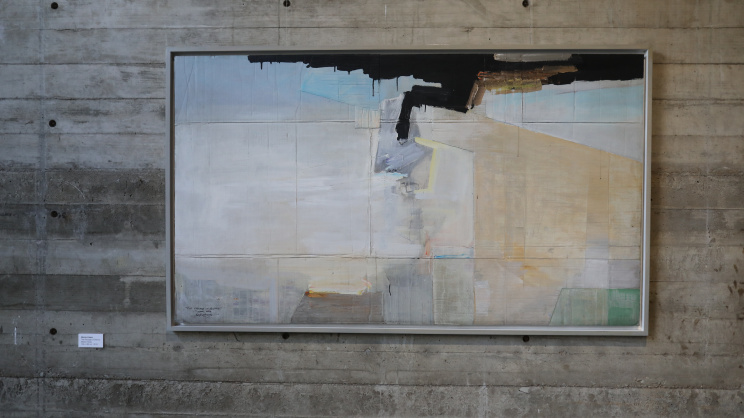
Elsewhere in the exhibition hall hangs Disappearing Frontiers, an etching by Monirul Islam, an international figure known for his signature style and experimental techniques. It is a warm, aged, stained brown: the colour of old parchment, of memory, of things that have weathered time. Across this surface, the title's frontiers are literally disappearing: faint, ghostly grid lines, the architecture of the printmaker's plate, dissolve into smudges of deep, bruised blacks. A heavy dark mass on the right looks like a storm cloud, or a shadow, or an ink spill that has bled into the fibres of the material. Near the bottom centre, a tiny streak of yellow-green pushes through the dark.
It is an image of erosion: slow, patient, almost tender. It is what happens when something is left alone long enough for its edges to soften. And it is the perfect introduction to what this exhibition is arguing: that the first impression, the bold line, the clear boundary, the immediate thrill, is not the truth. The truth is what happens after. The truth is the fading.
In a market that rewards the quickly legible canvas, this exhibition is an intervention. Printmaking is positioned not as painting's minor cousin but as an equal. A printmaker's obsession with structure resurfaces as architecture. Patient layering becomes atmosphere. An incised line returns as gesture. The canvas becomes an open, systemic exploration rather than a stage for a singular "perfect" work.
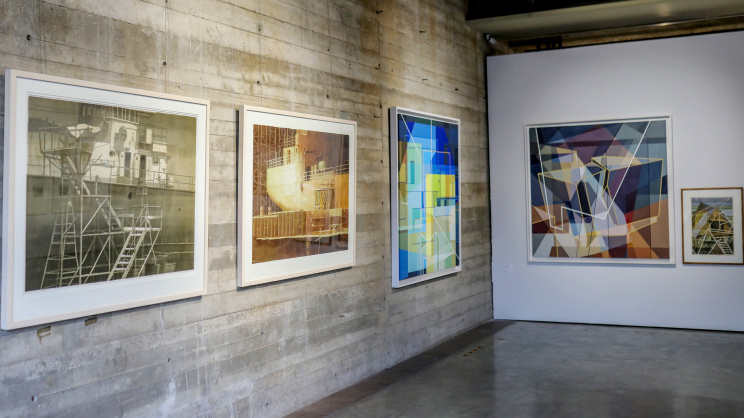
The second impression is a way of being in the world, and it has become countercultural. We live in a culture engineered for first impressions: the scroll, the thumbnail, the hook and the social media reel. Everything is optimised for the instant before you swipe away. The second impression is the opposite discipline. It says: the thing worth having is the thing that survives your own boredom. First impressions reward the loud, the young, the instantly legible, the quickly marketable. Second impressions reward depth, patience, craft and age.
Monirul Islam's Castle on the Beach is an etching with muted purples and greys: a tangle of black lines in the centre suggesting a makeshift structure; a kite in red and yellow on the left; tiny triangular boats on the right; vertical lines falling like rain. To me, the title is melancholic. He has taken the romantic idea of a "castle", something built to last forever, and placed it on a beach: a place of shifting sand, rising tides and inevitable erosion.
This is the work of an older, wiser artist. He is showing us impermanence: how fragile our structures are, whether castles, kingdoms or works of art. And yet, there is such joy in those tiny boats, such lightness in that kite. It is a picture of acceptance. Yes, the tide will come in. Yes, the castle will wash away. But right now, the kite is flying, and the light is catching the water. It is the exact philosophy of this entire exhibition, distilled into a single print: we build, we layer, we press and we let go.
An arched print by the late master Kalidas Karmakar captures a central figure within a glowing, mandorla-like enclosure. The palette is muted and earthy. The first thing that registers is the arch. It rises from the bottom of the plate almost to the top, framing the entire composition like a doorway, a niche or a mihrab. Inside that arch, the surface is dense, almost clotted with line. There’s no free space. It is a space that has been filled, patiently, over many hours.
At the centre stands a figure, or the trace of one. Its head is topped with a conical, ornamental shape. Its body is rendered in the same incised linework as the ground, so that it seems to emerge from the texture rather than sit on top of it. Below the figure, a vertical column of pale, wavy lines descends like water or smoke.
And around the edge of the arch, there is writing: faint, small, handwritten in what looks like some script, running along the curve of the arch and across the margins.
In one painting, a girl in a white dress stands alone at the centre of a deep, oceanic blue. Behind the girl rises a dark mass, or a shadow.
Another painting by Karmakar shows a ghostly profile of a head on the left; a large spiral unspooling downward into a cluster of red threads and a single eye; a fish floating on the right; and a dotted shape in the lower right. Everything here is connected: the face, the fish, the spiral, the eye. They float in a white, textured, infinite space. It feels like a dream, or a page from a book of secrets. And the spiral is the perfect image for the second impression: you do not get it in a single glance. You have to lean in, trace it, follow it, let it wind inward and outward.
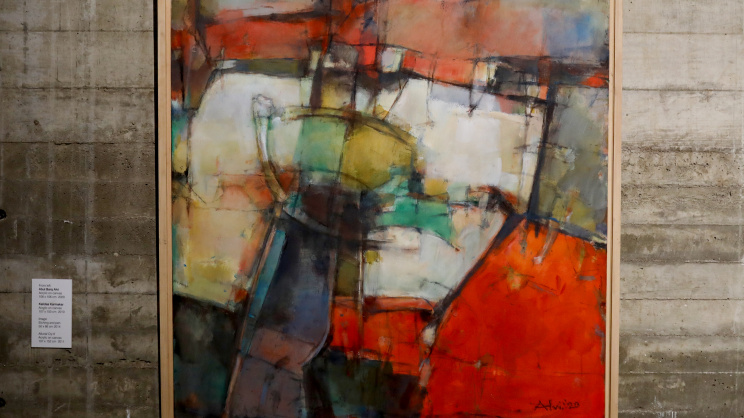
Two paintings by Abul Barq Alvi, hanging vertically, tell two sides of the same story.
In the upper painting, the dominant note is blue: a deep, weathered blue, the blue of distance, of twilight, of a wall that has held its colour through many seasons. Across this field, Alvi has laid down blocks of red-brown and passages of pale, almost chalky white, so that the canvas reads like a façade, or a map, or a grid seen through fog. The lines are firm but not hard; the edges of the blocks blur and soften where the paint has been scraped or wiped. Nothing here is quite solid. Everything is in the middle of becoming.
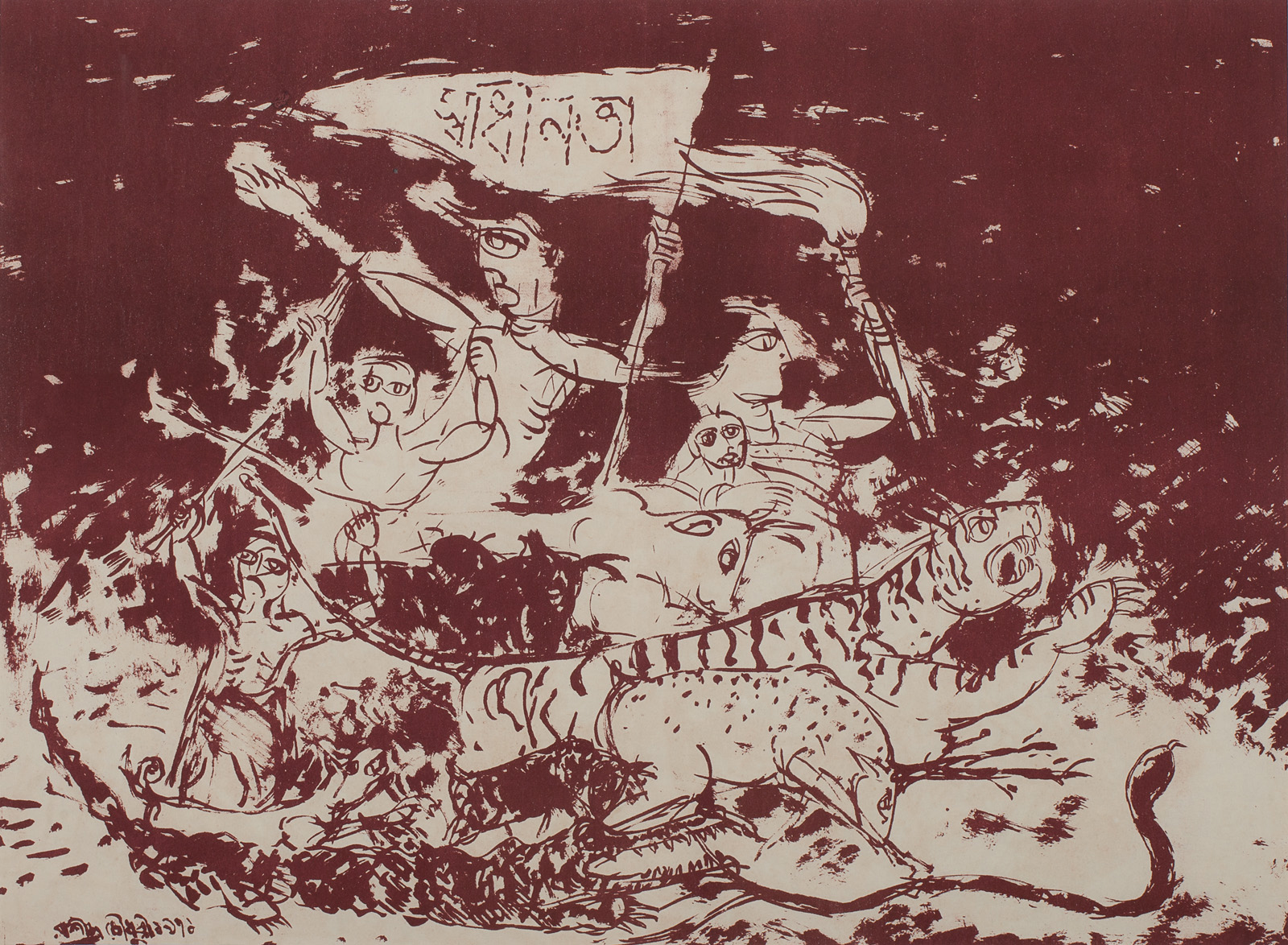
The lower painting is warmer and more organic. Its centre is a dense, saturated teal-green: the colour of deep water, or a forest canopy, or the interior of a room lit by a single lamp. Around this green, the canvas opens into misty passages of blue, grey and pale ochre, and within the green itself, shapes begin to emerge: fragments of figures, perhaps, or fragments of architecture, dissolving into the brushwork before they can fully form. Where the upper painting holds its forms at a distance, the lower one lets them sink into the atmosphere.
The print is intimate, something you hold in your hands. The paintings are monumental, something you stand before. They are equal, nonetheless. They are the whole sentence. Alvi does not see a hierarchy between the print and the painting. He sees two limbs of the same body, two expressions of the same searching eye.
Abdullah Al Bashir's Infinitive-3 is a large landscape with rolling mist and a textured sky. The composition is built on layers. At the bottom is a dark, dense, earthy mass: deep greens, browns, hints of gold. This is the grounded, physical world. Then, rising from that earth, is a churning, white, misty sea. It is the atmosphere made visible. It feels as though the weather is still changing, still moving.
And there, on the middle-left ridge, tiny trees stand silhouetted against the mist, a defiant mark of life in the vastness. This painting, perhaps the easiest to understand, is also about time. We cannot take everything in with a single glance. Our eye has to travel slowly. The painting asks us to linger. It rewards the gaze that stays. The title suggests something ongoing, unbound by time.
Farzana Ahmed Urmi's Impressions from the Past is what printmaking does, literally and otherwise. If we look at the two prints together, we can see the same memory told in two different temperatures. The lithograph, from 2009, is soft, granular, atmospheric: a figure seated on a chair, surrounded by a cloud of black ink that might be smoke, might be shadow, might be forgetting. It is an image of someone half-remembered, half-dissolved. The woodcut, from 2004, is the opposite: hard, incised, physical. You can almost feel the gouge biting into the wood. A rural scene emerges: a figure sitting on the ground among trees and branches, the earth dark and worked, the sky scratched and heavy. This is memory as something you can touch, something carved into you, something that leaves a mark on the block.
A lithograph is an impression pulled from a stone; a woodcut is an impression cut into a block and pressed onto paper. And a memory is an impression too: something pressed into you by an earlier life, still visible on the surface years later, softened at the edges but never entirely gone.
Both prints are black and white, and both are about the same thing: the past does not arrive whole. It arrives as an impression, a trace, a texture, a set of marks left behind. That is why they belong in this exhibition, and why they belong beside Monirul Islam's fading etchings and Rokeya Sultana's dissolving histories.
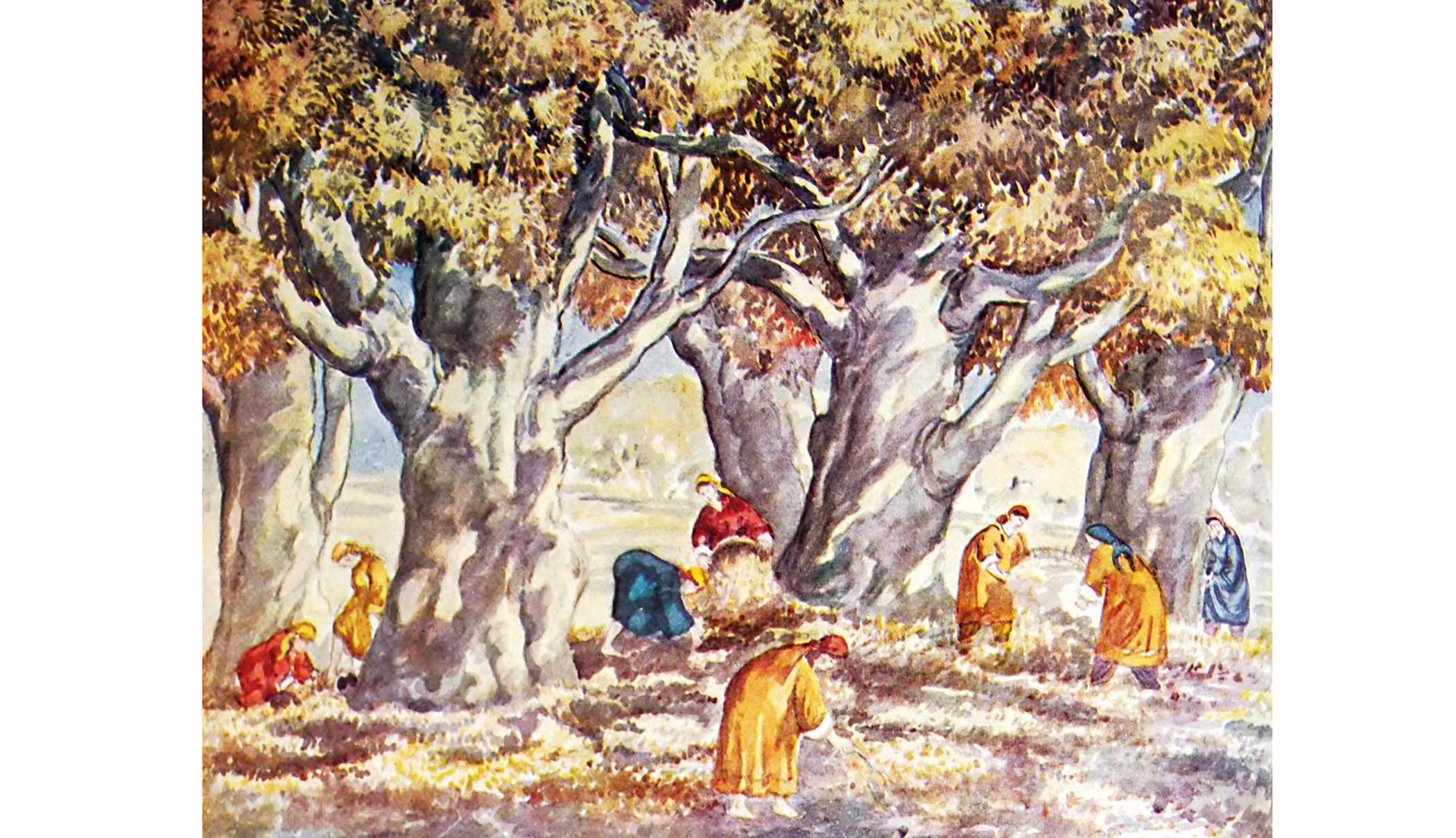
What is memory, after all, but a second impression? For me, the first impression is the event itself at Bengal Shilpalay, something immediate. The second impression is what remains: the version I can still see and carry with me long after the original has gone.
Arun Devnath is the Deputy Editor at The Daily Star.
Send your articles for Slow Reads to slowreads@thedailystar.net. Check out our submission guidelines for details.
How far can devotion take us? Radhe Jaggi’s BHAKTA explores the sacred
The moral hierarchy of pleasure: Who controls women’s bodies?
Inherited Memories / My grandmother’s world: Partition, Shia traditions and memories of Old Dhaka

The taste of childhood: Bengali food, family and memory
Along the Kapotaksha, in search of Madhusudan’s river
Where did gold come from?
Do we understand the children we try to teach?
AI is here. Can Bangladesh’s education system adapt?
Why are we in such a hurry to live?