


Higher match fees, but playing chances remain key

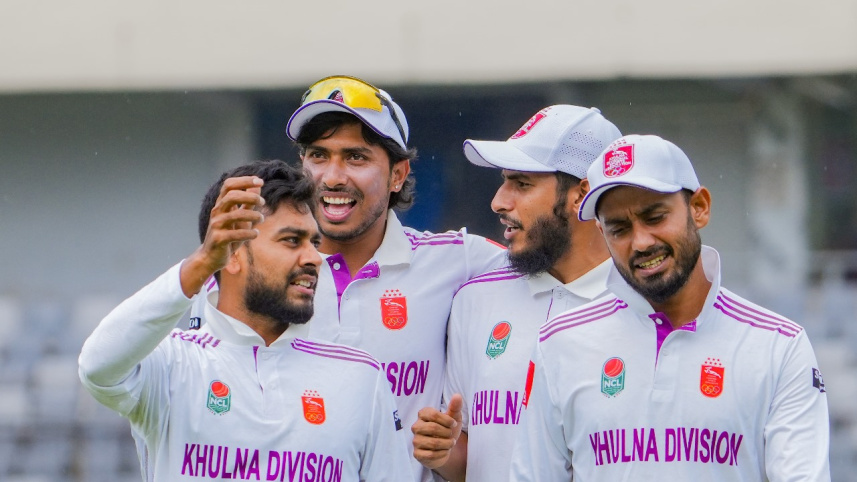
Bangladesh Cricket Board (BCB) president Tamim Iqbal on Thursday announced major increases in domestic match fees, drawing widespread praise across the cricketing community.
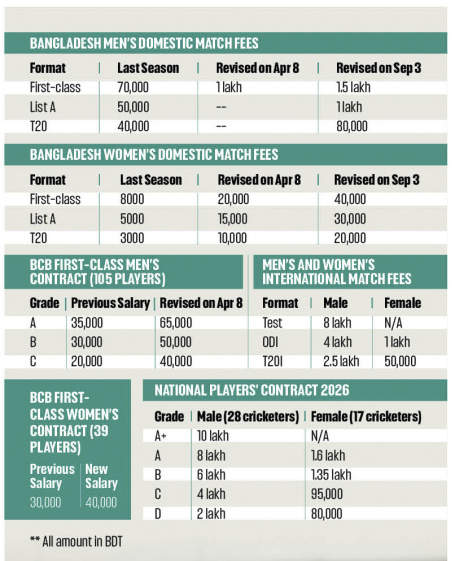
It was the second such hike in five months. On April 8, a day after taking charge of the BCB’s ad-hoc committee, Tamim had raised match fees and first-class salaries for male and female cricketers. But with no top-tier domestic competition held since then, players will only benefit when the National Cricket League’s four-day competition begins on October 3.

The latest revision sees first-class match fees rise 114.29 percent, while List-A and T20 fees double from last season. Women’s fees have also doubled across all three formats.
Tamim said a player completing the domestic season could earn Tk 35-40 lakh, including salary -- more than Tk 3 lakh a month when averaged over a year.
But that raises a pertinent question: will all domestic cricketers have a realistic opportunity to earn that amount, or will the increase primarily benefit those who already feature regularly in the national team, ‘A’ team and top-tier domestic competitions?
Last season’s reality
Only 21 players across the eight teams played all seven matches in the 2025-26 NCL four-day competition. At Tk 70,000 per game, they could earn a maximum Tk 4.9 lakh in match fees, excluding allowances and bonuses.
Rangpur Division played 10 NCL T20 matches, including the final, but no player featured in all 10. Five players -- Abu Hasim, Akbar Ali, Nasir Hossain, Naeem Islam and Alauddin Babu -- played nine each, earning Tk 3.6 lakh apiece at Tk 40,000 per game. Among them, only Naeem and Nasir also played all seven four-day NCL matches, meaning each could have earned Tk 8.5 lakh from the two BCB-run competitions. That excludes the Dhaka Premier Division Cricket League (DPL), Bangladesh Premier League (BPL) and Bangladesh Cricket League (BCL), which features four-dayers and one-dayers.
More matches, bigger fees
The BCB will retain the seven-match NCL four-day competition while introducing a new three-format domestic structure. The NCL T20, though, has been scrapped.
At Tk 1.5 lakh per game, a player appearing in all seven NCL matches can now earn Tk 10.5 lakh. Under the proposed six-team structure, five first-class, five List-A and 10 T20 matches could yield another Tk 20.5 lakh in match fees if the T20 competition uses a double-league format.
The BCB currently has 105 first-class and 28 national contracts, covering 133 male cricketers. First-class players earn Tk 40,000-65,000 a month, compared with Tk 2-8 lakh for national-contract players. A first-class contracted player therefore earns at least Tk 4.8 lakh a year, while national players also receive international match fees.
But higher fees mean little without playing opportunities.
Problem of playing opportunities
Not every player features in all three formats, while unused squad members receive no match fee beyond daily allowances. Those lower down the first-class hierarchy, or without BCB contracts, could therefore see little benefit. Also, occasionally, some players may be rested from domestic matches when national stars are called in, therefore losing matches and subsequent income.
BCB hopes an NCL Second XI will broaden opportunities, although its match fee has yet to be decided. As it will consist of three-day matches without first-class status, the board does not currently intend to offer a substantial fee.
“It’s very little,” a tournament committee official requesting anonymity told The Daily Star, saying the question of player income “was actually not given much importance there”.
 For all latest news, follow The Daily Star's Google News channel.
 The Second XI, he explained, is primarily for players “totally left out” of the main system, giving them a chance to “regain form” and “develop as professional cricketers”.
The proposed structure of NCL will have 15 players in each regular NCL squad and 14 in the Second XI, while the six teams in the new domestic structure will have 25-30 players each.
‘Not all benefit’
Some players, however, fear the fee increase could actually widen the gap between established players and those struggling for opportunities.
“The benefit is not going to be there for all the players,” a Chattogram Division cricketer said, arguing that it will mainly go to those who “play regularly”.
National and ‘A’ team players are best placed to benefit, he said, because they also feature in the BPL and DPL. For those at ‘C’ level, though, “if they don’t get to play”, the increase means little.
Another player proposed paying Second XI cricketers half the first-tier fee. That, he said, would mean a player could earn Tk 50,000 from a three-day game instead of “sitting at home” while getting another chance to prove himself.
Women’s problem simpler: playing
Women’s match fees have more than doubled, from less than Tk 10,000 to Tk 20,000-40,000 depending on format. But their immediate concern is not the size of the fee -- it is the lack of matches.
Their last domestic tournament was the Women’s Bangladesh Cricket League T20 in December 2025. No domestic competition has been held since; the Dhaka Women’s Premier Division Cricket League was also not staged this year, while the proposed Women’s BPL failed to materialise despite two announced dates.
“The amount of match fees has been increased two times, which is very good news for us,” former national skipper Rumana Ahmed told The Daily Star. But she added that “it’s disappointing as we haven’t played a single game this year”.
The issue, she added, has been discussed with the women’s wing chairman, who told players that “they are trying to arrange matches”.
The latest match-fee hike is undoubtedly a major step forward for those who regularly feature in domestic competitions. But without more fixtures and a fairer distribution of playing opportunities, the headline figures could remain considerably more impressive than the actual earnings of a large section of domestic cricketers.
Comments