


Rodri to Real? How his potential transfer could transform Madrid and Man City tactically
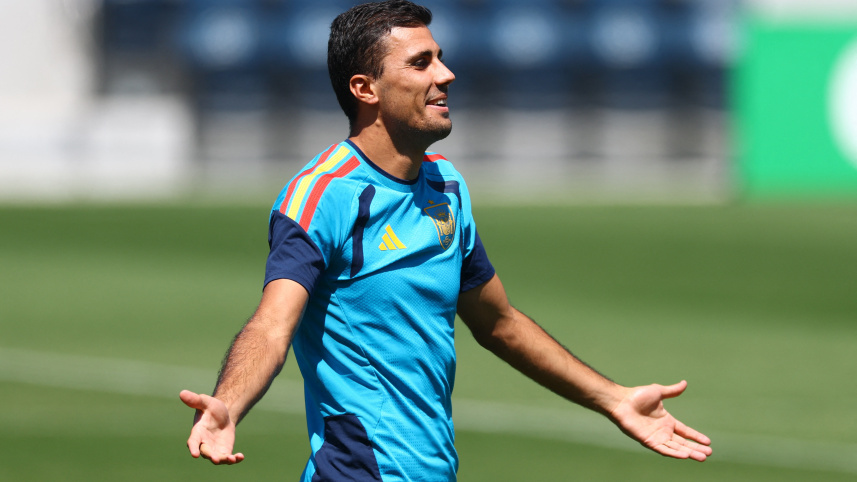
Rodri's potential move from Manchester City to Real Madrid could do far more than dominate the transfer window.
Even with the 30-year-old Ballon d'Or winner facing imminent back surgery and entering the final year of his contract, a switch to the Bernabeu could fundamentally reshape the tactical identities of two of Europe's biggest clubs.

For Madrid, the Spaniard would fill the void left by Toni Kroos and Luka Modric, restoring authority to a midfield that has lacked a true conductor. For City, his departure would force new manager Enzo Maresca to accelerate a tactical evolution built around collective movement rather than reliance on an irreplaceable individual.
A potential transfer, therefore, is about far more than replacing a player or cashing in before his contract expires. It is about redefining how two elite sides seek to control football matches.
Madrid's Missing Conductor
Real Madrid's shortcomings over the past two seasons have rarely stemmed from a lack of attacking quality. Jude Bellingham, Vinicius Junior and Kylian Mbappe possess enough firepower to trouble any defence. Their greater issue has been establishing authority in midfield.
Since Kroos retired in 2024 and Modric departed a year later, Madrid have struggled to dictate the tempo of matches with the same consistency.
Aurelien Tchouameni and Eduardo Camavinga have excelled in defensive phases, but neither has developed into the metronomic presence capable of controlling possession under pressure. Arda Guler's experiments in a deeper role produced flashes of creativity but lacked the positional discipline required to orchestrate Madrid's build-up.
Rodri represents the closest thing modern football has to that profile.
During the 2025-26 Premier League season, no player averaged more than his 96.3 passes per 90 minutes. Yet his influence extends far beyond distribution. Few midfielders read transitions better, recognise danger earlier or recover possession as cleanly after turnovers.
Those qualities were equally evident during Spain's World Cup triumph, where Rodri dictated matches against Portugal, Belgium, France and Argentina without dominating the headlines. His greatest strength lies in controlling space rather than chasing it.
That profile also appears tailor-made for Jose Mourinho's second spell at the Bernabeu.
While Mourinho has never prioritised sterile possession, his best teams have always been built on structural balance and territorial control. Rodri would provide precisely that. His positional awareness allows Madrid to counter-press aggressively while simultaneously protecting the back line, giving attacking players greater freedom to commit numbers forward without exposing defensive vulnerabilities.
For a side searching for control rather than creativity, Rodri could prove the ultimate missing piece.
A Different City Under Maresca
Replacing Rodri, however, may prove impossible.
Pep Guardiola spent years developing him into arguably the world's finest holding midfielder following Fernandinho's gradual succession. Expecting another player to replicate his intelligence, passing range and positional awareness overnight would be unrealistic.
Instead, Maresca appears ready to ask a different question altogether.
Rather than searching for another Rodri, the Italian seems intent on building a system that relies less on one player dictating every phase of possession.
His positional-play model is built around constant rotations within a fluid 3-2-2-3 structure, where responsibilities are shared rather than concentrated in a single holding midfielder. City's recruitment strategy already offers clues as to how that vision could take shape.
The £116 million signing of Elliot Anderson is a clear indication of that thinking. Comfortable dropping into defence, covering advancing full-backs and operating across multiple midfield roles, Anderson offers tactical flexibility rather than a direct replacement for Rodri.
City are also monitoring Lille teenager Ayyoub Bouaddi, another player capable of playing as a holding midfielder, centre-back or full-back. Such versatility reflects Maresca's preference for interchangeable players capable of maintaining positional structure regardless of who occupies each zone.
 For all latest news, follow The Daily Star's Google News channel.
 The objective is not to find another Rodri. It is to create a collective capable of reproducing his influence through movement, rotations and shared responsibility.
Under Guardiola, City often built around the certainty that Rodri would occupy the right space at precisely the right moment. Under Maresca, that certainty may instead come from coordinated movement across the team, with multiple players assuming different responsibilities as situations demand.
If the move materialises, Madrid would acquire arguably the game's outstanding midfield organiser. City, meanwhile, would embark on a different challenge -- not replacing Rodri, but reinventing themselves without him.
Comments