


That Johannesburg night and Robben’s lasting regret

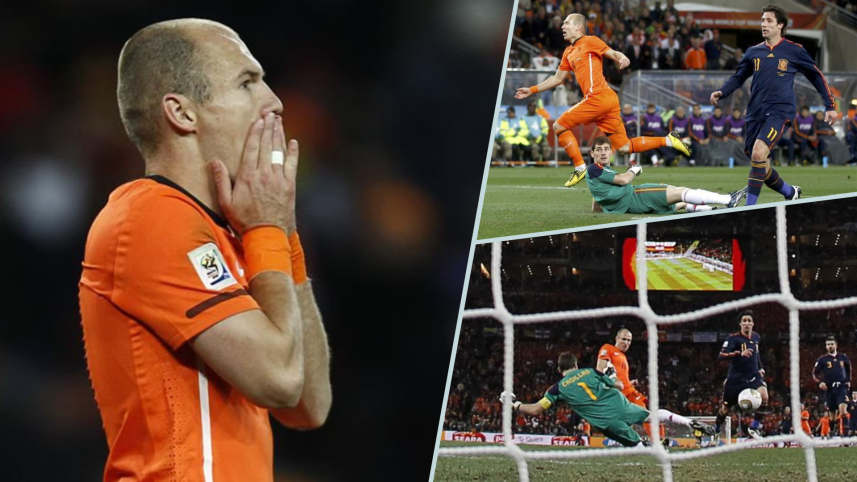
July 11, 2010. The Soccer City Stadium in Johannesburg was thick with breath-taking tension. Spain and the Netherlands were going toe-to-toe in the final of the FIFA World Cup. The entire footballing world waited with bated breath to see a brand-new world champion crowned.
For the Netherlands, it was a golden opportunity to banish the ghosts of back-to-back final defeats in 1974 and 1978, and finally claim football’s ultimate crown. For one particular player from the nation that birthed "Total Football", it was a chance to achieve sporting immortality. Instead, the night morphed into a lifelong nightmare.

Winger Arjen Robben had earned his place in that World Cup squad off the back of sensational form. Yet, after a stellar domestic season with German titans Bayern Munich, he came agonisingly close to missing out on the tournament altogether. Just before the showpiece began, he picked up a hamstring injury during a warm-up friendly against Hungary.
Dutch manager Bert van Marwijk, however, refused to contemplate boarding the plane to South Africa without his most lethal weapon. Robben was kept with the squad, and though he missed the opening two group fixtures against Denmark and Japan, his recovery was swift. After coming on as a substitute in the final group game against Cameroon, he established himself as the focal point of the Dutch attack for the remainder of the tournament.
Robben’s performances in the knockout stages were nothing short of magical. His trademark "cut inside" and finish against Slovakia in the Round of 16, followed by a brilliant towering header against Uruguay in the semifinals, propelled the Dutch into the final. Opposing defences were repeatedly undone by his blistering pace down the right flank and the wizardry of his left foot.
In the final, against a star-studded Spain team renowned for their “Tiki-taka” football, Robben remained the linchpin of the Netherlands’ counter-attacking strategy.
Yet, the first World Cup final on African soil quickly descended into a display of raw physicality rather than beautiful football. Referee Howard Webb handed out yellow cards like confetti, significantly dampening the fans' hopes of witnessing an aesthetic spectacle. Amidst Spain’s suffocating dominance of possession, Robben was the ultimate terror whenever the Dutch broke forward. But at the definitive moment of destiny, when the stage was set for him to become the hero, disaster struck.
The clock showed 62 minutes played. The scoreline remained deadlocked at 0-0. Collecting the ball deep within his own half, Wesley Sneijder threaded a sublime, defense-splitting through-pass right through the heart of the Spanish backline. Outpacing La Roja’s star defensive duo of Carles Puyol and Gerard Pique, Robben seized control of the ball. He surged into the penalty area at breakneck speed. Only goalkeeper Iker Casillas stood between him and glory. The entire stadium fell into a pin-drop silence.
Bearing down on goal, Robben unleashed a left-footed strike. Casillas, who had rushed off his line, had already committed and dived the wrong way. But his reflexes were unbelievable. Even as he lost his balance, he flung up his right leg. The ball clipped the trailing toe of his boot and spun agonisingly wide of the post. Robben sank to his knees, clutching his head in utter disbelief.
One shot. A fraction more elevation, and the ball would have hit the back of the net, handing the Dutch their long-awaited first World Cup title. But it was not to be. That iconic save by the man affectionately known as "San Iker" didn't just turn the tide of the match; it altered the very course of football history. Robben would get one more half-chance in the 83rd minute, but once again, Casillas denied him.
With regulation time ending goalless, the final moved into extra time. When Andres Iniesta finally struck the winning goal for Spain in the 116th minute, the sound of Robben and Dutch hearts breaking echoed far beyond Johannesburg, resonating across the entire Netherlands.
That miss, when presented with a one-on-one opportunity against the keeper, has saddled Robben with an unwanted, permanent regret. Reflecting on it in a later interview, he admitted:
"Of course, that miss will stay with me for the rest of my life. There is no escaping it. But... none of that matters now. It is in the past, and these things happen in sport."
Exactly four years later at the 2014 World Cup in Salvador, Brazil, Spain and the Netherlands crossed paths once more. For the Dutch, that group-stage fixture was a mission of pure vengeance. Robben, seemingly fuelled by the lingering frustration of that dark night in Johannesburg, tore the Spanish defence to shreds.
The Netherlands utterly humiliated the reigning world champions with a 5-1 demolition, with Robben netting a breathtaking brace. Yet, on the grand canvas of the World Cup, that thumping victory and Robben’s superhuman performance served as nothing more than a minor plaster over an old, unhealed wound.
 For all latest news, follow The Daily Star's Google News channel.
Comments