


The beautiful game under a heavy sky

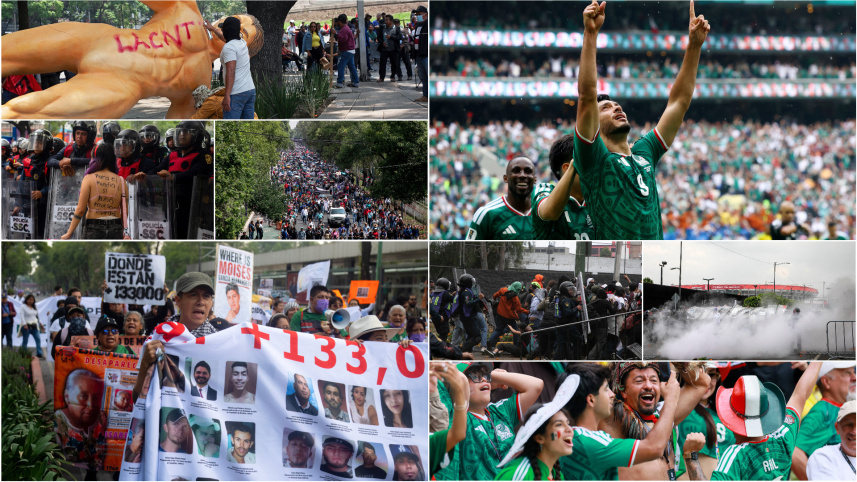
Before dawn had even broken over Mexico City, two processions had already taken to the streets. One was driven by celebration, the other by anger. Both carried banners. On one were the names of football teams; on the other, the faces of sons and daughters who had disappeared without a trace.
This is how a FIFA World Cup can begin -- not merely with football, but as a mirror reflecting a society far larger than the game itself.

The previous day had been declared a public holiday in Mexico City. Schools were closed, offices shut, and the entire capital seemed to be slowly gravitating towards a single destination: the Azteca Stadium. Yet on Avenida Reforma, the atmosphere was very different.
A giant footballer’s effigy erected to celebrate the World Cup had been covered with the message: “No solution, no football.”
It was written by teachers from the CNTE, Mexico’s radical teachers’ union, who only days earlier had pulled down several football-themed sculptures along the same avenue in protest. Their demand was clear: reverse a controversial pension reform that had remained unresolved for years.
Standing alongside them were judges, human rights activists, animal rights campaigners, and the families of more than 150,000 missing people in Mexico -- parents who watched their children leave home one day and never return.
Football could not silence them. If anything, the tournament handed them a global stage. The world’s cameras were focused on Mexico City; why would they allow that moment to pass?
But where did those 150,000 people go?
For many families, the answer is painfully familiar: the drug cartels.
Since the Mexican government launched its military campaign against organised crime in 2006, the number of disappearances has risen dramatically, with cases increasing by around 200 per cent over the last decade. Cartels have used abductions to spread fear and establish control over territories. Many victims are murdered and buried in clandestine graves or dissolved in acid to erase evidence. Others vanish into human trafficking networks or illegal organ trafficking.
For years, families have searched with their own hands, digging through fields and deserts while accusing the state of failing to deliver justice. On the day of the World Cup’s opening, the tournament was not merely a celebration for them; it was an opportunity to make the world listen.
Even on the morning of the opening match, protesters attempted to march towards the stadium before being blocked by police. President Claudia Sheinbaum, who had promised during her election campaign to address the teachers’ grievances and other social issues, was facing criticism as many of those promises remained unfulfilled more than a year into her presidency.
Then came the football.
The Azteca is a stadium heavy with history. Pele played here in 1970. Diego Maradona produced his magic here in 1986. And now, in 2026, it became the first stadium in history to host matches in three different FIFA World Cups.
It is no longer just a football ground. It is a living museum.
As the opening ceremony unfolded, Colombian superstar Shakira took the stage alongside Nigerian artist Burna Boy. Together they performed Dai Dai -- an Italian phrase meaning “come on” or “keep going”. The song’s message seemed to transcend borders. Was it for Mexico? Or for the entire world gathered around the tournament?
Once the match began, it became clear that Mexico had left the controversies of the outside world beyond the touchline. They did not merely come to win; they came to entertain.
Early chances flowed immediately. Israel Reyes delivered a dangerous cross, Raul Jimenez rose to meet it, but South African goalkeeper Ronwen Williams produced a superb save. The resistance lasted only a few minutes more.
In the ninth minute, Julian Quinones -- the Colombian-born forward who had once faced criticism from those questioning whether he was truly Mexican -- opened the scoring. Later, a brilliant delivery from Roberto Alvarado allowed Jiménez to score the first World Cup goal of his career.
Three red cards cast a shadow over the contest, but they did not diminish Mexico’s performance. South Africa finished with nine men as the hosts secured a convincing 2-0 victory.
 For all latest news, follow The Daily Star's Google News channel.
 The evening’s second match in Guadalajara carried a different rhythm -- Asia against Europe.
South Korea controlled possession and constantly pushed forward, only to be repeatedly denied by Czech goalkeeper Matej Kovar, who stood like an impenetrable wall. Son Heung-min came close time and again but found no way through.
Then, against the run of play, Czech captain Ladislav Krejci headed home from a long throw by Vladimir Coufal, and it seemed the night would not belong to Korea.
Comments