


The prodigy who refused to wait
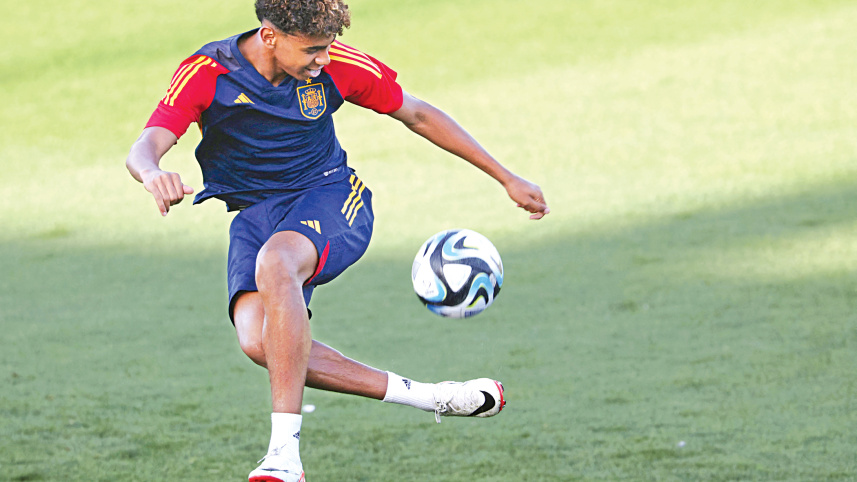
The first thing that stands out about Lamine Yamal is not flair, nor is it raw skill or a penchant for trying the unobvious. It is the calm -- an eerie, composed serenity that completely belies his age.
At a time when most teenagers are still asking to leave class early, Yamal is leaving world-class defenders on the floor and everyone else in utter disbelief.

The world first bore collective witness to this unsettling serenity on a sweltering summer evening in Munich. The date is July 10, 2024. Intense hype surrounds the 16-year-old Spain and Barcelona star as he prepares for a Euro 2024 semifinal against a French side that had dominated all before falling to Argentina in the 2022 World Cup final.
Yamal walks into the ground looking like a million dollars. In a packed stadium, the weight of expectations reverb across the stands and onto the pitch. The pressure is on but Yamal wears it like a crown.
Receiving the ball near the right half-space, he shimmies right, wrongfooting the French backline, before feinting left to bury a magnificent left-footed curler into the top left corner.
He had officially announced his arrival in national colours. That Euro, he played like it belonged to him; he turned 17 years and a day old when he lifted the trophy as the youngest-ever player to win the tournament. Yet, that exquisite curling trajectory was a signature loop he would continuously recreate.
Fast forward to May 7, 2025. Barcelona faced Inter Milan at home in the Champions League semis, falling 2-0 behind within 21 minutes at the Olympic Stadium in what turned out to be a classic affair. Moments like these set up destiny.
Completely unfazed, Yamal shimmies deep into Inter territory, freezing defenders in his wake before producing a clinical, bending effort off the left post to get Barca back on track. Moments later, he draws Federico Dimarco and Henrikh Mkhitaryan to the goal line near the right post, faking them out entirely to hit the crossbar from an impossible angle, leaving commentators gasping, saying “This is a wonderkid!”.
By the end of a dazzling night, as the tie finished 3-3, he had firmly etched his name into football lore. Inter eventually progressed with a 4-3 win in the second leg, but those curling strikes were mapping out a growing stature and his eagerness to impact matches -- an arc Yamal was writing entirely for himself.
Even Lionel Messi had taken notice, noting that the youngster reminded him of his own early years, seemingly anointing him as his successor. Beyond the validation of trophies or sheer numbers, Messi has always belonged to the game’s iconic moments, making his early recognition of Yamal feel like a profound footballing prophecy.
The technical sensitivity is clear; his assists are put on a silver platter and his dribbles bend cognitive reality. The numbers from this past club season back up the hyperbole -- a league title defence with Barcelona, crossing the forty mark in goal contributions, proved that his output has finally caught up to his genius. And yet, he navigates it all looking like a child.
Born to a Moroccan father and a mother from Equatorial Guinea, his journey mirrors Messi’s hurdles, culminating in a formative education at La Masia. Yet, their characters diverge sharply. Where Messi remains a minimalist on the pitch and a humble genius off it, Yamal thrives on social media, carving out a massive reputation in the digital sphere.
His mojo is built on vibrant self-expression, channelling a Neymar-esque street flair, complete with the alluring lifestyle of stardom. He dons the legendary Barcelona number 10 shirt as if it were always destiny.
Having spent the gruelling 2025/26 campaign carrying the tactical weight of that iconic jersey, he enters this tournament no longer as a prodigy on trial, but as the established heartbeat of Barcelona.
In a previous era, a teenager might have been told to wait his turn, but Yamal represents a new archetype of immediate autonomy. “I don’t want to be Messi -- and he knows it,” he famously said. The footballing world moves fast; when Ansu Fati arrived at 16, he was heralded as the next best thing, but now finds himself on loan at Monaco.
Ultimately, football has a way of rewarding those who master its deepest nuances. Whenever the ball reaches Yamal’s feet, entire crowds stand up, squinting for a clearer view, captive to the expectation that something extraordinary is about to happen.
A late twist to the tale sees Yamal carrying a lingering injury into the World Cup. After a gruelling near fifty-game club season that saw him pushed to his physical limits, the heavily bandaged ankle he sports in training camps has thrown a shadow of anxiety over Spain’s camp. Diego Maradona in 1990 or Ronaldo Nazario in 2002 famously entered tournaments compromised, yet still willed their teams to the finals.
Yamal, no matter how many World Cups lie ahead, won’t let this opportunity go by, considering Messi got his hands on the trophy so late in the career.
Youngest player ever to get into the ballon d’Or podium and stepping into North America on the back of successive Kopa Trophies, Yamal arrives like a certainty.
The World Cup remains the grandest stage for ultimate expression, and the world eagerly awaits the next shape of Yamal’s rising arc.
 For all latest news, follow The Daily Star's Google News channel.
Comments