


Guns fall silent in Syria
ahead of fresh round of peace talks in Geneva
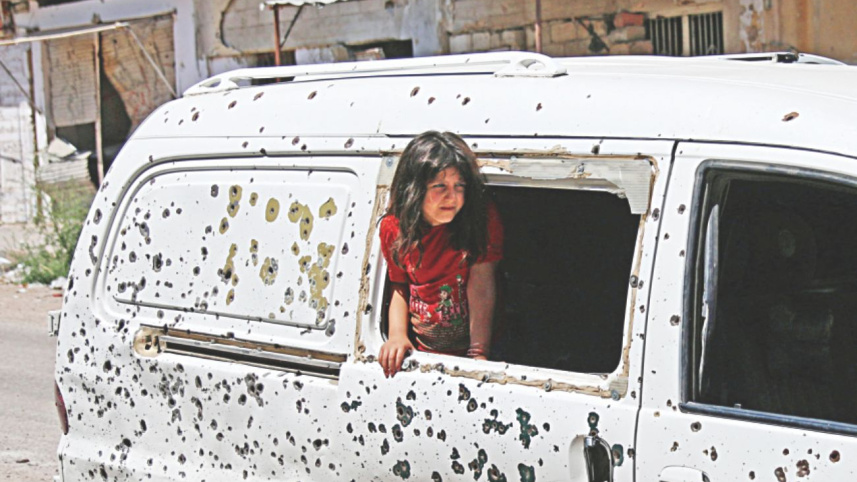
A US-Russian brokered ceasefire for southwest Syria was holding hours after it took effect yesterday, a monitor and two rebel officials said, in the latest international attempt at peace-making in the six-year war.
Clashes and shelling had halted in the three southern provinces covered by the truce, Daraa, Quneitra, and Sweida, as it went into effect at noon local time.

The ceasefire deal was announced Friday by Russian Foreign Minister Sergei Lavrov, and comes as Syrian government and opposition delegations are due to attend a new round of talks in Geneva from today.
"The main fronts in the three provinces between regime forces and opposition factions have seen a cessation of hostilities and shelling since this morning, with the exception of a few scattered shells fired on Daraa city before noon," said Rami Abdel Rahman, the head of the Britain-based Syrian Observatory for Human Rights.
The Syrian regime had announced its own unilateral ceasefire on Monday but fighting had continued on frontlines in the three provinces.
The ceasefire deal comes after regime allies Russia and Iran and rebel backer Turkey agreed during talks in May in the Kazakh capital Astana to set up four "de-escalation" zones in Syria.
Implementation of that deal has been delayed as the three sides try to agree who will monitor the zones, one of which is located in southern Syria.
There has been no official comment from Syria's government on the announcement, and there was no mention of the ceasefire on state television's noon news bulletin.
The Al-Watan newspaper, which is close to the regime, quoted the head of Syria's parliamentary Foreign Relations Committee suggesting that the agreement was negotiated in consultation with Damascus.
"No details on the agreement were presented, but the Syrian state has background on it," Boutros Marjana told the newspaper.
"The final word on adding southern Syria to the 'de-escalation' zones belongs to the Syrian state, and there is coordination with Russia on that," he added.
On Friday, before the ceasefire deal was announced, a delegation of rebel factions that attended talks in Astana expressed opposition to any ceasefire for just one part of the country.
In a statement, the factions said they were concerned about "secret meetings and understandings between Russia, Jordan and America on a deal for the south of Syria, separate from the north."
Such an agreement "would divide Syria, as well as the delegation and the opposition, in two."
The United States, which has largely stepped back from involvement in the Syrian conflict since President Donald Trump took office in January, praised the deal.
"Such zones are a priority for the United States, and we're encouraged by the progress made to reach this agreement," Trump's national security adviser HR McMaster said Saturday.
 For all latest news, follow The Daily Star's Google News channel.
Comments