


Is there enough space for cycling in Dhaka?
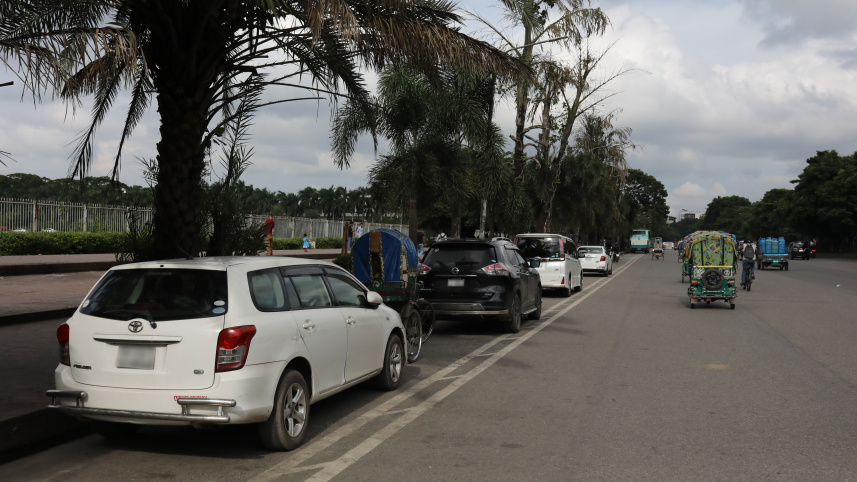
Cycling infrastructure is practically non-existent in Dhaka. Although a few cycle lanes exist, they too are a result of the poor planning and gross mismanagement of the city’s urban infrastructure. A visit to the cycle lanes in Agargaon and Manik Mia Avenue made this painstakingly clear.
In Agargaon, the cycle lanes were occupied by parked vehicles and dozens of fruit vendors. For rickshaws and CNGs, it became a makeshift stand of sorts. There were even segments where there was nothing but soil on the cycle lanes, making it quite dangerous for cyclists.

Similarly, in Manik Mia Avenue, the lanes were occupied by dozens of parked vehicles and food carts. Many cars, which were up for sale, were parked in front of Rajdhani High School. Close by, an underpass construction site occupies the cycle lane together with a significant portion of the road. At some places, the lane was filled with garbage and potholes.
With the existing cycle lanes rendered largely unusable, cyclists are forced onto Dhaka’s already hazardous roads. But how safe or convenient is cycling on these roads in the first place? The answer is overwhelmingly clear: it is neither.
On our roads, cyclists face many problems. One of the most prominent amongst them is the pervasive culture of reckless driving. Fahadul Islam, a cycling enthusiast and owner of the shop Cycle Gear, says, “On our roads, the traffic rules are not equal for everyone. Larger vehicles drive as they wish in any place they want. Cyclists mostly remain in the left lane. Sometimes, due to their reckless driving, we are forced to go rightwards. This is a problem for us because compared to other vehicles on the road, cyclists are very slow.”
Similarly, Zaber Abdullah, a job holder, concurs, “I feel very unsafe while cycling. Sometimes, due to large vehicles or even vehicles like CNGs and auto-rickshaws, we are pushed away from the left lane. Due to this, we frequently get into accidents.”
Although greater investment in cycling infrastructure like dedicated lanes may make cycling easier, it’s the culture of reckless driving that makes it so difficult to have a safe environment for everyone involved, especially cyclists.
Md Arif, a job holder who also regularly commutes by cycling, says, “Everyone should be aware of traffic rules. If everyone drives in their own lanes, even if it means being late, cycle lanes will be well-suited. If not, cycling becomes another danger.”
“Even if cycle lanes are made, people start parking vehicles, setting up stalls, as well as lodging and resting there. A driver may show up and park their vehicle. This forces us to get off the lane,” adds Arif.
Additionally, the dilapidated state of our roads disproportionately affects cyclists more than motor vehicles. Fahadul says, “As cycles have thin wheels, there is a chance of them breaking if the speed is high, which prevents them from absorbing the shock. This increases the chance of accidents for cyclists.”
Other factors like air pollution and a lack of secure parking facilities for bicycles also discourage many from cycling and opt for motor vehicles.
Niaz Mahmud Zafri, a doctoral student in the Department of Urban Studies and Planning (DUSP) at the Massachusetts Institute of Technology (MIT) and also an assistant professor at the Department of Urban and Regional Planning (DURP) at Bangladesh University of Engineering and Technology (BUET) says, “Bicycles account for a very small share, reportedly less than one percent, of daily trips in Dhaka.”
Due to the unplanned nature of Dhaka’s urban setting, much needs to be done to overhaul the city’s infrastructure in order to ensure safe and comfortable cycling.
“Dhaka is a hyper-dense megacity where roughly seven to eight percent of land is allocated to roads, far below what the city actually needs. There is a severe mismatch between travel demand and available supply,” says Zafri. “Given these constraints, transportation investment should follow a clear hierarchy. An integrated network of mass transit and high-quality bus services should form the system’s backbone. Safe pedestrian infrastructure should provide universal access to that network. Within this multimodal system, conventional bicycles and e-bikes can serve as additional feeder modes, particularly for short neighbourhood trips and access to public transportation.”
He also stressed the importance of regulating three-wheelers to ensure the efficiency of this framework.
Together with such a system and a robust network of safe cycle lanes as well as proper enforcement of traffic rules, cycling can genuinely become a more significant mode of transport in Dhaka, reducing dependency on motor vehicles, which cause a lot of externalities.
But hurdles do remain, and they serve as major barriers for cycling initiatives. They include Dhaka’s road system and climate. Zafri says, “Road space is extremely limited. On Dhaka’s already overloaded arterial roads, allocating a full lane exclusively to bicycles may not always be the most effective immediate use of scarce space.”
He continues, “Dhaka's heat, humidity, monsoon rainfall, and air pollution make utilitarian cycling, such as commuting to work or school, physically taxing, leading to sweat and discomfort issues.”
However, it’s fair to say a major contributor to heat in cities is vehicles themselves, and cycling may itself do a lot to fix this issue. It’s thus clear that creating an effective system to encourage cycling needs to go beyond isolated initiatives like creating a few hundred metres of cycle lanes. There needs to be several changes and a move towards a system prioritising public transport and cycle-based feeder networks to make cycling a viable option for Dhaka’s residents.
However, this begs the question: why should Dhaka move from car-centric development to a system that prioritises cycling coupled with public transport networks?
 For all latest news, follow The Daily Star's Google News channel.
 Zafri explains, “Bicycles require substantially less road and parking space, produce no direct emissions, consume little or no external energy, require comparatively inexpensive infrastructure, and are affordable for a much broader segment of the population.”
Cycles are known to help build a more sustainable and liveable city that prioritises its people’s safety and health and its environment. Car-centric development, on the other hand, consumes scarce road space and encourages greater dependency on private vehicles, which undermines efforts to prioritise public transport and pedestrians.
On the individual level, cycling regularly for commuting or travelling short distances allows people to get the much-needed daily aerobic exercise that is usually not easy to get due to busy schedules. This lowers the risk of many diseases, especially cardiovascular diseases that are very common nowadays. A study published in The BMJ found that people who regularly cycled to work had a substantially lower risk of cardiovascular disease, cancer, and death from any cause compared with those who used non-active forms of transport.
Arif says, “Cycling is something that keeps your health very well, both physically and mentally. It gives your mind a sense of freedom and clarity. It’s like another preventive treatment.”
References
1. The BMJ (2017). Association between active commuting and incident cardiovascular disease, cancer, and mortality: prospective cohort study.
Ayaz is a contributing writer at Campus. Reach him at ayazkader710@gmail.com
Comments