


Most default loans are wilful, strong laws can recover 60%

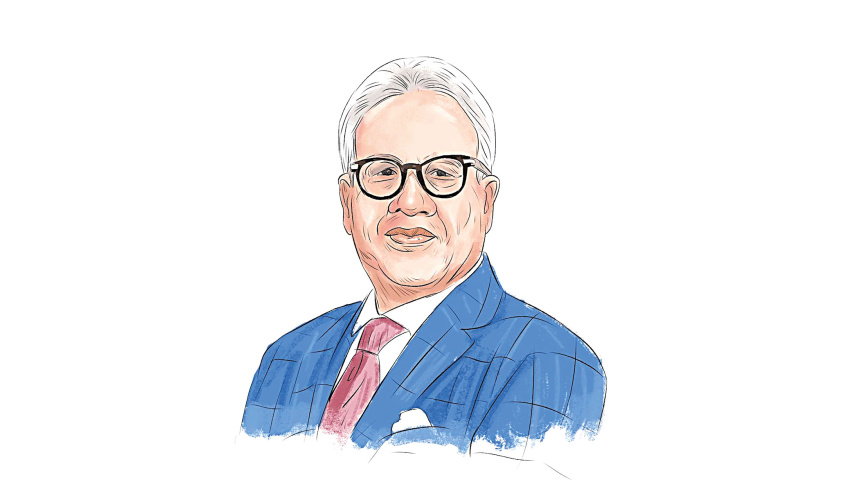
Private commercial banks need stronger legal backing rather than financial support in the next national budget to restore confidence in the banking sector and protect depositors, according to the Bangladesh Association of Banks (BAB).
Around 90 percent of default loans are wilful defaults, and nearly 60 percent of those could be recovered through stricter legal measures, BAB Chairman Abdul Hai Sarker said in an interview with The Daily Star ahead of the national budget for fiscal year 2026-27.

Sarker, who is also chairman of Dhaka Bank and founder of Purbani Group, said weak laws and lengthy court procedures make loan recovery extremely difficult.
“In many cases, banks take months just to prepare cases and obtain court orders, while influential defaulters secure repeated delays or use political influence to stop asset seizures at the last moment,” he said.
At the end of 2025, default loans in the banking sector stood at Tk 5.45 lakh crore, Finance Minister Amir Khosru Mahmud Chowdhury told parliament in April. The amount is equivalent to nearly 69 percent of the original national budget for the current fiscal year.
The finance minister told the House that banks had been instructed to strengthen their legal departments and recover at least 1 percent of their defaulted loan balances in cash by June 30 this year.
In the interview, Sarker argued that banks could recover up to 60 percent of bad loans if laws were strengthened and properly enforced.
He said the new budget should introduce stricter legal provisions so that absconding defaulters cannot appoint representatives to fight cases in court while remaining abroad.
On Wednesday last week, BAB met the finance minister to discuss the upcoming budget. At the meeting too, the association stressed the need for faster legal recovery measures and stricter enforcement. Banking reform was also discussed.
According to Sarker, the current government has inherited multiple challenges and needs time to stabilise the economy.
He said the country’s economic condition can improve if the reforms proposed during the interim government are properly implemented through coordinated efforts.
Asked about the BNP-led government’s commitment to banking reforms, the BAB chairman said it is too early to judge as the administration has been in office for only around three months.
He described the situation as “wait and see” and said a clearer assessment can be made after at least six months.
Against this backdrop, Sarker said the government should adopt a realistic and manageable budget for FY27 given the country’s large fiscal deficit.
The size of the new budget is likely to be more than Tk 9 lakh crore, while revenue collection might reach Tk 6 lakh crore. The resulting Tk 3 lakh crore deficit would need to be financed either through foreign borrowing or borrowing from domestic banks.
Sarker said that excessive government borrowing from banks can place further pressure on the economy and the financial system.
Besides, he said the banking sector expects a more balanced corporate tax structure in the new budget.
Currently, banks face higher tax rates than many private and public companies, while neighbouring countries maintain comparatively lower corporate tax rates, he said.
He, however, added that given the government’s current revenue shortfall, an immediate tax cut may not be practical.
 For all latest news, follow The Daily Star's Google News channel.
 Instead, Bangladesh should focus on widening the tax net rather than increasing tax rates on existing taxpayers, he said.
Many registered companies and individuals still remain outside the tax system, according to Sarker.
He said the government could automatically identify potential taxpayers and improve tax collection by integrating services such as land registration, vehicle registration, utility bills, company registration and tax identification into a single digital platform.
The BAB chairman also emphasised building trust between taxpayers and tax authorities.
“Instead of imposing higher tax burdens on compliant taxpayers, the government should simplify tax procedures, recognise legitimate household and business expenses, and encourage voluntary compliance.”
According to him, cultural and administrative reforms in tax collection would raise revenue more effectively over the long term than repeatedly increasing tax rates.
Speaking further on taxation, he said many businesses and vehicle owners have TIN numbers or company registrations but still do not pay taxes. “The authorities should identify them, engage with them, and ask why they are not paying taxes.”
In the interview, the BAB chairman criticised the enactment of the Bank Resolution Act with debated changes, the merger of five troubled shariah-based banks, Bangladesh Bank’s loan rescheduling and restructuring facilities for large businesses, and the government’s factory reopening fund.
Sarker said Section 18(Ka) of the Bank Resolution Act allows former owners and directors of troubled or merged banks to regain control. According to him, the provision effectively rewards major loan defaulters and money launderers by allowing them easier repayment terms despite siphoning off large amounts of money abroad.
“How can former owners regain control by paying only 7.5 percent of the money? If these bank looters regain control of the banks, the sector will suffer further damage,” he said.
Sarker also said the opinion of BAB, as a stakeholder, was not sought before the law was approved.
The BAB chairman also criticised the interim government’s decision to merge five troubled banks. According to him, such major decisions should involve consultation with stakeholders.
“Before forcing mergers, the government should first stabilise troubled banks through financial support and confidence-building measures to protect public trust in the banking system,” he said.
On loan restructuring and rescheduling facilities, Sarker said banks know their customers best through KYC (Know Your Customer) practices, but the central bank imposed blanket facilities without considering borrowers’ backgrounds and repayment capacity.
The banking sector expects a more balanced corporate tax structure in the new budget. Currently, banks face higher tax rates than many private and public companies, while neighbouring countries maintain comparatively lower corporate tax rates. However, given the government’s current revenue shortfall, an immediate tax cut may not be practical
The Dhaka Bank chairman said those measures increased pressure on banks, weakened discipline and encouraged large defaulters.
Referring to the government’s Tk 60,000 crore stimulus package for the private sector, including Tk 20,000 crore earmarked for reopening closed factories, Sarker said financial support alone would not solve the problem.
“Factories shut down mainly because of weak demand, a lack of buyers, poor management or shortages of raw materials,” he said.
Before providing funds, the government should conduct proper investigations through committees involving private-sector representatives, the Bangladesh Bank and relevant ministries to determine whether a factory is commercially viable, he added.
Speaking about the banking sector more broadly, the Dhaka Bank chairman said coordination between the sector and the current leadership of the central bank has improved because policymakers now have stronger practical business knowledge.
Criticising the central bank leadership during the interim government, he said public comments about weak banks have damaged confidence in the financial sector.
In his view, a central bank governor should act as a careful manager rather than make statements that can create panic among depositors and investors.
Comments