


Ambitious revenue target, elusive reality for NBR

Highlights
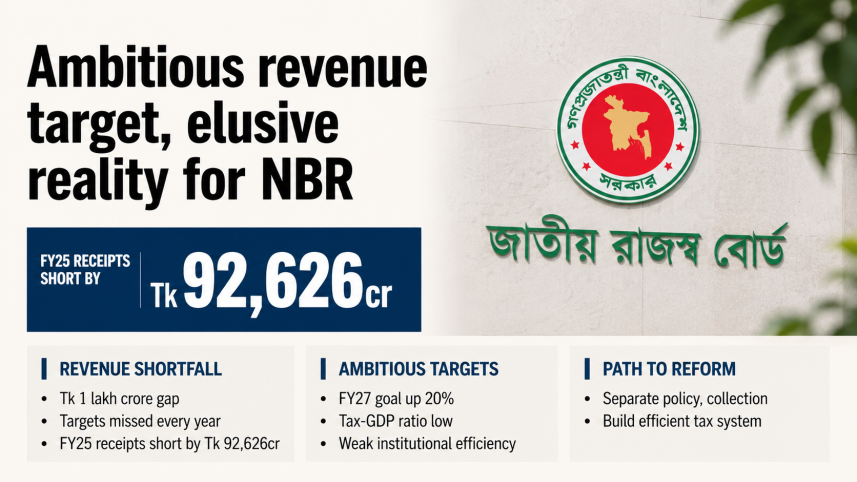
- NBR faces Tk 1 lakh crore shortfall in FY26
- Government plans ambitious Tk 6 lakh crore target for FY27
- Institutional inefficiencies and stalled reforms worsen fiscal deficit
Every budget season in Bangladesh unfolds with a familiar ritual. The finance ministry unveils an ambitious revenue collection target, wrapped in promises of growth, macroeconomic stability, and development, while economists raise quiet eyebrows. The National Board of Revenue then spends the rest of the fiscal year scrambling to close an ever-widening gap.
The current fiscal year 2025-26 is proving to be no different. Revenue growth has remained sluggish amid a slowing economy, weakening private sector expansion, persistent inflation, and mounting pressure on businesses already struggling with rising costs and deep financial uncertainty.

Compounding these challenges are the NBR’s own institutional inefficiencies, which have further undermined collection efforts, leaving the revenue authority staring at a shortfall approaching Tk 1 lakh crore in the first nine months of FY26.
Despite these strains, the state’s appetite for revenue continues to grow. Rising expenditure demands are driven by the new government’s pledges on social protection programmes, including several targeted cards and higher allocations for health and education. This has only widened the distance between what Bangladesh needs and what it can raise.
Against this backdrop, the government is preparing another ambitious target for FY27 of over Tk 6 lakh crore, a 20 percent increase over this fiscal year’s revised budget, aimed at lifting the tax-to-GDP ratio that fell to just 6.8 percent last year, one of the lowest in the world for an economy of Bangladesh’s size and trajectory.
This reality is difficult to avoid: Bangladesh’s fiscal framework is increasingly caught between rising expenditure demands and a revenue system struggling to keep pace with economic reality. Each year, the targets grow taller. But the gap between ambition and achievement widens.
Over the last decade, the tax administration has been missing its targets.
For instance, the last fiscal year (FY25), the tax authority’s overall receipts were Tk 370,874 crore, falling short of its revised target by Tk 92,626 crore. The government initially aimed to collect taxes of Tk 480,000 crore in FY25 but ultimately slashed the target by Tk 18,500 crore.
Although such shortfalls have become almost routine, they are increasingly exposing deeper structural weaknesses in the country’s tax administration and broader economic governance. The problem lies not only in poor collection performance, but also in the way revenue targets are set-- often unrealistically and without adequate alignment with prevailing economic conditions.
This ‘unplanned’ targeting system has turned into a persistent institutional failure, placing enormous pressure on NBR officials to meet ambitious goals through ad hoc and often arbitrary tax collection measures. In many cases, that pressure ultimately trickles down to ordinary citizens and compliant businesses, further worsening public frustration and weakening confidence in the tax system itself.
On top of that, the tax system badly needs rigorous reform and automation, with the separation of tax policy from tax administration. Unfortunately, the process that began with the interim government has now stalled after being lapsed by the Parliament.
Following widespread criticism, the BNP-led government later formed a nine-member committee to review the Revenue Policy and Revenue Management Ordinance, 2025, along with its subsequent amendment. The committee, headed by Prime Minister’s Adviser on Public Administration Ismail Zabiullah, has been tasked with scrutinising the contentious reform measures and assessing their administrative and policy implications.
Finance Minister Amir Khosru Mahmud Chowdhury has recently acknowledged as much and gone further, offering a rare public critique of the mindset that has long governed tax policy in Bangladesh.
“Tax policymakers need to understand the pain of business, the pain of industry, and the pain of ordinary people,” he said at a recent discussion in Dhaka.
“A certain mindset has developed in taxation: ‘I need tax, so take this much percent from here, that much percent from there.’ When tax falls short, the thinking becomes-- take this much from here, that much from there. It is simply a matter of making the numbers add up.”
“By trying to make the numbers add up through taxation, you cannot bring about any real change,” he said.
That is precisely why policymakers are now speaking of the need for a qualitative transformation, one that moves beyond bureaucratic entanglements, arbitrary target-setting and reactive tax measures.
If pursued properly, the ongoing reform efforts could provide Bangladesh with an opportunity to rebuild a more rational, efficient and credible tax system.
Unless the country can break free from this pattern of “big budgets and bigger revenue deficits”, the ritual will continue unchanged. Targets will rise, collections will fall short, deficits will deepen, and next year, someone will once again sit down, sharpen a pencil, and write an even bolder number than before.
 For all latest news, follow The Daily Star's Google News channel.
Comments