


Apparel exporters are losing Russian buyers

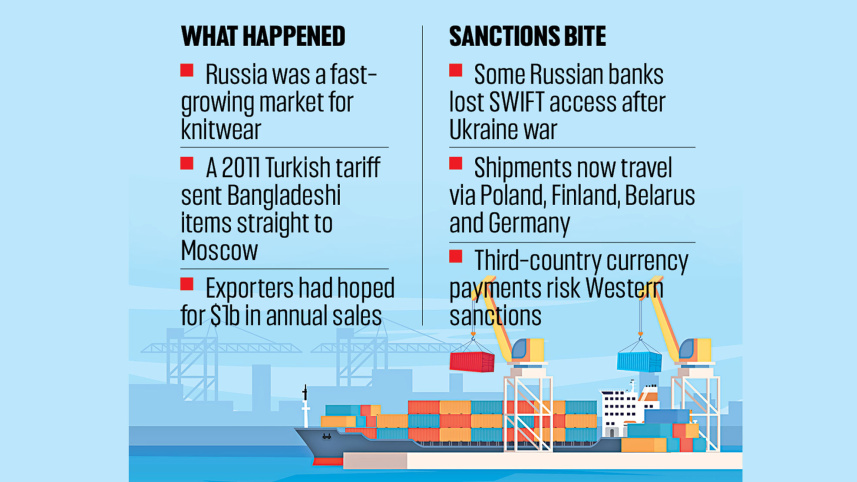
Once a fast-growing market for Bangladeshi ready-made garment exporters, shipments to Russia have been falling in recent years after Western sanctions over the Ukraine war cut Moscow off from international payment systems and disrupted shipping routes.
Before the Russia-Ukraine war began on February 24, 2022, exports to Russia were growing rapidly, driven mainly by strong demand for Bangladeshi garments, particularly sweaters and other knitwear.

Garments accounted for more than 95 percent of Bangladesh’s exports to the country. Local exporters hoped to raise annual apparel exports to Moscow to $1 billion before the sanctions jeopardised the market.
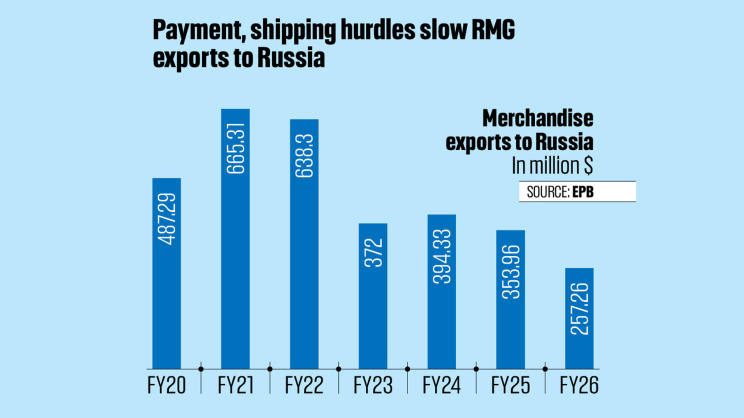
Bangladesh exported goods worth $665.31 million to Russia in fiscal year 2020-21, shortly before the war began, according to Export Promotion Bureau (EPB) data. Exports remained high at $638.30 million in fiscal year 2021-22, but began falling the following year and dropped to $257.26 million in fiscal year 2025-26.
Bangladesh’s garment exports to Russia started to grow faster after the Turkish government imposed a 17.5 percent safeguard duty on Bangladeshi apparel in 2011 to protect its domestic garment industry.
Before the duty was imposed, Bangladeshi manufacturers shipped large quantities of basic garments to Turkey. Turkish garment exporters then rebranded and re-exported those products to Russia.
The high safeguard duty prompted Bangladeshi exporters to reduce shipments to Turkey and send garments directly to Russia instead.
But garment manufacturers now face several problems in serving the Russian market. Many have significantly reduced their shipments as a result.
One of the biggest problems is receiving payments from Russian buyers. Several Russian banks and financial institutions were cut off from the Society for Worldwide Interbank Financial Telecommunication (SWIFT), the global interbank payment system, after the war began.
Exporters can also no longer ship goods directly to Russia. They have had to use alternative routes through countries such as Poland, Finland, Belarus and Germany, making shipments more complicated and expensive.
“Because of payment problems, I stopped exporting to Russia, although I used to export more than $1 million worth of garments to the country before the war,” said Rajiv Chowdhury, managing director of Young4ever Textiles, a local apparel exporter.
He said he faced major difficulties in receiving a $100,000 payment from a Russian buyer. After three years of negotiations, the buyer finally paid the amount through a third-party company in another country.
Despite the difficulties, Rajiv said the Russian market has strong potential for Bangladesh because demand for “Made in Bangladesh” garments remains high due to their competitive prices.
Bangladeshi manufacturers have been trying to ship goods to Russia through third countries and receive payments in third-country currencies. However, they said such arrangements carry significant risks, including the possibility of not receiving payments.
“For example, if a company ships goods to Russia and receives payment in Turkish lira or Chinese yuan, Western countries could impose sanctions on or blacklist the company,” Rajiv said.
Mohammad Hatem, president of the Bangladesh Knitwear Manufacturers and Exporters Association (BKMEA), said local garment exporters are owed more than $1 billion by Russian buyers because they could not receive payments through SWIFT following restrictions on Russian banks’ access to the system.
Many small and medium-sized knitwear exporters are yet to receive $3 million to $4 million in payments from Russian buyers, Hatem said.
“Many negotiations with Russian buyers have taken place, but the payments have not been received,” he said.
He added that some local exporters are also struggling to receive payments for goods shipped to Russia through Polish buyer LPP.
Mahmud Hasan Khan, president of the Bangladesh Garment Manufacturers and Exporters Association (BGMEA), said Western governments have imposed several sanctions on Russia.
 For all latest news, follow The Daily Star's Google News channel.
 As a result, exports to the Russian market have fallen, prompting local manufacturers to focus more on new markets such as Japan, Turkey, India and South Korea. These markets also offer strong potential for Bangladesh, he said.
However, Bangladesh could make Russia a major export destination again once the war ends, as the country remains a large market, he added.
Comments