Why does Tagore still trouble Bangladesh’s idea of ‘us’?

There is a particular kind of argument about Rabindranath Tagore that is difficult to treat as literary criticism because very little literature is involved. One version says, with the confidence of a joke that has somehow become an argument, that everything Tagore wrote was really for his sister-in-law, Kadambari Devi. Another asks what this ‘Indian Hindu poet’ ever wrote for ‘us’.
If the ‘sister-in-law’ line were merely a bad joke, it would not deserve much attention. But repeated alongside the insistence that Tagore was Hindu, Indian and therefore culturally external to Bengali Muslims, it begins to do something more interesting politically. The word I find most revealing in the argument is not ‘Hindu’, ‘Indian’ or even ‘boudi’. It is ‘us’. Who is being included in that pronoun, and who has the authority to decide what belongs inside it?
The literary reduction is almost comic in its ambition. Tagore wrote poetry, songs, novels, short stories, plays, essays and letters, as well as works on education, society, religion, nature, colonialism and nationalism. Yet apparently the interpretive key to all of this is ‘boudi’. If reading literature were really that economical, Gitanjali, Gora, Ghare Baire, Chandalika and Streer Patra could be placed on one side of the desk and a single word on the other. A new discipline could be founded: boudi tattva.
Whatever the precise character of Tagore’s relationship with Kadambari Devi, it is a legitimate subject of biography and historical inquiry. It cannot plausibly serve as an explanatory key to his entire intellectual production. There is also something revealing about reducing Kadambari herself to ‘the sister-in-law’ who supposedly explains a male writer’s work. She disappears as a historical person and becomes a sexual and romantic punchline. The joke that claims to expose Tagore ends up flattening a woman as well.
The more consequential reduction is the attempt to settle Tagore’s cultural citizenship through the words ‘Hindu’ and ‘Indian’. Both descriptions can contain historical information, but neither can carry all the political meaning now placed upon them.
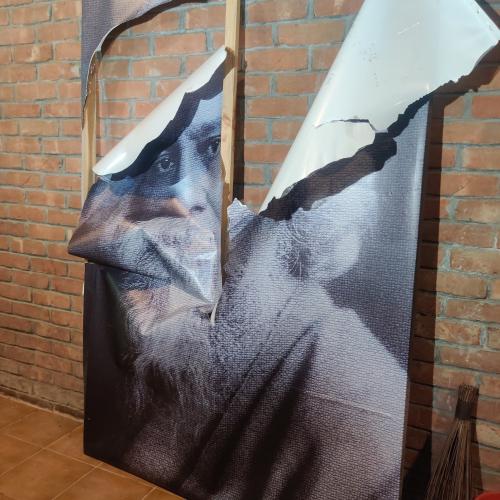
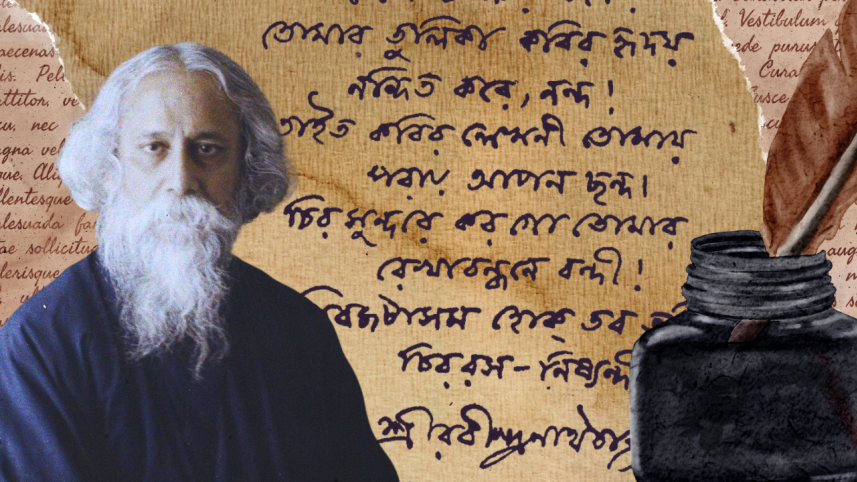
Tagore was born into the Brahmo tradition, and Upanishadic thought shaped his intellectual world. He was also a poet, novelist, short-story writer, dramatist, composer, painter, educational thinker, social critic and institution-builder. He won the Nobel Prize in Literature in 1913. His politics cannot be fitted comfortably into a nationalist box either. He participated in the Swadeshi movement against the partition of Bengal but became a powerful critic of aggressive nationalism. After the Jallianwala Bagh massacre, he renounced the knighthood he had received from the British Crown.
None of this requires turning him into a saint. Tagore was also a zamindar, and his class position, contradictions and limitations deserve scrutiny. Intellectual history is not improved by replacing criticism with reverence. Recognising Tagore as part of Bangladesh’s cultural inheritance does not require treating his particular Bengali world as the whole of Bengal, still less as the only legitimate version of Bengali culture.
The problem with describing him as a foreign cultural presence in Bangladesh becomes clearer when we look at geography. Tagore died in 1941. India and Pakistan were created six years later; Bangladesh appeared three decades after his death. To decide his cultural nationality retrospectively through today’s passport borders is therefore historically awkward. More importantly, a substantial part of his life and literary imagination was formed in places that are now in Bangladesh.
He first came to Shilaidaha in 1889 and spent long periods there between 1891 and 1901 while managing the family estates. He travelled through Shilaidaha, Shahzadpur, Patisar, Kaligram and other parts of East Bengal. The Padma, river life, rural poverty, ordinary people and the landscape entered his letters, stories and poetry. Many of the stories later collected in Galpaguchchha, as well as the world depicted in Chhinnapatra, emerged from these encounters. At Shilaidaha, he wrote or developed major works including Sonar Tari, Chitra and Chaitali; in 1912, he began translating Gitanjali into English there.
The soil of present-day Bangladesh is therefore not an incidental footnote to Tagore’s literary life. If we want to deport him culturally from Bangladesh, we would first have to deport the Padma from his imagination.

The same experience of East Bengal complicates another familiar question: what did he do for ordinary people? At Patisar, in present-day Naogaon, Tagore established schools, a charitable dispensary and an agricultural bank, and supported cooperative initiatives connected with agriculture and rural industry. Accounts of his estate work also record experiments involving education, health, water supply, roads and attempts to reduce peasants’ dependence on exploitative credit. None of this erases the unequal structure of zamindari. It does make the claim that he had no engagement with the lives of the people around him difficult to sustain.
What makes this argument especially difficult to dismiss as a passing social media quarrel is that Bangladesh has encountered versions of it before.
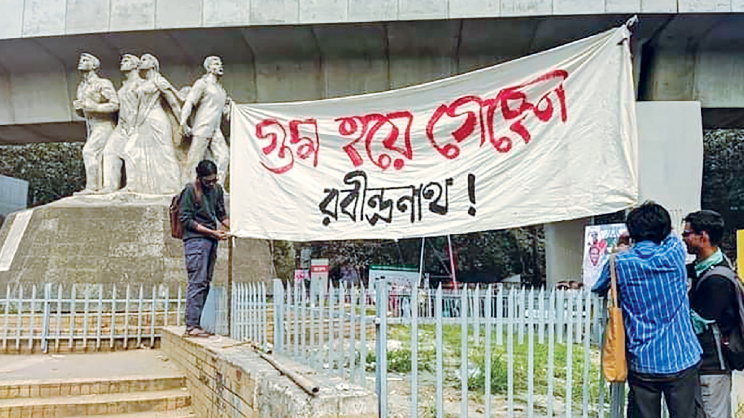
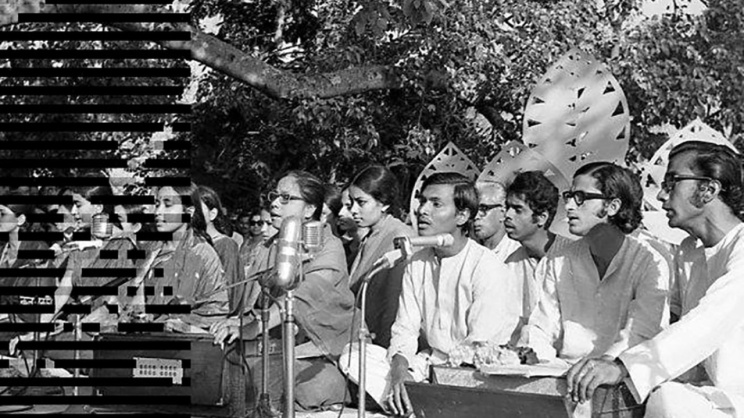
During the Pakistan period, Bengali culture became one of the arenas in which competing ideas of nationhood were fought over. In 1961, resistance to official hostility surrounding Tagore’s birth centenary drew together intellectuals and cultural activists in East Pakistan and formed part of the context in which Chhayanaut emerged. In 1967, Pakistan’s information and broadcasting minister, Khwaja Shahabuddin, announced restrictions on broadcasting Tagore songs regarded as inconsistent with Pakistan’s cultural ideology. Writers, artists and intellectuals protested.
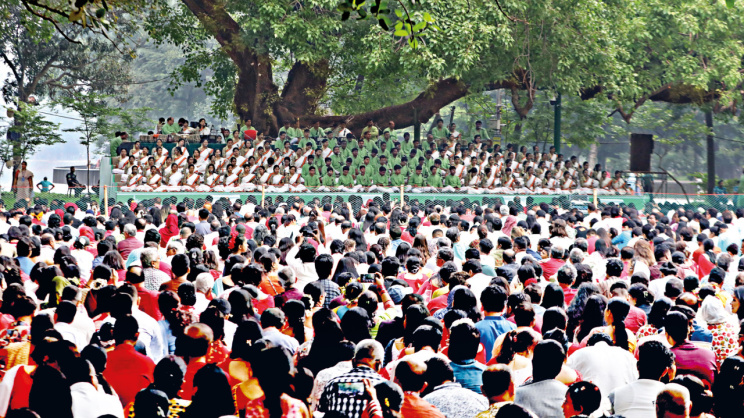
The logic was recognisable: Tagore could be represented as Hindu, Indian and therefore culturally suspect within a Pakistan officially imagined through a Muslim national identity. Yet attempts to push him out of East Bengal helped give Rabindra Sangeet a different political life. It became entangled with resistance to the state’s attempt to define Bengali Muslim culture from above.
Amar Sonar Bangla makes that history particularly difficult to ignore. The song had emerged from the movement against the 1905 partition of Bengal, but its political life did not end there. Banglapedia records its performance at the Paltan Maidan meeting on 3 March 1971, before Sheikh Mujibur Rahman’s 7 March speech, and again during the 23 March programme of the Swadhin Bangla Kendriya Chhatra Sangram Parishad. Before Bangladesh formally existed as a sovereign state, the song had already entered the political imagination of independence.
Cultural texts do not remain permanently owned by the author’s religious identity or by the political geography into which the author is later placed. Communities receive them, argue with them, reinterpret them and sometimes make them part of a new political language. Tagore came from a Brahmo background in colonial Bengal. In 1971, Amar Sonar Bangla was being sung by people in East Bengal imagining a sovereign Bangladesh.
Bangladeshis did not import Tagore from India after independence. His place in the country’s cultural history had already been fought over under Pakistan. In that struggle, Tagore often came to signify something larger than the writer himself: the right of Bengali language and culture to possess a history that could not be reduced to the religious ideology of the Pakistani state.
That dispute did not disappear with Pakistan. After the political upheaval of August 2024, a public demand to change Bangladesh’s national anthem revived arguments over Amar Sonar Bangla and, inevitably, over Tagore’s place in the national imagination. The interim government said it had no plan to change the anthem, while 48 prominent citizens publicly condemned the demand. Jamaat-e-Islami also said that the remarks made by former brigadier general Abdullahil Amaan Azmi were his personal views and not the party’s position. The episode matters here not because every proposal to change a national symbol has the same motive, but because objections to the anthem repeatedly return to questions about Tagore’s religion, nationality and cultural belonging.
So when I hear the apparently simple question, ‘What did Tagore write for us?’, I find myself wondering what kind of relationship between literature and belonging the question assumes. Literature is not a parliamentary development allocation. A writer does not become part of a culture because he set aside a certain number of poems for a future constituency. Shakespeare did not write his plays for every person who would later call themselves English. Rumi did not compose poetry with the passport politics of modern Iran, Turkey or Afghanistan in mind. Cultural inheritance is created through language, circulation, memory, reinterpretation and historical experience, often long after an author has died.
This is why I keep coming back to the word ‘us’. It carries much more of the argument than it first appears to. If Bangladesh’s cultural inheritance is defined retrospectively by the present majority religion, the consequences do not stop with Tagore. What do we do with Michael Madhusudan Dutt’s Christianity? Where do we place Lalon’s resistance to fixed religious identity? If Kazi Nazrul Islam is reduced to a ‘Muslim poet’, what happens to his Shyama Sangeet, his extensive use of Hindu mythology, his attacks on religious orthodoxy and his language of human equality?
Bengali culture itself makes the search for purity difficult. Its language and cultural forms developed through centuries of exchange among Sanskritic, Persian, Arabic, Vaishnava, Sufi, Baul, folk, colonial and modern traditions. The existence of those entanglements does not mean that Bengal’s history was harmonious or that all communities experienced it in the same way.
The movement against the 1905 partition of Bengal is an important reminder. It should not be romanticised as an uncomplicated expression of Bengali unity. Hindu bhadralok dominance and the use of Hindu religious symbolism were real, as were the economic and political concerns of many Muslims in eastern Bengal. Tagore himself later criticised the temptation to explain Hindu and Muslim estrangement entirely through British manipulation while ignoring inequalities within Bengali society. Cultural inheritance can belong to us without its history having to be innocent.
Bangladesh became a sovereign state in 1971, but the cultural histories from which Bangladeshis inherited their language, literature, music and political vocabulary obviously did not begin that year. Reading the pre-1947 history of Bengal only through today’s India-Bangladesh border, or testing pre-1971 culture against contemporary religious nationalism, produces a past arranged according to categories that did not exist in the same form when much of that past was made.
This is why saying ‘Tagore is not ours’ interests me more than the familiar argument over whether Tagore is overrated. On the surface, the statement classifies the poet. What interests me more is what happens to the meaning of ‘ours’ when we say it. Does the word refer to the complicated historical inheritance of people who have lived in this region, or only to cultural forms that can be made compatible with a particular religious and national identity in the present?
This is why saying ‘Tagore is not ours’ interests me more than the familiar argument over whether Tagore is overrated. On the surface, the statement classifies the poet. What interests me more is what happens to the meaning of ‘ours’ when we say it. Does the word refer to the complicated historical inheritance of people who have lived in this region, or only to cultural forms that can be made compatible with a particular religious and national identity in the present?
Once the second test becomes normal, the argument cannot remain confined to one poet. A writer can become too Indian; a song can become too Hindu; a festival can be asked to prove its religious pedigree. Music, sculpture, theatre, clothing and public ritual can all be subjected to the same question of cultural legitimacy. The issue then is no longer whether something forms part of the history of this society, but whether it fits comfortably enough within the identity of the majority.
There is no obligation to like all of Tagore’s writing, to treat him as beyond criticism, or to ignore the privileges of the world from which he came. His politics, personal life, class position and literary reputation should remain open to arguments grounded in evidence. But there is a difference between criticism and reducing a historical figure until only the identity category useful to a present argument is left.
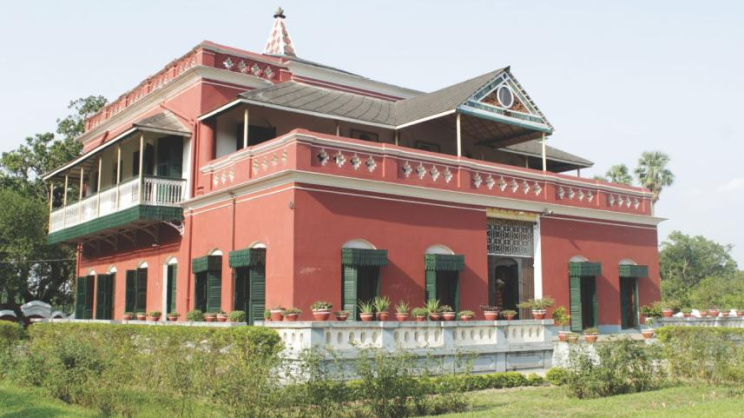
Tagore can be placed outside Bangladesh easily enough in contemporary political rhetoric. The historical record is less accommodating. Shilaidaha remains in Kushtia. Patisar remains in Naogaon. The Padma remains inside his writing. Amar Sonar Bangla remains Bangladesh’s national anthem, carrying with it a political history that includes March 1971.
For me, the question at the end of all this is not whether Bangladesh must admire Tagore. It is whether a plural society can recognise a cultural inheritance that was made by people with different religions, class positions, political commitments and historical contradictions. A country does not have to make its past pure in order to claim it. But if the present becomes too narrow to accommodate that past, eventually history itself has to be rewritten to fit it.
Dr Lubna Ferdowsi is a researcher and educator whose work engages with society, culture, identity, public policy and questions of citizenship.
Send your articles for Slow Reads to slowreads@thedailystar.net. Check out our submission guidelines for details.

Can Bangladesh make better use of its zakat money?
Three revolutions that reshaped the world
Paradise lost and found: Rediscovering early modern Bengal
Unbound Mother: The making and remaking of Kaali in Bengal
Do great leaders make history, or does history make them?
Poison and cremation: A forensic history of colonial Bengal
Partition, Bor Porong and the Chakmas’ unfinished struggle for belonging
The young radicals who challenged 19th-century Bengal

More men are cooking. But is patriarchy leaving the kitchen?