


Bangladesh launches first grid-connected agrivoltaics pilot
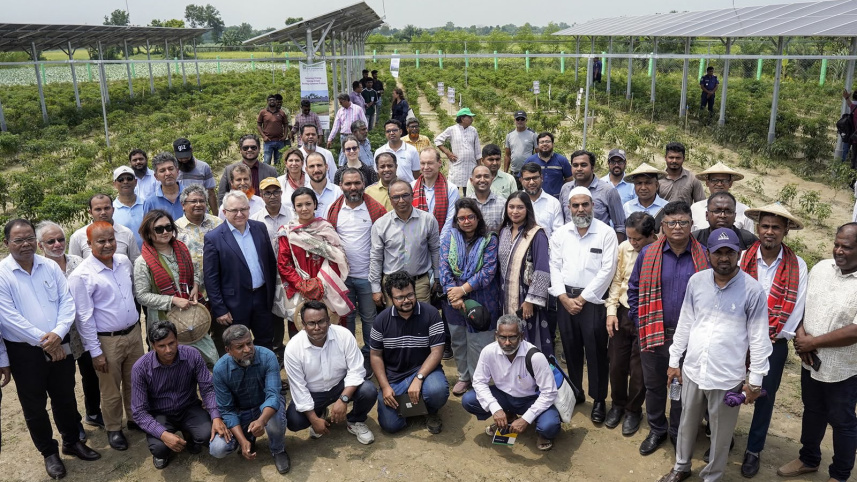
Bangladesh has launched its first scientifically designed agrivoltaics pilot project in Chuadanga to promote renewable energy without sacrificing valuable farmland.
Co-funded by the European Union (EU) and the German Federal Ministry for Economic Cooperation and Development (BMZ) and implemented by GIZ Bangladesh in partnership with the Power Division, the initiative integrates solar power generation with the cultivation of crops such as green chillies and rice.

The Fraunhofer Institute is providing technical expertise to help develop the facility as a model for sustainable land use and local capacity building.
The project aims to create a scalable framework to help Bangladesh achieve its clean energy targets.
Data gathered from the site will help shape national policies aimed at balancing food security with the transition to a green economy.
The 49.6 kWp initiative is being piloted under the Green Energy Transition – Policy Advisory Partnership (GET-PAP) project, according to a press release.
Green chillies are currently being cultivated at the pilot site, while other suitable seasonal vegetables and rice are planned for cultivation in the coming season.
Fraunhofer ISE, a leading European research and development institute for solar energy, has more than 30 years of experience in the sector and is providing technical support for the development of agrivoltaics in Bangladesh.
Ahead of the official inauguration, hands-on training sessions were organised for local farmers, teachers and researchers, as well as officials from engineering, procurement and construction firms and system operators.
The capacity-building sessions focused on shade-tolerant agronomic practices, system maintenance and digital data collection. They are intended to equip local agricultural communities and industry stakeholders with the practical skills needed to operate, maintain and replicate the agrivoltaics model across the country based on scientific data.
Muhammad Khalequzzaman, joint secretary of the Efficiency and Conservation Division of the Ministry of Power, Energy and Mineral Resources, said Bangladesh would be able to contribute to achieving its sustainable energy goals without compromising agricultural productivity and food security.
Ulrich Kleppmann, head of development cooperation at the Embassy of the Federal Republic of Germany in Dhaka, and Tanzina Dilshad, programme manager for energy, environment and green inclusive development at the Delegation of the European Union to Bangladesh, also spoke at the event.
As Bangladesh targets generating 20 percent of its electricity from clean energy sources by 2030, scientific data, crop-yield metrics and operational insights gathered from the Chuadanga demonstration site will help inform national policy frameworks.
The GET-PAP project is part of the Team Europe Initiative in Bangladesh, which pools more than €3.7 billion from the European Union, its member states and financial partners to help the country build a green and resilient economy.
In November 2025, the project also helped form a National Working Group on Agrivoltaics and Floating Solar, marking a step towards promoting renewable energy solutions that maximise the use of limited land resources.
 For all latest news, follow The Daily Star's Google News channel.
Comments