


Merchant power risks losing price appeal under proposed charges

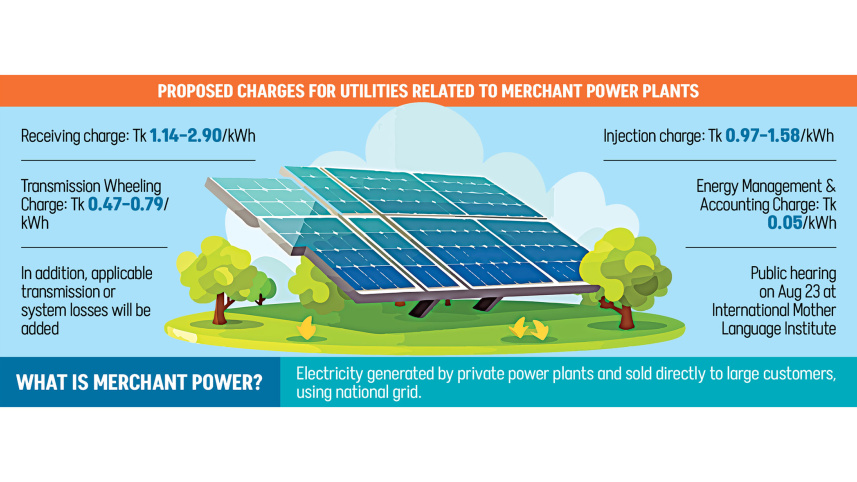
Big factories and industries hoping to save money by buying electricity directly from private power plants, instead of the national grid, may find those savings shrink sharply if a new set of proposed fees are implemented, according to an analysis of the proposals.
The government’s Merchant Power Policy 2025 lets large consumers, particularly exporters wanting renewable energy, skip the usual utility system and strike deals directly with private power producers.

But utilities have now proposed four separate open-access charges, following a framework recommended by a technical committee in a February report on the impact of the policy.
On top of that, some electricity is lost in transmission, further raising the customer’s real cost.
The proposals were made by distribution utilities, Power Grid Bangladesh and Power Development Board (PDB).
The Bangladesh Energy Regulatory Commission (BERC) is scheduled to hold a public hearing on the proposals on August 23 at the International Mother Language Institute auditorium.
THE CHARGES
Think of the national electricity grid like a network of roads. If a factory wants to “import” power from a private plant instead of the regular utility, it still has to use those roads, and the road owners want to be paid for wear and tear.
The four such toll-like charges are: Injection Charge, Transmission Wheeling Charge, Receiving Charge, and Energy Management and Accounting Charge.
Not all charges will apply to every transaction. Which ones apply depends on which networks and voltage levels are used, or kV (kilovolt) — a measure of how much electrical pressure is pushing the power through the wires.
The committee has mapped out 13 possible combinations, ranging from connections at 400/230/132kV down to 0.4kV.
Electricity usually starts out at very high voltage for long-distance travel and is then stepped down to lower voltages as it nears homes and factories, the same way water pressure is reduced as it moves from a main pipeline into a household tap.
Of the proposed four fees, the Receiving Charge – paid to whichever utility ultimately delivers the power to the factory – alone ranges from Tk 1.14 to Tk 2.90 per kilowatt-hour or per unit, depending on the utility and voltage level.
The Receiving Charge includes two things bundled together: the utility’s actual cost of running its local distribution network, and a “cross-subsidy surcharge”.
Utilities argue that under the current system, industrial and commercial customers, who pay more, effectively help cover the cost of supplying electricity to households and other consumers who pay less.
If big industrial customers leave the conventional system to buy power privately, utilities worry they will lose that revenue while still bearing the same network costs. The surcharge is designed to make sure those customers keep contributing even after they switch.
The proposed Injection Charge will be charged when power from a private plant has to pass through a distribution utility’s local network before reaching a customer served by a different utility.
The state-run Dhaka Power Distribution Company (DPDC), for example, has proposed charging Tk0.97 to Tk1.58 per unit, with the exact rate depending on the “voltage level” used.
The Transmission Wheeling Charge will be applied when electricity travels through the main national grid, run by Power Grid Bangladesh. The agency has proposed Tk 0.4657 per unit at 230kV, Tk 0.4901 per unit at 132kV, and Tk 0.7891 per unit at 33kV.
The wheeling charge for a regular grid connection currently stands at TK 0.37-0.38 per unit.
 For all latest news, follow The Daily Star's Google News channel.
 The Energy Management and Accounting Charge, a smaller administrative fee proposed by state-run PDB, had been set at Tk 0.05 per unit.
HOW MUCH SAVINGS COULD BE LOST?
The level of these charges matters because a merchant generator has to offer a price sufficiently attractive for an industrial customer to leave the conventional supply arrangement.
A look into what private solar developers are already charging PDB helps the understanding better. Recent PDB contracts for 11 solar projects, totalling 818 megawatts of capacity, carry per-unit rates of 7.49 to 8.32 US cents,
The average of the contracted tariffs is around 8 US cents, or roughly Tk 9.8 per unit at Tk 122 to the dollar.
That comparison isn’t perfect as many PDB projects sit on government-provided land, while private developers buying land themselves typically face higher costs.
The figures nevertheless illustrate why the level of open-access charges could be crucial: if a factory strikes a deal with a private plant for around Tk 9-10 per unit, and then the four new charges add another Tk 2-4 or more per unit on top (particularly if the Receiving Charge lands at the higher end of its Tk1.14-2.90 range), the price advantage over buying from the grid could shrink considerably.
That is particularly relevant for export-oriented manufacturers seeking renewable electricity to meet environmental requirements imposed by international buyers.
LOSSES ALONG THE WAY ADD TO THE COST
Separately, some electricity simply gets lost as it travels through wires and transformers.
The committee has proposed that these losses be deducted from the amount of power credited to the customer. For electricity passing through the 132kV grid, the transmission-loss rate determined by BERC would be deducted, and if it subsequently passes through the 33/11kV distribution network, the applicable distribution loss would also be deducted.
Where multiple distribution utilities are involved, each utility’s applicable distribution loss may be considered. If the same utility operates at both ends of the transmission network, however, distribution loss would be deducted only once.
The result is that the amount of electricity a private plant sends out will not necessarily be the same as the amount the customer is actually billed for, adding a further, less visible cost on top of the charges themselves.
WHAT ANALYSTS SAY
Shafiqul Alam, an energy analyst at the Institute for Energy Economics and Financial Analysis, said keeping the initial open-access charges as low as possible would be important for developing the market.
If the charges are too high, he said, industrial consumers could lose much of the incentive to purchase electricity directly from private generators.
He also questioned the logic of making merchant-power customers bear costs arising from inefficiencies elsewhere in the electricity system.
“The costs arising from system inefficiencies and the subsidy burden should not be imposed on customers who are not responsible for them,” he said.
Mostafa Al Mahmud, chairman of the Bangladesh Sustainable and Renewable Energy Association (BSREA), went further, warning that the charges could undermine the government’s own goal of attracting private investment in power generation.
He said merchant-power producers would need to price electricity below the effective grid tariff to make direct purchases worthwhile for industrial customers in the first place. Adding several taka per unit in open-access charges on top of that, he said, could wipe out most of that price advantage.
“If the charges become Tk 2 or Tk 3 per unit, there will be little scope for investment,” he said.
He argued that open access should initially be free to encourage private investment and strengthen energy security, particularly given Bangladesh’s constraints on foreign currency, fuel imports and grid capacity.
BERC will consider the proposals at its public hearing before determining the final tariff.
The decision will be crucial in determining whether direct power purchase becomes a commercially attractive alternative for large consumers -- or whether the additional charges erode much of the price advantage of merchant power.
Comments