


BBS plans advance calendar for data releases

The Bangladesh Bureau of Statistics (BBS) is set to introduce an annual advance calendar showing when it will publish major statistics, making government data more predictable and accessible to users.
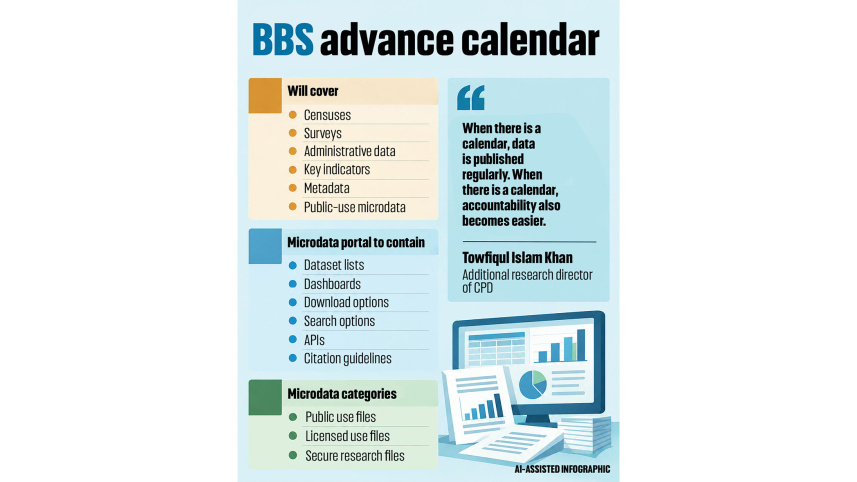
The calendar will cover censuses, surveys, administrative data, key indicators, metadata and public-use microdata, according to BBS documents.

“If the scheduled release date is changed due to unavoidable circumstances, the revised schedule, along with the reason for the change, shall be published as soon as possible,” the draft says.
The BBS will publish the calendar under its Data and Microdata Dissemination and Access Policy, 2026, which aims to overhaul how the agency publishes and shares official statistics and microdata.
The BBS will publish the calendar under its Data and Microdata Dissemination and Access Policy, 2026, which aims to overhaul how the agency publishes and shares official statistics and microdata.
The BBS is now seeking feedback from stakeholders after posting the draft policy on its website.
The initiative addresses a long-standing concern among data users, particularly researchers and policymakers, who need not only reliable information but also clarity about when it will be available.
The draft policy treats official statistics as a public resource. It says data should be open unless access is restricted by law, privacy concerns or national interest.
MICRODATA ACCESS TO BE EXPANDED
The policy also proposes a Microdata Portal with dataset lists, dashboards, search and download options, APIs and citation guidelines. Along with reports, the portal would provide anonymised microdata, questionnaires, codebooks and methodology notes.
The draft divides microdata into three categories based on access requirements and privacy risks: Public Use Files, Licensed Use Files and Secure Research Files.
Public Use Files would be fully anonymised and openly available. More sensitive datasets would require approval and could only be accessed under specific conditions or in a secure research environment.
For example, the BBS could first publish a statistical report, followed shortly by its public-use microdata and supporting documents.
Before releasing the data, the BBS would edit, validate and check its quality, anonymise it and assess the risk of identifying individuals. It would also provide metadata and codebooks to help users work with the datasets.
Researchers seeking Licensed Use Files or Secure Research Files would have to provide information about themselves, their research purpose and how they plan to use the data. They would also have to agree not to identify individuals or share restricted data with third parties.
A Microdata Review Committee would assess the applications. Applicants whose requests are rejected could appeal to the BBS director general within 30 days.
Md Firoz Sarker, secretary of the Statistics and Informatics Division (SID), said the calendar would specify in advance which surveys would be conducted and when.
“When you do something repeatedly or suddenly, a lot of time and money are wasted. We want to avoid that,” he said.
He said SID is collecting feedback from stakeholders before sending the draft policy to the minister for approval.
Broader access to the microdata analysis lab will follow the completion of a data warehouse, which is expected by 2027, he said.
 For all latest news, follow The Daily Star's Google News channel.
 “Once the data warehouse is created, you will be able to come from outside and work here through the website,” he said.
Public-use microdata will remain free to download and use for publishing, while the policy allows fees for customised tables and special analysis, Firoz said.
Towfiqul Islam Khan, additional research director of the Centre for Policy Dialogue (CPD), said the policy could improve the accessibility, timeliness and accountability of government data.
He said recognising data as a public good was a significant part of the draft policy.
“The policy has recognised data as a public good. I think there will be more facilities in terms of access to both data and microdata,” he said.
He added that an advance release calendar would make data publication more regular.
“When there is a calendar, data is published regularly. When there is a calendar, accountability also becomes easier,” he said.
“We hope this will increase the credibility of BBS and also increase its engagement with other stakeholders,” he added.
Towfiqul also suggested that other government agencies that produce major datasets, including those responsible for public finance data, should adopt similar release policies.
“BBS, being the custodian and leader of data, should lead this process going forward,” he said.
“The more transparent it becomes, the more helpful it will be for whichever government is in charge,” he added.
Comments