


Halal export potential trapped in regulatory maze
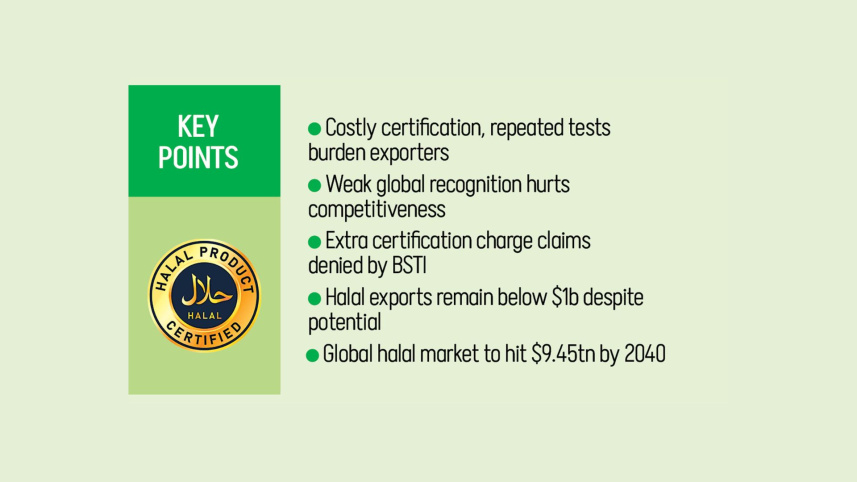
Bangladesh’s halal industry has grown in recent years, but weak regulations, institutional gaps and costly certification processes are preventing exporters from benefiting from the rapidly expanding global halal market, businesses said at an event yesterday.
They said companies have invested heavily to obtain halal certification, but the process remains expensive and time-consuming due to separate certification fees for each product, repeated inspections and additional testing requirements.

Exporters also pointed out that some required laboratory tests are not available in Bangladesh, adding further costs for manufacturers.
The remarks came at a discussion titled “Halal for Export Diversification”, organised by the Bangladesh Chamber of Industries (BCI) at its office in the capital to explore ways to boost halal exports.
Khurshid Ahmad Farhad, general manager for international business and corporate affairs at Bombay Sweets and Company Limited, said the biggest challenge is the lack of international recognition for Bangladesh’s halal certification.
Many importing countries, particularly Saudi Arabia, require halal certificates from internationally accredited certification bodies. Since Bangladeshi certification bodies are not recognised by some of these countries, exporters often have to obtain additional certification from foreign organisations.
“This increases costs, duplicates the certification process and makes Bangladeshi products less competitive in global markets,” he said.
Khurshid added that the lack of internationally recognised accreditation has also affected exports. In some cases, companies had to remove halal logos from product packaging because importing countries did not accept Bangladesh’s certification.
This resulted in costly repackaging and delays in entering those markets, he said. Zia Hayder Mithu, chairman of Easy Cook Food Processing Limited, alleged that exporters are asked to make additional payments when applying for halal certificates from the Bangladesh Standards and Testing Institution (BSTI).
“When you go to get a halal certificate from BSTI, they ask for extra money. They ask for a contribution based on how many tonnes will be exported,” he said. He said many foreign buyers, after learning about the additional charges, simply ask exporters to print “Halal” on product packaging instead of obtaining a certificate.
“There’s no need for such a certificate. Rather, these certificates should be issued free of charge,” he said.
Ahmad Asif, chief executive officer of Bengal Meat Processing Industries Limited, and two other business representatives raised similar concerns.
Responding to the allegations, SM Abu Sayed, deputy director of the Halal Certification Wing at BSTI, denied any wrongdoing.
“Their allegation that bribery took place is entirely false, fabricated, and without any basis. We categorically reject this allegation,” he told The Daily Star.
NEED FOR A COMPLETE HALAL ECOSYSTEM
Md Mominul Islam, assistant professor of marketing at the College of Business Administration of the International University of Business Agriculture and Technology, said the global halal market is currently worth around $3.5 trillion and is expected to reach $9.45 trillion by 2040.
He said Bangladesh needs a complete halal ecosystem covering supply chains, education, certification and industry collaboration to develop the sector.
Malaysia has built a successful Shariah-compliant, knowledge-based halal economy, and Bangladesh can learn from its experience, he added.
Bangladesh has several advantages, including a strong agricultural base, competitive labour costs, industrial capacity and a Muslim-majority population, Mominul said.
However, policy gaps, limited academic preparedness and a lack of specialised education in halal science, supply chain management and marketing are preventing the country from fully using these strengths, he added.
 For all latest news, follow The Daily Star's Google News channel.
 Md Deen Islam, professor of economics at the University of Dhaka, said the halal economy should not be viewed only as a religious concept but also as an economic opportunity based on quality, safety and consumer confidence.
Although the global halal market is worth around $3.3 trillion, Bangladesh’s presence remains limited despite having one of the world’s largest Muslim populations, he said.
Bangladesh has around 300 halal-certified manufacturers and 600-700 certified export products, while halal exports remain below $1 billion, he said.
As a result, the country’s share of the global halal market is still very small, he added.
Anwar-Ul-Alam Chowdhury, president of BCI, said the ready-made garment (RMG) sector alone accounts for nearly 82 percent of Bangladesh’s exports, earning $38.28 billion, while halal exports stand at only $850 million.
However, Bangladesh has significant potential in the halal market as it has the world’s third-largest Muslim population, with around 91 percent of its population being Muslim, he said.
“Bangladesh needs its own halal branding. If we look closely, after Indonesia, Bangladesh could have a domestic halal market worth $125 billion. Indonesia has created huge local demand by making halal certification mandatory in its domestic market,” he said.
Mohammad Hasan Arif, vice-chairman of the Export Promotion Bureau, said export diversification is crucial in the current situation, and halal products are among the key sectors with strong potential.
He said halal is not limited to agro-based and food products but covers a wide range of products and opportunities that Bangladesh can explore.
Shabbir A Khan, former president of the Bangladesh-Malaysia Chamber of Commerce and Industry, also spoke at the event.
Comments