


Phantom exports worth Tk 24cr surface

It was just before the Eid-ul-Azha holidays in May this year. Offices were racing to finish their last files before a long vacation.
Against this backdrop, Narayanganj-based knitwear maker RT Fashion told customs it was exporting garments worth around Tk 84 lakh. Its clearing and forwarding (C&F) agent filed the export declaration, which was then entered into the National Board of Revenue’s Asycuda World, the web-based electronic customs management system.

Under the normal process, the cargo would arrive at an inland container depot (ICD), where customs would assess the declaration, examine the goods and verify the documents. After clearance, the container would move to Chattogram port and be loaded onto a vessel.
RT Fashion’s consignment was shown as cleared in the customs system and ready to leave the country.
There was just one problem: there was no cargo!
Nothing had moved from the factory in Narayanganj to Summit Alliance Port Limited, the ICD through which the shipment was declared, or to Chattogram port, according to official documents.
Yet the consignment was recorded as an export using forged documents, signatures and seals.
RT Fashion was not an isolated case.
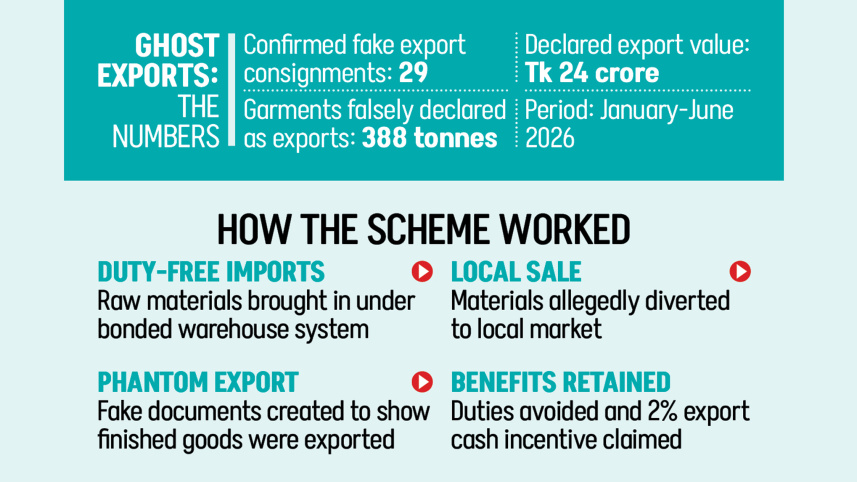
The Daily Star identified irregularities involving 122 consignments linked to at least seven companies. Through verification with customs officials, ICD authorities and C&F agents, this newspaper has so far confirmed 29 consignments as fake exports worth around Tk 24 crore were recorded between January and June this year.
The fake exports were linked to at least seven companies.
The companies are RT Fashion, HBS Apparels, Al Galeb Fashion Limited, Deluxe Apparels Ltd, NM Fashion, NM Knit Fashion, Bhuiyan Fabrics Ltd.
The shipments, declared for Italy, the United States, Austria, Sweden, the United Arab Emirates and Hong Kong, were recorded as exports even though the cargo never entered the designated depots.
The cases followed a similar pattern, exploiting the bonded warehouse system. Under the scheme, export-oriented garment manufacturers can import raw materials without paying duties, on condition that the finished products are exported.
Customs officials and C&F agents said some exporters instead sold the duty-free materials in the local market and then filed phantom export documents to make it appear that they had turned those materials into exported garments.
If bonded goods are diverted to the domestic market, importers must pay duties and taxes ranging from 89 percent to 159 percent, depending on the product.
By creating fictitious exports, the exporters can allegedly avoid those payments while retaining access to duty-free imports and claiming the government’s 2 percent export cash incentive.
A WEIGHT DISCREPANCY RAISED THE ALARM
The latest round of export fraud first came to light when customs officials spotted an anomaly in an RT Fashion declaration.
On May 24, the company declared the export of 23,992kg of garments through Summit Alliance Port Limited. Officials became suspicious because the gross and net weights were identical, even though gross weight normally includes packaging.
When customs sought the original assessment documents, the exporter allegedly took advantage of the Eid holidays and the vessel’s cargo cut-off deadline.
 For all latest news, follow The Daily Star's Google News channel.
 On May 26, the shipment was shown as cleared using forged seals and signatures belonging to Assistant Revenue Officer Jannatul Jannat Ivy and three other customs officials.
“My seal and signature, as well as those of my colleagues, were forged in at least four consignments, including the RT Fashion shipment,” Ivy told The Daily Star.
By the time customs reviewed the paperwork after the holidays, the shipment had already been recorded as exported.
Sourav Mondal, assistant commissioner in charge of the depot, said, “The fraudsters exploited our manpower shortage by submitting the documents on the cargo cut-off day, when officials were under pressure to process shipments quickly.”
Declarations of the 29 ghost exports were filed through three C&F agents -- Shahjalal Enterprise, Alpha Textile Ltd and Bangladesh Shipping Agency.
They were processed through two private ICDs -- Summit Alliance Port Limited and Port Link Logistics Centre Limited.
Customs officials say the exporters also siphoned large sums abroad through import overvaluation and later used fictitious exports to legitimise those transactions. Both offences are punishable under the Money Laundering Prevention Act.
“The latest round might be the tip of the iceberg,” one official said.
AN OLD FRAUD IN A NEW ROUND
Phantom exports are not new. The Daily Star first reported it in November 2021 in an investigation titled “Chattogram Port: Phantom export raises alarm”. A subsequent customs probe found that at least 20 companies had claimed incentives through more than 100 fake export consignments.
That led to another investigation in April 2022, headlined “At least 20 companies pocket incentives over 5 years through ghost shipments”.
The reports prompted an Anti-Corruption Commission (ACC) investigation that found evidence implicating exporters, C&F agents and customs officials.
In the latest development, a court in July this year sent 11 customs officials to jail in connection with the case.
According to ACC sources, evidence has also been found implicating exporters, C&F agents and bank officials, in addition to the customs officials named in the case. The investigation is still ongoing.
The latest phantom exports are surfacing amid persistent questions about the reliability of Bangladesh’s export statistics.
Since 2024, large discrepancies between figures published by different government agencies have fuelled allegations that the Export Promotion Bureau (EPB) overstated exports.
A Centre for Policy Dialogue study published on July 30, 2025 found that the mismatch was longstanding. The gap exceeded $12 billion in FY2022-23, narrowed to $3.66 billion in FY2023-24, then widened again to nearly $4 billion in the first 11 months of FY2024-25 despite reconciliation efforts.
The latest data also shows a gap of close to $4 billion between EPB and the Bangladesh Bank figures for the first 10 months of FY2025-26.
“Price discounts, order cancellations and delays in repatriating export proceeds can create some differences between the datasets. But a gap of around $4 billion is highly unusual and warrants a comprehensive investigation,” said Prof Mustafizur Rahman, distinguished fellow at CPD.
He said, “Repeated incidents of phantom exports, coupled with long-standing discrepancies in export data, have raised fresh questions about the credibility of Bangladesh’s export reporting system. The failure to take tough action in previous cases has allowed such fraud to persist.”
Speaking on condition of anonymity, a former senior customs official said previous probe committees had recommended a forensic audit of the entire Asycuda World system, but the recommendation was never implemented.
“As long as the system logs, user access records and data alteration history are not independently audited, the real perpetrators cannot be identified. Arresting a few individuals will not dismantle the network,” he said.
COMPANIES DENY WRONGDOING
Repeated calls to Anwarul Islam of RT Fashion went unanswered.
Abul Khayer, commercial manager of HBS Apparels, said, “To the best of our knowledge, all the documents we submitted are genuine. The ICD customs authorities have sought our explanation, and we will respond accordingly.”
Nawab Ali, managing director of Al Galeb Fashion Limited, said, “We had no intention of making any fictitious export declaration. I do not understand how this happened. My commercial manager is in contact with the C&F agent concerned.”
Sajjad Hossain, director of Deluxe Apparels Ltd, said he was unaware of the matter and would check with his commercial manager. He did not respond to further calls.
The Daily Star could not reach NM Fashion, NM Knit Fashion or Bhuiyan Fabrics Ltd.
Iqbal Hossain of Shahjalal Enterprise, which handled consignments for three of the companies, denied involvement.
Abul Basher Md Shafiqur Rahman, commissioner of Chattogram Custom House ICD, said customs is reviewing export records for the first six months of the year.
“We have found evidence of fake exports at two private ICDs, while investigations are continuing at the remaining depots. A probe committee has been formed, and only after its investigation will we know the full extent of the fraud,” he added.
Comments