


Red Sea tensions drive up import costs




A crude oil tanker of Bangladesh Shipping Corporation (BSC), MT Ninemia, arrived at Chattogram port from Saudi Arabia on Saturday.
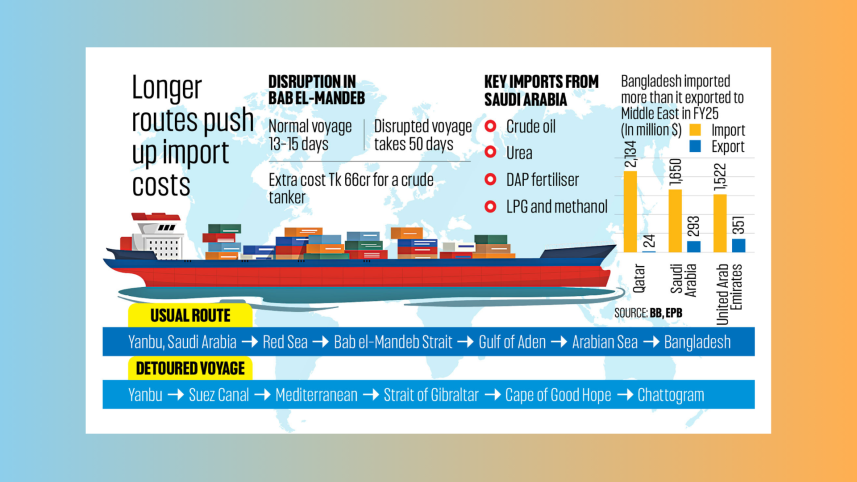
Carrying 1 lakh tonnes of oil, the ship sailed through the Suez Canal, the Mediterranean Sea and the Strait of Gibraltar before going around South Africa’s Cape of Good Hope.

To avoid the Bab el-Mandeb Strait amid tensions, the detour stretched to 50 days. Besides, it cost an additional Tk 66.63 crore.
Had the vessel taken the regular route from Yanbu through the Red Sea and Bab el-Mandeb, the Indian Ocean and then to Bangladesh, the voyage from Yanbu to Chattogram would have taken around 13 to 15 days, officials said.
After the US-Israel war on Iran led to disruption in the Strait of Hormuz, Bangladesh had been increasingly relying on shipping routes through the Red Sea for oil and other energy imports from the Middle East.
But as Yemen’s Houthi rebels have tightened their grip on the Bab el-Mandeb Strait, a narrow waterway located at the mouth of the Red Sea, the escape route for a sizable chunk of the Middle East’s oil is looking increasingly shaky.
As a result, Bangladesh’s imports from Saudi Arabia and other Middle Eastern countries face significantly longer routes and higher transport costs. The development is significant for Bangladesh because Saudi Arabia is a key source of crude oil, urea, diammonium phosphate (DAP) fertiliser, liquefied petroleum gas (LPG) and methanol.
Bangladesh imported 29.98 lakh tonnes of goods worth Tk 21,307 crore from Saudi Arabia in the fiscal year 2024-25. The volume rose to 30.41 lakh tonnes, worth Tk 25,673 crore, in FY2025-26.
In the first two and a half months of the fiscal year 2026-27, Bangladesh imported about 526,000 tonnes of goods worth Tk 5,604 crore from the Gulf country.
Of the 30.41 lakh tonnes imported from Saudi Arabia in 2025-26, crude oil accounted for 13 lakh tonnes, urea 6.07 lakh tonnes and DAP 3.27 lakh tonnes.
NO IMMEDIATE RISK TO FUEL SUPPLIES
Bangladesh relies on Saudi Arabia and the UAE for crude oil imports, although its dependence on the Middle East for refined petroleum products is minimal.
The country now sources diesel and other refined fuels from a wider group of suppliers under government-to-government arrangements and international tenders.
Recent procurement has involved suppliers from China, Malaysia, the UAE, Indonesia, Thailand, India and Oman, while crude oil imports remain concentrated in Saudi Arabia and the UAE.
Under government-to-government arrangements, BPC imports Arabian Light crude from Saudi Arabia and Murban crude from the UAE.
Monir Hossain Chowdhury, joint secretary of the Energy and Mineral Resources Division who oversees fuel issues, told The Daily Star that Bangladesh currently faces no immediate risk to fuel supplies because stocks remain adequate and refined petroleum products continue to arrive normally from alternative sources.
According to Bangladesh Petroleum Corporation (BPC) data, Bangladesh’s annual petroleum demand is about 72 lakh tonnes, while Eastern Refinery Ltd (ERL) refines about 15 lakh tonnes of crude oil, all of which is imported.
“Our stocks are sufficient. I can assure you that we have at least 35 days of diesel stocks.
There has been no interruption in the supply chain so far, and no supplier has told us that they will be unable to supply,” said Monir.
He said Bangladesh does not significantly depend on the Middle East for refined petroleum products, limiting the immediate impact of disruptions around the Bab el-Mandeb Strait.
 For all latest news, follow The Daily Star's Google News channel.
 Crude oil imports, however, remain a concern as Bangladesh sources crude from the region.
Asked about the possibility of higher transport costs as crude vessels take longer routes, Monir said such additional costs may have to be borne if the security situation persists.
“We may have to incur higher costs, but as long as the supply chain remains secure, we have nothing to be anxious about,” he added.
Apart from the MT Ninemia, another tanker carrying about 1 lakh tonnes of crude oil from the UAE’s Fujairah port is scheduled to sail on September 14-15 and reach Chattogram on September 29.
BPC officials said the vessel does not need to pass through the Bab el-Mandeb Strait and is therefore expected to arrive on schedule.
Even so, officials are becoming increasingly concerned about the broader impact of rising global oil prices. Brent crude recently crossed the $100-a-barrel mark, which could push up the price of refined petroleum products.
FERTILISER MAY FACE RENEWED PRESSURE
The disruption risk extends to fertiliser imports, especially urea and DAP, for which Bangladesh relies significantly on Saudi Arabia.
In FY 2025-26, Bangladesh imported 14.79 lakh tonnes of urea, of which 6.06 lakh tonnes came from Saudi Arabia. During the same period, the country imported 7.81 lakh tonnes of DAP fertiliser, including 3.27 lakh tonnes from Saudi Arabia.
Any prolonged diversion of vessels away from the Bab el-Mandeb could therefore raise freight costs and extend delivery times for fertilisers.
Md Mosharraf Hossain, chairman of the Bangladesh Fertilizer Association, said fertiliser supplies could come under renewed pressure if growing Houthi control along Yemen’s Red Sea coast disrupts shipping through the Bab el-Mandeb Strait.
“There is already anxiety and concern, and we have already started discussions with the exporters,” he said.
Mosharraf said fertiliser imports need to be expedited, as the upcoming Rabi season will require adequate supplies for crops including potatoes, corn, linseed, oilseeds, onions and garlic.
He thinks any disruption or delay in fertiliser supplies during the Rabi season could create serious problems for agricultural production.
TENSION MAY HURT FOOD EXPORTS
Ahsan Khan Chowdhury, chairman and chief executive officer of PRAN-RFL Group, said Bangladesh exports about $200 million worth of agro-processed food products to Saudi Arabia each year.
He said PRAN has significant business dealings with Saudi Arabia. Any disruption or delay in shipments could therefore affect business operations.
“If shipments are affected, the impact will naturally be felt in our business,” he said.
However, Ahsan expressed optimism that the situation would not continue for long and that business activities would eventually return to normal.
“We believe the situation will not prolong. Ultimately, things will be okay,” he said.
Comments